More Germans Would Rather Live in a Socialist Country
New INSA polling shows that 42% of Germans favor a socialist country, compared with 33% who prefer a capitalist one. The survey also points to deep dissatisfaction with the government, the economy and the media.
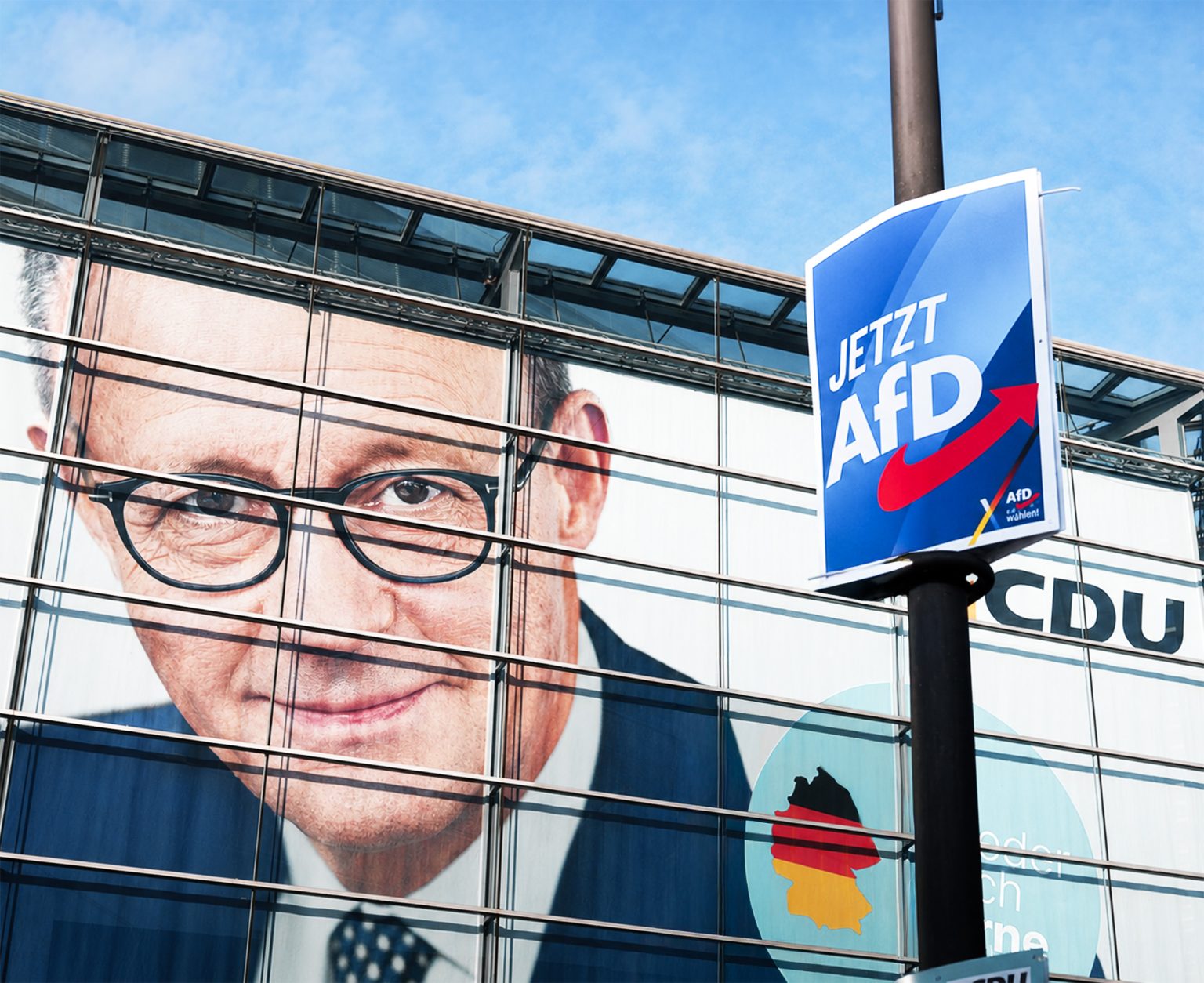
An AfD campaign sign is mounted outside CDU headquarters in Berlin, where a large portrait of CDU leader Friedrich Merz covers the building facade. A new INSA poll points to a center-right preference among voters but low confidence in the CDU/CSU-SPD government. Photo: Michael Kappeler/picture alliance via Getty Images
|
Germany’s political mood is moving in two directions at once. A larger share of voters favors a center-right course for the federal government rather than a center-left approach. At the same time, more Germans say they would rather live in a socialist country than a capitalist one.
A new INSA survey captures a country that is dissatisfied with its government, worried about its economic situation and increasingly skeptical of the media. Only 27% believe the CDU/CSU-SPD government is likely to pass a reform package capable of convincing a majority of voters, while 61% consider this unlikely.
The same tension runs through the economic findings. Most respondents still see Germany itself as capitalist. But when asked what kind of society they would rather live in, 42% chose a more socialist country and only 33% a more capitalist one.
Since the 2025 federal election, the two strongest political formations, the liberal-conservative sister parties CDU and CSU, together with the right-wing AfD, have continued to command at least parliamentary majorities in opinion polls. This has often led to the argument that voters want a center-right course, but are governed by a center-left coalition.
We wanted to examine that question directly. Respondents were asked what political course a federal government would have to take to move the country forward in their view.
Almost one in three respondents, 32%, chose a more center-left course. A larger share, 39%, chose a more center-right course.
Only respondents aged 40 to 69 showed clear pluralities in favor of a center-right course. Those under 40 and over 70 were more divided.
The preferences of party electorates are revealing. CDU/CSU, AfD and FDP voters strongly favor a center-right course. Among SPD, Green, Left Party and BSW voters, the preference is firmly for a center-left course.
There is currently a preference toward the center-right in Germany.
Capitalist Country, Socialist Preference
The pattern changes when voters are asked what kind of country they would prefer to live in.
Asked to choose between socialism and capitalism, 42% chose socialism and 33% capitalism. One in four respondents could not or would not decide.
Only those who place themselves right of center preferred capitalism, by 50% to 33%. Respondents left of center chose socialism by 55% to 28%, while those in the center did so by 43% to 33%.
Among party electorates, only voters of the Left Party, at 62%, and the BSW, at 65%, showed absolute majorities for socialism. FDP voters were the only group with an absolute majority for capitalism, at 55%.
Yet when asked whether Germany itself is more socialist or more capitalist, respondents gave a very different answer. Only 26% see Germany as more socialist. More than twice as many, 53%, see it as capitalist.
Across almost all sociodemographic groups, majorities view Germany as a capitalist country. Older respondents and eastern Germans do so even more often than younger respondents and western Germans. The majorities are clear.
Former German Chancellor Helmut Kohl once said that socialism begins when the state accounts for 50% of the economy. Germany’s state spending ratio is again around that level, but most citizens do not appear to see it as an immediate socialist danger.
Socialism should not be defined solely by public spending as a share of gross domestic product. Yet the risks that a large state sector poses to a free market order should not be underestimated either.
Although many respondents would rather live in a socialist country than a capitalist one, I want to make the case for the social market economy, which combines economic freedom with social security.
A majority of Germans, 55%, have a positive view of the basic idea behind the social market economy. Almost one in five, 19%, views it negatively.
Age makes a marked difference. Only 12% of those over 70 have a negative view of the social market economy. The share rises with each younger age group, reaching 34% among those under 30.
Support for an economic order cannot simply be preserved. It has to be won again and again.
Work Ethic Remains Strong
Chancellor Merz has faced criticism after he was understood as suggesting that Germans were too lazy. In the latest opinion trend, we asked people in employment whether they would continue working even if they no longer had to do so for financial reasons.
A clear majority answered yes: 61% would keep working, while 27% would not.
Among employed respondents who expressed a view, more than two thirds, 70%, said they would continue to work even if their livelihood was otherwise secured.
This work ethic is evident across all sociodemographic groups, regardless of age, sex, region, income or party preference.
Little Faith in the Government
However strong the German work ethic may be, dissatisfaction with the CDU/CSU-SPD government runs deep.
Only 27% think the federal government is likely to pass a reform package during this parliamentary term that ultimately convinces a majority of voters. More than twice as many, 61%, consider that unlikely.
Across almost all sociodemographic groups, clear majorities no longer believe this government will succeed. The skepticism also cuts across the political spectrum: whether left of center, in the center or right of center, most respondents expect failure.
That view is strongest among voters right of center, at 70%. It is somewhat weaker among those in the center, at 62%, and weakest among voters left of center, at 59%. But in every group, clear majorities regard a reform package that convinces most citizens as unlikely.
Only Union voters are more optimistic. Among them, 53% believe the CDU/CSU-SPD coalition could still pass a reform package that wins over a majority of voters, while 39% consider this unlikely.
A Relative Majority Against an AfD Ban
Many Germans are dissatisfied with the current government and have low expectations of its success. At the same time, the three opposition groups in the Bundestag – the AfD, the Greens and the Left Party – are divided among themselves, while the AfD, as the strongest opposition force, remains highly controversial.
The two smaller opposition groups are the strongest supporters of a ban on the AfD. Among the population as a whole, however, a relative majority currently rejects such a step.
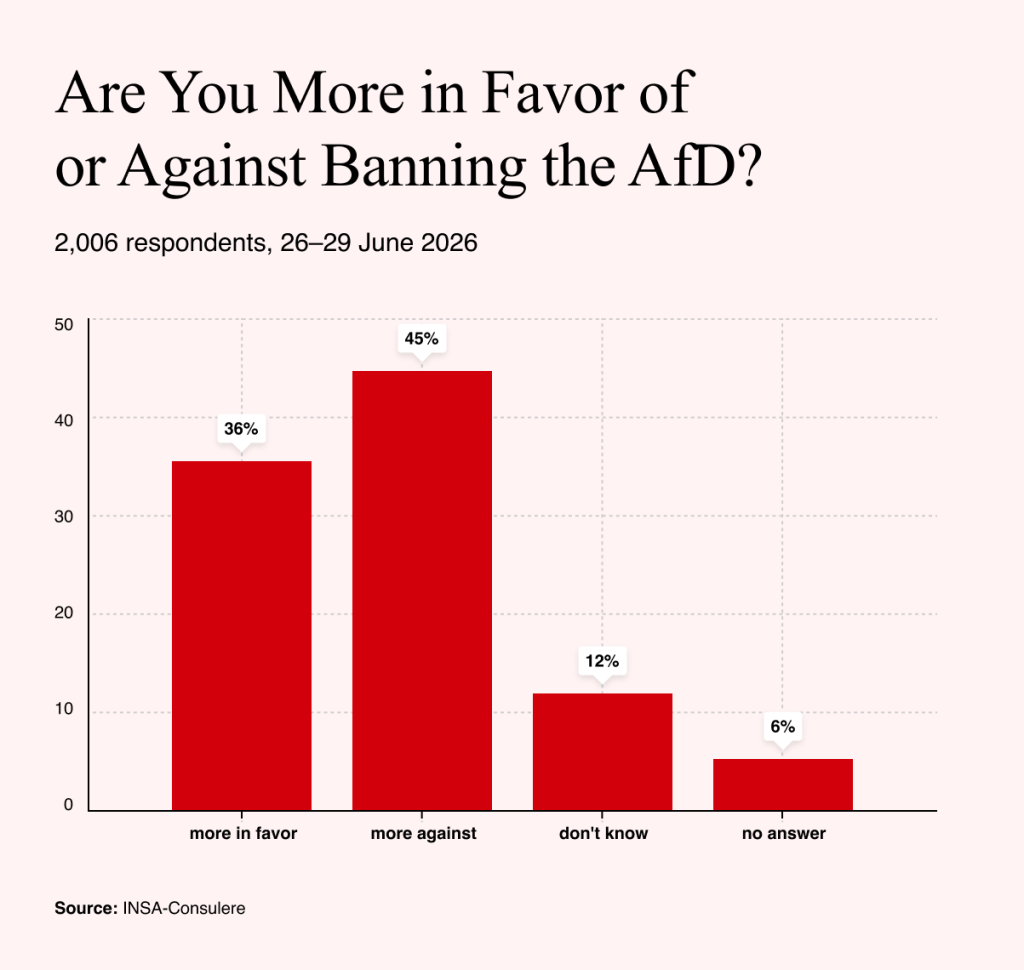
Some 45% oppose an AfD ban, while 36% support one. Absolute majorities in favor of banning the AfD are found only among SPD, Green and Left Party voters. Across almost all other sociodemographic groups, majorities are against such a move.
Source: INSA-Consulere
If proceedings were nevertheless brought before the Federal Constitutional Court, whether by the Bundestag, the Bundesrat, the federal government or a federal state, then in my view the case should be decided quickly rather than left hanging for years. The court would need the capacity to do so.
As Professor Andreas Rodder recently pointed out, such a ruling could create clarity. It could also help end the AfD’s special treatment and political exclusion.
The Situation May Be Worse Than the Mood
A majority of Germans are dissatisfied with the federal government and worried about the country’s current economic situation. We wanted to know whether respondents believe Germany’s actual condition is, all in all, better or worse than the public mood suggests.
About one in six, 16%, said the situation is better than the mood. Just over one in three, 34%, said the two broadly match. A larger share, 42%, said the situation is even worse than the mood.
Western Germans, at 17%, and respondents who place themselves politically left of center, at 28%, were more likely than eastern Germans, at 11%, and those in the center or right of center, at 15% and 11%, to say that the situation is better than the mood.
Among party electorates, Green voters were most likely to judge the situation more favorably than the public mood, at 35%. AfD voters, at 7%, and BSW voters, at 8%, rarely took that view. Among BSW voters, 54% believe the situation is worse than the mood. Among AfD voters, the figure is 65%.
The public mood is often shaped by how events are presented in the media. We therefore asked how much trust people place in different types of outlets.
Local newspapers perform best. A majority of respondents, 52%, consider them trustworthy, while only just over one in four, 26%, take the opposite view.
Public broadcasters are trusted by 47% of respondents, while 35% say they do not trust them. Leading outlets such as Der Spiegel, Die Zeit, FAZ and Sueddeutsche Zeitung fare similarly: 44% consider them trustworthy, compared with 32% who do not.
Private radio stations are viewed positively by 37% of respondents and negatively by 31%.
At first glance, alternative and new media, such as Apollo, Nius and Tichys Einblick, perform worst. Only 17% regard them as trustworthy, while 41% do not. But it is striking that 42% of respondents either cannot or do not want to give an answer.
Only time will show which media manage to build new trust. At the moment, no single type enjoys outstanding credibility on its own. There are also major differences between age groups, western and eastern Germany, household income groups and party preferences.
Distrust of German media is also one reason why more and more Germans are turning to foreign outlets.