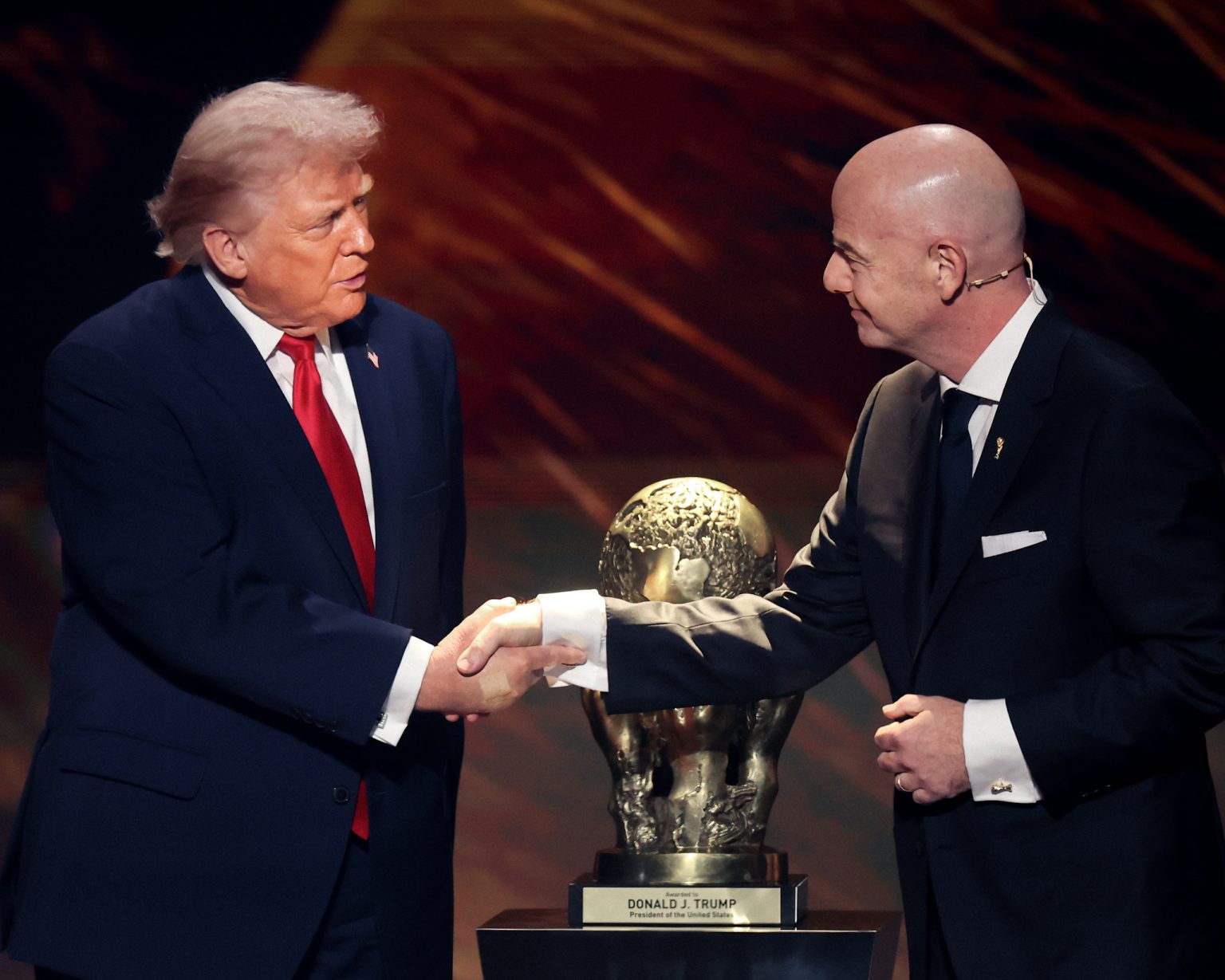
The most extraordinary thing about the Folarin Balogun affair, which has plunged the World Cup into political controversy, is that according to all official records, the red card which the player was issued last week still stands: it is the punishment that has been deferred.
This is the worst of all worlds. Certainly, the US team and its supporters had a stateable case that the sending-off of their star forward, and his subsequent automatic suspension for the team’s last-16 game against Belgium tonight, was unfair. Sport being sport, and officials being human, sometimes harsh or incorrect decisions are made. And while opinions may vary, this writer’s view of the incident was in accordance with that of most American supporters: the red card should not have been issued.
In most professional football competitions, there is an appeal process for such incidents. A review panel might observe the footage and decide that, the card having been wrongly issued, any suspension accruing from it might be overturned. The red card in such circumstances would be rescinded.
Unprecedented
But that is not what has happened here. Instead, something unprecedented has taken place. The history books will show that Folarin Balogun was sent off the pitch for serious foul play, accruing an automatic suspension for his team’s next game. And the history books will show that the American received an unprecedented reprieve: his suspension will stand, but will not be served for one year, allowing him to play tonight.
The same thing will not happen in the case of England’s Jarell Quansah, sent off against Mexico, who will now miss England’s quarter-final against Norway on Saturday. Nor will it apply to any other player. This is a one-off decision, designed to benefit one player from one country.
And it was instigated, we now know, by the president of the United States.
There are two separate problems here, and both are grave.
You might be interested
The Great “Leaving the World Cup to Become a Dad” Controversy
If Rules Do Not Apply to All, Fairness Cannot Exist
The first is the sporting problem. Football, like all sports, depends upon the basic premise that every team takes the field subject to the same rules. Those rules may sometimes produce injustices. But the whole point of a competition is that the injustice, when it comes, is borne equally and that all teams are at risk of bad luck or bad decisions.
A bad refereeing decision against Ghana is not meant to matter less than a bad refereeing decision against Germany. A suspension for England is not meant to bite harder than a suspension for the United States – yet in this case it explicitly will, as Quansah (sent off last night for an almost identical, unintentional foul) will be suspended while Balogun will not.
So the basic principle that all teams and players are equal has now been abandoned.
It may well be said, in response, that justice has been done. Balogun should not have been suspended, and therefore FIFA has merely arrived, by an unconventional route, at the correct destination. Except, of course, that this is not what has happened: Balogun’s punishment still stands – it is simply that he and his team alone will benefit from a deferral of that punishment that other teams are not permitted to seek.
Besides, even if one agrees with the decision on the facts of the individual case, this is a classic example of a procedural trap that conservatives constantly – or used to constantly – warn about. Once the governing principle becomes not “what do the rules say?” but “what outcome would be fairest in this particular case?” then the rules are no longer rules at all. They are merely suggestions, to be enforced against those without sufficient political influence to secure a second hearing. This is as true in the courts and in politics as it is in football or other sports.
And that brings us to the second, much more serious, problem: the political one.
How Can FIFA Say “No” Ever Again?
There is something grimly comic about the spectacle of FIFA, of all institutions, suddenly discovering the virtues of mercy and discretion after a phone call from the White House. Here is an organization that has spent decades insisting upon the independence of football from political interference; an organization that will fine national federations for political banners, dock teams for government meddling and solemnly lecture the world about the purity of the game. Yet when the president of the United States personally intervenes on behalf of a player in the American national team, the rules become optional.
You might be interested
The World Cup Outrage Machine
One does not have to be anti-American to see the problem. In fact, one suspects many Americans can see it perfectly clearly themselves. Had Vladimir Putin telephoned FIFA to ask for leniency for a Russian player, the Western press would be in convulsions. Had Viktor Orban intervened to secure a reprieve for Hungary’s center-forward, we would by now be reading grave think-pieces about authoritarianism, sporting integrity and the creeping politicization of international football. Had the emir of Qatar placed such a call during the last World Cup, it would have been cited as evidence of corruption before the receiver had been put down.
But this was America, and this was Trump, and this was a World Cup on American soil. And so we are invited to pretend that what happened here is somehow normal.
It is not normal. It is extraordinary.
The Belgian complaint, in that context, is not merely the sour grapes of a team now facing a stronger opponent than it had expected. Belgium are entitled to ask a very simple question: would this decision have been made for them? Would Romelu Lukaku, or Kevin De Bruyne, or any other Belgian player have received the same treatment if the Belgian prime minister had telephoned Gianni Infantino? Would FIFA have dusted off the same obscure provision and discovered the same hidden flexibility? Or would Belgium have been told, politely but firmly, that the rules are the rules?
Everyone knows the answer.
This is the problem with making exceptions for the powerful: they do not remain exceptions. They become precedents. The next time a player is suspended in controversial circumstances, his federation will ask why Balogun was different. The next time a government believes its national interest is at stake, it will be tempted to make the call. This is especially true of the World Cup and other sporting competitions where governments prostrate themselves to be seen as patriotic. The next time FIFA insists that politics must stay out of football, it will be laughed at – and deservedly so.
The Damage Is Done
The pity of it is that Balogun himself is not really the villain here. He was sent off harshly, and no player in his position would voluntarily sit out a World Cup knockout match in order to preserve the dignity of FIFA’s disciplinary code. Nor are American supporters wrong to be pleased that one of their best players is available tonight. And let’s be honest: if Ireland ever again has a footballer good enough to provoke an international disciplinary crisis – which would be proof of miracles – this writer will consider moral questions after the final whistle.
But governing bodies are not supposed to think like supporters. They are not supposed to ask which outcome would be popular in the host country, or convenient for the television spectacle, or pleasing to the head of state. They are supposed to protect the competition itself. And in this case, they have failed.
There is, too, a delicious irony in all this. For years, football’s administrators have insisted that the game is now governed by systems, processes and protocols. VAR was introduced to remove subjectivity and to ensure that absolutely everything was accurate and consistent – remember that word, consistent – down to the final millimeter. Disciplinary codes were written to remove inconsistency. The modern game is forever congratulating itself on its professionalism.
Then the president rang.
And suddenly, the system bent. Consistency is for suckers.
Which begs a question: if Balogun scores a goal tonight, but is only three millimeters offside, should that be struck off? Or will a call from President Trump convince FIFA that there should be flexibility in that section of the rulebook also?
This has been a truly shameful episode.