Anti-Christian Incidents Rise Sharply in Jerusalem
A new report documents a sharp increase in harassment and abuse directed at Christians in Israel, nearly 90% of it in Jerusalem. The authors say ignorance of the city’s Christian history and present-day communities is helping to fuel hostility.
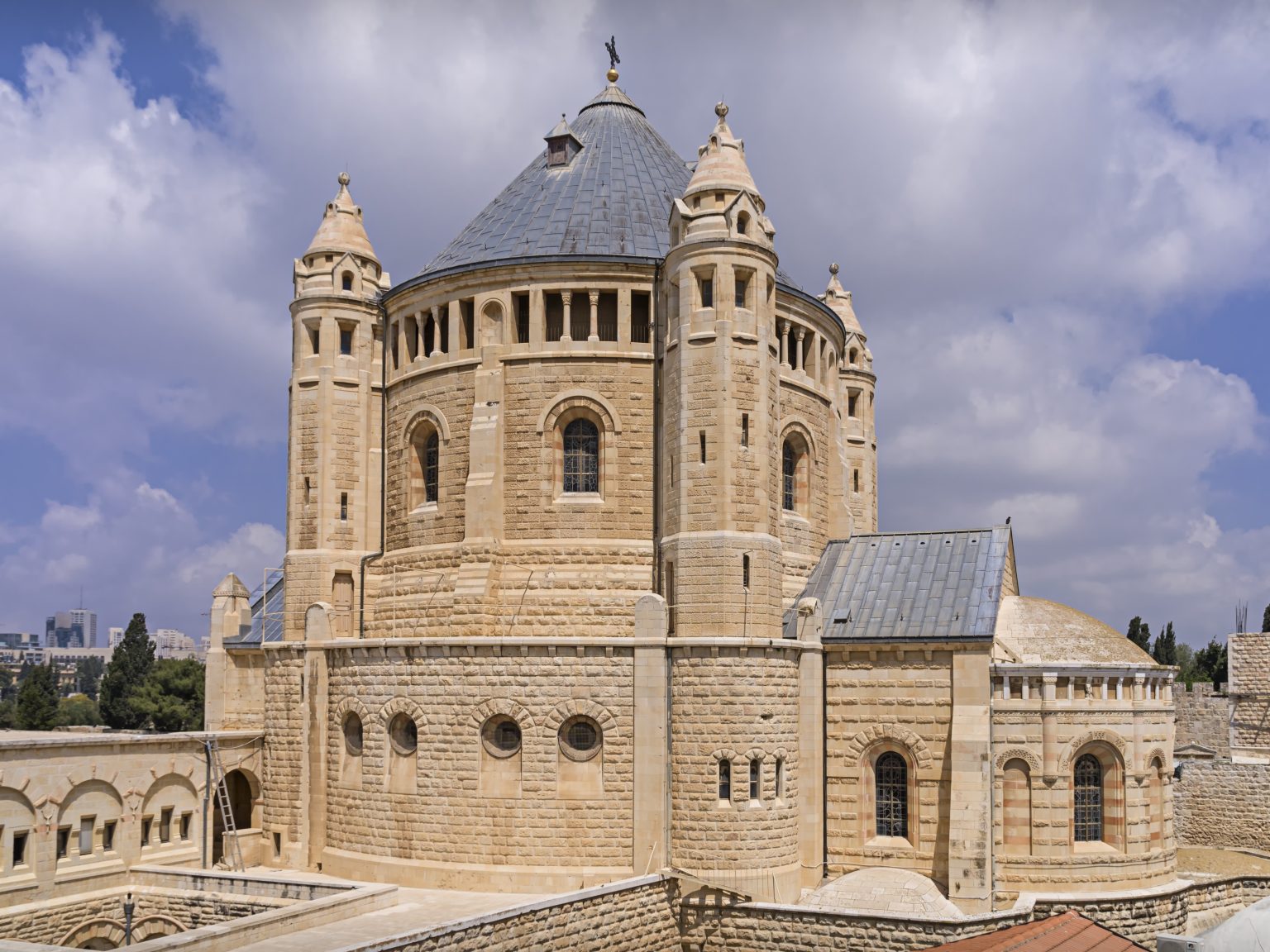
Dormition Abbey stands on Mount Zion, one of the main flashpoints identified in the report. Photo: iStock/Getty Images Plus
|
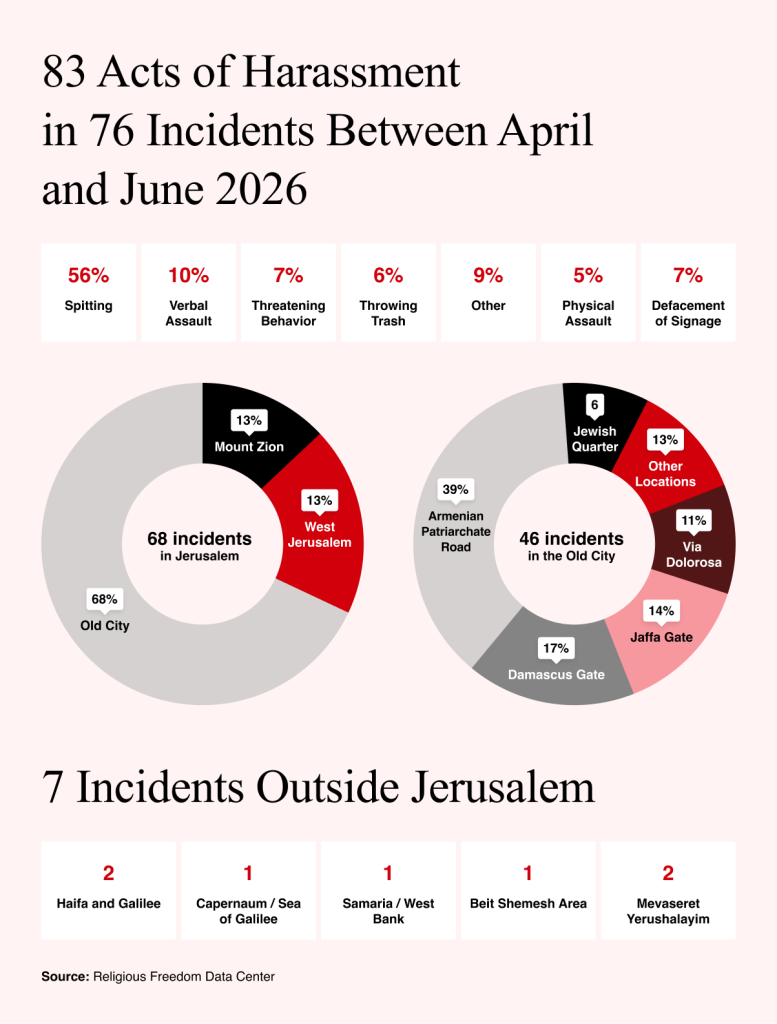
The Religious Freedom Data Center (RFDC) recorded 83 acts of harassment in 76 separate incidents between April and June 2026. Of these, 68 occurred in Jerusalem, accounting for almost 90% of the total.
Forty-six incidents were reported in the Old City alone. The main flashpoints included Armenian Patriarchate Road, the areas around Damascus Gate and Jaffa Gate, the Via Dolorosa and Mount Zion.
Grafic:statement.com
The figures do not point to systematic persecution or a sudden outbreak of serious violence. Instead, they show how religious contempt is becoming a routine feature of public life in Jerusalem.
The cases recorded by the RFDC range from humiliation, threats and online abuse to vandalism and isolated physical assaults. Its central warning is that such hostility risks becoming an accepted part of everyday life in the Holy City.
A Pattern Long Overlooked
The RFDC is an Israeli civil-society organization that documents attacks, harassment and discrimination against Christians in the Holy Land. It is an independent civic initiative rather than a government body.
It was founded by Yisca Harani, an Israeli expert on Christianity in the Holy Land and a long-standing interfaith activist. For decades, she has worked as a lecturer, adviser and researcher on Christianity, pilgrimage and the Christian presence in the region.
The center was established because anti-Christian incidents, particularly in Jerusalem, had long gone unrecorded in any systematic way. It describes itself as a professional, non-partisan Jewish-Israeli organization that monitors abuses involving Christian communities, clergy, pilgrims and church institutions. In some cases, it also intervenes directly.
Harani speaks as a Jewish-Israeli expert with decades of experience in interfaith dialogue. In interviews, she has argued that Jewish Israelis need to speak more openly about anti-Christian violence and harassment.
The RFDC is now in its fourth year of documenting such incidents and operates a hotline through which attacks and harassment can be reported. Its latest findings have been cited by several international media outlets, including Crux and Vatican News. The latter said the figures showed a near-doubling of anti-Christian incidents in the second quarter of 2026.
Spitting as Religious Contempt
One of the most commonly reported forms of abuse is spitting. In this context, it is not merely an act of rudeness, but a deliberate expression of religious contempt.
Nuns, monks, priests, seminarians and visibly Christian pilgrims have all been targeted. So too have processions, churches, monasteries and religious symbols.
The report records a concentration of incidents around Jerusalem Day and the Flag March on 14 May. It describes participants spitting in the direction of a church and Christian clergy, at a statue of the Virgin Mary and outside the Armenian monastery.
In one case, a boy believed to be 13 or 14 years old reportedly said outside the Armenian monastery: “Because they are heretics.” The remark made clear that the act was not random vandalism, but an explicitly religious form of denigration.
Mount Zion as a Flashpoint
The report repeatedly identifies sites of particular religious and historical significance. Mount Zion features prominently, with incidents recorded around Dormition Abbey, the Cenacle, Ad Coenaculum, the Greek Garden and the Polish monastery.
The RFDC describes the area as a flashpoint where competing religious and historical claims converge within a confined space.
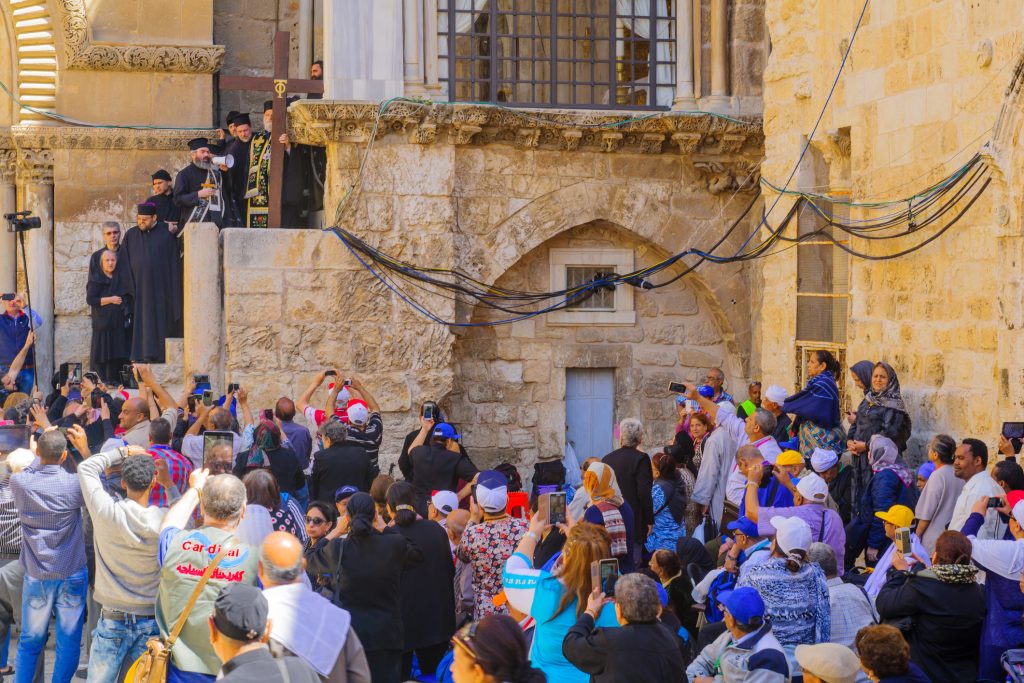
Orthodox Christians gather at the Church of the Holy Sepulchre on Good Friday, a reminder of the living Christian presence at the heart of Jerusalem. Photo: iStock Editorial/Getty Images Plus
Harani argues that many young Israelis arrive in Jerusalem with little understanding of the city’s Christian history or its present-day Christian communities. Visible expressions of Christianity may therefore strike some visitors as alien or even provocative.
The report calls for better preparation of school groups, tour guides and military groups visiting the city. On this account, the problem stems not only from deliberate hostility, but also from ignorance of Christianity’s place in Jerusalem.
Placeholder For Topreaded Placeholder For Topreaded
Placeholder
Placeholder
Placeholder For Topreaded Placeholder For Topreaded
Placeholder
Placeholder
Placeholder For Topreaded Placeholder For Topreaded
Placeholder
Placeholder
Placeholder For Topreaded Placeholder For Topreaded
Placeholder
Placeholder
Placeholder For Topreaded Placeholder For Topreaded
Here is placeholder for Article excerpt Here is placeholder for Article excerpt Here is placeholder for Article excerpt Here is placeholder for Article excerpt
Here is placeholder for Article excerpt Here is placeholder for Article excerpt Here is placeholder for Article excerpt Here is placeholder for Article excerpt
Here is placeholder for Article excerpt Here is placeholder for Article excerpt Here is placeholder for Article excerpt Here is placeholder for Article excerpt
Welcome to the comments section of the Štandard daily. Please take note of our guidelines, comments are moderated by us. You can contact the moderators at [email protected].
Participate in the discussion
Comments are available to subscribers only. If you'd like to join the discussion, choose a subscription starting at €6.72 per month.
All comments 0
Register
Comments are available to registered users only. If you'd like to join the discussion, register here.