Government Celebrates Bureaucracy Cuts as Public Sector Expands
As Germany’s labor market collapses, public-sector employers are still hiring. The federal government claims to be slashing bureaucracy, but the figures behind its much-vaunted success are grossly inflated.
Digital Minister Karsten Wildberger puts the coalition’s claimed reduction in bureaucratic costs at more than €10bn, though most German companies report rising administrative burdens. Photo: Kay Nietfeld/dpa/picture alliance via Getty Images
|
The federal government says it is making progress in its fight against bureaucracy. Digital Minister Karsten Wildberger put the savings achieved to date at more than €10bn ($11.4bn). The governing coalition has set a target of €16bn ($18.3bn) over four years. Strikingly, the largest single item in the government’s calculation comes from the Building Modernization Act.
Better known as the Heating Act, it is Germany’s version of a heat-pump requirement that has also been debated in Britain and the United States. Comparable policies include Britain’s planned phase-out of fossil-fuel boilers and debates over gas bans in US states. The current government says its reform of the legislation introduced by its predecessor accounts for €7.7bn ($8.8bn), the bulk of the claimed reduction in red tape.
German companies see things differently. The German Economic Institute’s (IW) Future Panel, which surveyed more than 1,000 businesses, found that 55% reported a noticeable increase in administrative burdens. A further 24% had seen some increase, while only 1.5% said the burden had eased. Nearly one in five companies had to create new positions specifically to cope with regulatory requirements. Among businesses with at least 250 employees, almost three in four had taken on additional staff to deal with the growing red tape.
Ifo President Clemens Fuest summed up the problem in an Ifo Institute press release dated 25 June 2026, warning: “The private sector, which sustains economic development over the long term, is shrinking, while the state continues to expand. Germany has been in a phase of economic stagnation for about seven years, but the actual situation is even worse than generally assumed.”
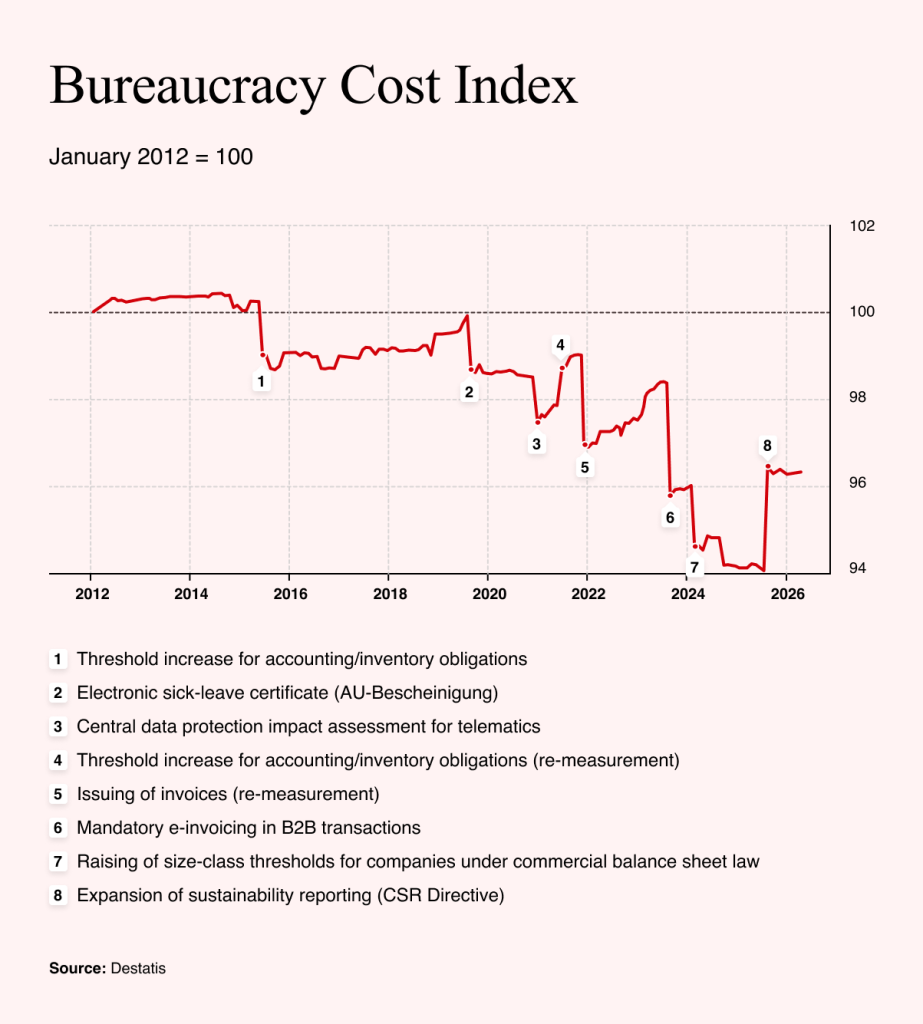
Source: statement.com Item 2 refers to the German "Arbeitsunfähigkeitsbescheinigung" — the doctor's note confirming an employee is unfit for work — being issued and transmitted electronically instead of on paper. Item 7 refers to the size thresholds (revenue, balance sheet total, employee count) that determine whether a company counts as small, medium, or large under German commercial law (HGB), which in turn determines its reporting and audit obligations.
The country’s official bureaucracy cost index has recorded a decline in bureaucratic costs since 2012. However, it covers only reporting and documentation requirements arising from federal laws. It excludes EU law, state and municipal regulations and the burden created by constant legislative changes. Economists at the IW therefore argue that the official measurement creates a false impression of precision. The Ifo Institute puts the economic output lost to bureaucracy at €146bn ($167bn) each year.
Private Sector Sheds Jobs
While the government hails its success in cutting red tape, economic data tells a different story. The labor market is undergoing a striking shift. The claimed reduction in bureaucracy has coincided with a curious development. In 2025, industrial employment fell by 124,100. Construction lost 23,000 positions, while trade, transport and hospitality shed a further 15,000. The public sector, by contrast, added 95,100 jobs.
Clemens Fuest, president of the Ifo Institute, says Germany’s economic situation is worse than generally assumed. Photo: Peter Kneffel/dpa picture alliance via Getty Images
When education and health care are included, the total increase rises to 205,000. No other sector of the economy saw a larger absolute increase in employment in 2025. While the public sector added jobs, the private sector was cutting them. At the same time, the number of vacancies fell by 35,000, according to Germany’s Federal Employment Agency.
Value Added Falls Sharply
In economic terms, the shift of jobs into the public sector alone shrinks the economy’s productive base. Manufacturing generates around €74 ($85) in value added per hour worked. The corresponding figure for the public sector is only around €50 ($57). When workers move from the former to the latter, economy-wide value added falls by €24 ($27) per hour, even if total employment remains stable. The state’s funding base consequently erodes while its costs rise and place an increasing strain on the budget.
The federal government promises less bureaucracy. Companies are experiencing more of it. Official measurements exclude major sources of red tape. Europe, meanwhile, continues to produce regulations that Germany simply waves through. And while industry, trade and other private businesses shed jobs, the public sector remains the only sector still creating new positions on any significant scale.
The government celebrates billions in savings, most of which come from correcting earlier laws that one of the parties now in power helped to introduce. Yet businesses say that red tape is increasing. The only additional positions some companies are creating are those needed to comply with new or amended regulations. Mass layoffs loom in other sectors.
Reality Is Worse Than Official Figures Suggest
The official index reports progress because it does not measure most of the actual burden in the first place. At the same time, the sector where bureaucracy is concentrated is expanding, while the sectors that must finance it are shrinking. The public sector added more jobs in 2025 than any other part of the economy. Yet the total number of vacancies fell. Germany is moving workers away from value-creating sectors and into the administrative apparatus.
Placeholder For Topreaded Placeholder For Topreaded
Placeholder
Placeholder
Placeholder For Topreaded Placeholder For Topreaded
Placeholder
Placeholder
Placeholder For Topreaded Placeholder For Topreaded
Placeholder
Placeholder
Placeholder For Topreaded Placeholder For Topreaded
Placeholder
Placeholder
Placeholder For Topreaded Placeholder For Topreaded
Here is placeholder for Article excerpt Here is placeholder for Article excerpt Here is placeholder for Article excerpt Here is placeholder for Article excerpt
Here is placeholder for Article excerpt Here is placeholder for Article excerpt Here is placeholder for Article excerpt Here is placeholder for Article excerpt
Here is placeholder for Article excerpt Here is placeholder for Article excerpt Here is placeholder for Article excerpt Here is placeholder for Article excerpt
Welcome to the comments section of the Štandard daily. Please take note of our guidelines, comments are moderated by us. You can contact the moderators at [email protected].
Participate in the discussion
Comments are available to subscribers only. If you'd like to join the discussion, choose a subscription starting at €6.72 per month.
All comments 0
Register
Comments are available to registered users only. If you'd like to join the discussion, register here.