Another AfD Candidate Barred From Local Election in Germany
A local election committee in Lower Saxony rejected an AfD candidate after the state Interior Ministry questioned his commitment to the constitutional order. The case has fueled concerns about political bias.
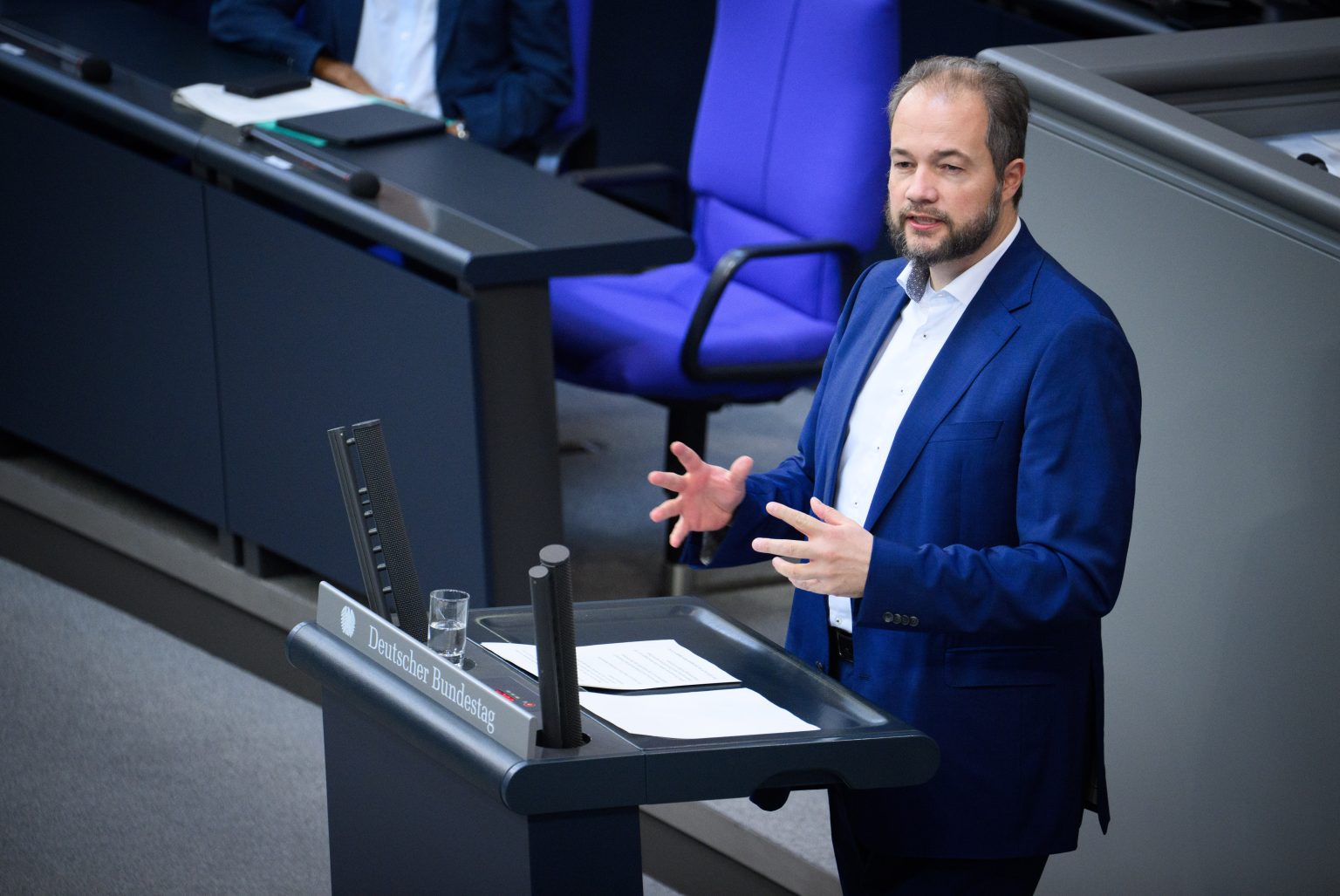
Martin Sichert was barred from running for district administrator by the Friesland District Election Committee. Photo: Bernd von Jutrczenka/dpa/picture alliance via Getty Images
|
Martin Sichert, an Alternative for Germany (AfD) MP, has been prevented from running for district administrator in Friesland, Lower Saxony. On 21 July, the district election committee voted five to one to exclude him from the election on 13 September.
The decision was based on an assessment by Lower Saxony’s Interior Ministry, which questioned whether Sichert could be trusted to uphold Germany’s free democratic basic order at all times. His AfD membership and his roles within the party’s Lower Saxony branch played a central part in the assessment.
The AfD is not banned in Germany. It is the second-largest parliamentary group in the Bundestag and is represented in numerous state parliaments.
Sichert is from Nuremberg and holds a degree in business administration. Before entering politics, he worked in the Bavarian public sector at the Bavarian Agency for Municipal Data Processing. He has served in the Bundestag since 2017.
In Germany, a district administrator is an elected public official serving a fixed term. The officeholder heads the district administration, implements decisions taken by the district council and represents the district externally. The role also carries responsibility for disaster relief, building supervision, public health, youth welfare and public safety.
A Growing Pattern
Sichert’s case is not an isolated one. In 2025, AfD state legislator Joachim Paul was excluded from the mayoral election in Ludwigshafen, while Haik Jaeger was barred from running for mayor in Neukloster.
Further reviews of AfD candidates are under way ahead of Lower Saxony’s municipal elections in September 2026. Those affected include Jessica Schülke in Hanover, Adrian Maxhuni in Bersenbrück, Thorsten Moriße in Wilhelmshaven and Stephan Bothe, who is running for district administrator in Lüneburg.
Lower Saxony’s domestic intelligence service had previously designated the AfD’s state branch an “object of observation of considerable significance”. The designation is broadly equivalent to classifying the branch as a confirmed right-wing extremist organization.
According to the Hanover Administrative Court, the 212-page report draws mainly on publicly available speeches, interviews, social media posts and press coverage.
The AfD is challenging the classification in court. Although the Hanover Administrative Court rejected the party’s application for interim relief, it did not issue a final ruling. The matter will be decided only in the pending main proceedings, leaving the legal validity of both the report and the extremist classification unresolved.
Guilt by Association
The classification of the state branch nevertheless played a major role in assessing Sichert’s commitment to the constitutional order.
Lower Saxony’s domestic intelligence service is part of the executive and answers to the Interior Ministry. Unlike a court, it is not institutionally independent. Critics therefore argue that when an executive agency classifies an opposition party, suspicions of political influence are difficult to avoid.
The ministry also cited Sichert’s own statements and activities. It interpreted remarks about rainbow flags and swastika flags as trivializing National Socialism and said his comments reflected an ethnopluralist worldview.
It further objected to his remarks about Islamization and his attendance at an event involving Jürgen Elsässer, the editor of the far-right magazine Compact. Sichert was also faulted for sharing material from certain websites and using the terms “cartel parties” and “bloc parties”.
None of these actions constitutes an administrative or criminal offense.
Sichert addressed some of the accusations in a video posted on social media on Monday. He said he regularly used the term “cartel parties” because the other parties had united behind their firewall against the AfD, effectively forming a cartel against it.
AfD Demands Reversal
The decision drew sharp criticism from the AfD in Lower Saxony, particularly because Sichert’s party membership formed part of the case against him.
Ansgar Schledde, the AfD’s state chairman, said it was absurd to question Sichert’s commitment to the constitution merely because he belonged to the party.
“The AfD Lower Saxony condemns this course of action in the strongest possible terms”, Schledde said. He called for Sichert and all other lawfully nominated candidates to be admitted immediately.
Lower Saxony amended its municipal election law on 28 April 2026. Mayors and district administrators have long been required to guarantee that they will uphold the free democratic basic order at all times. This is standard under German civil-service law.
The new provision allows election committees to refer cases to the municipal supervisory authority when doubts arise. The authority may consider findings from the domestic intelligence service as well as publicly available statements, including social media posts.
What Counts as Constitutional Disloyalty?
The ministry issues only a recommendation. The final decision rests with the local election committee.
According to the explanatory memorandum to the law, “justified doubts” are sufficient. Those doubts must, however, be based on circumstances serious enough to raise objective concerns about a candidate’s future commitment to the constitutional order.
Committee members may not exclude candidates merely because they reject their political views or regard them as radical.
The central question in Sichert’s case is whether the statements cited genuinely demonstrate hostility to the free democratic basic order or merely amount to provocative, polemical and perhaps distasteful political speech.
Terms such as “cartel parties”, criticism of Islam or attendance at the same demonstration as an extremist do not in themselves prove that someone seeks to abolish democracy, human dignity or the rule of law.
Who Decides Who May Stand?
Critics also point to a broader structural problem. A candidate may be excluded by an election committee whose members are nominated by the political groups represented on the district council.
Although committee members are legally required to act impartially, cases such as Sichert’s inevitably create the impression that political appointees are deciding whether a rival may stand for election.
The five-to-one vote in this case only reinforces that impression.
Access to the courts is another concern. The organization More Democracy has warned that candidates barred in Lower Saxony have little chance of obtaining a ruling before election day. Afterwards, they must generally show that their participation would probably have changed the result – something that is almost impossible to prove when their names never appeared on the ballot.
Here is placeholder for Article excerpt Here is placeholder for Article excerpt Here is placeholder for Article excerpt Here is placeholder for Article excerpt
Here is placeholder for Article excerpt Here is placeholder for Article excerpt Here is placeholder for Article excerpt Here is placeholder for Article excerpt
Here is placeholder for Article excerpt Here is placeholder for Article excerpt Here is placeholder for Article excerpt Here is placeholder for Article excerpt
Welcome to the comments section of the Štandard daily. Please take note of our guidelines, comments are moderated by us. You can contact the moderators at [email protected].
Participate in the discussion
Comments are available to subscribers only. If you'd like to join the discussion, choose a subscription starting at €6.72 per month.
All comments 0
Register
Comments are available to registered users only. If you'd like to join the discussion, register here.