Why a Gas Shortage in Europe Is Unlikely, But Not Impossible
With winter approaching, Europe's gas reserves are unusually low. Whether the continent has enough will depend on a handful of factors, and if several turn unfavorable at once, the risk becomes real.
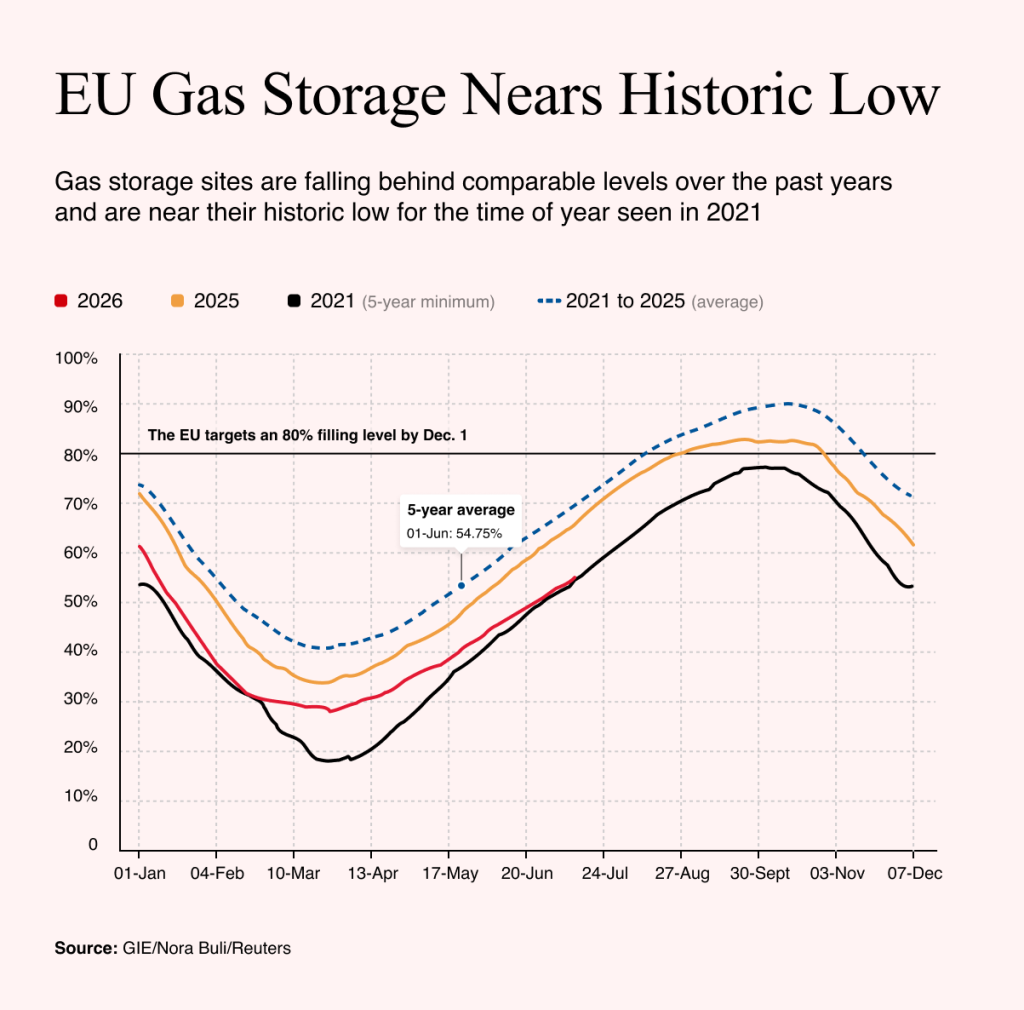
European gas storage levels are at one of their lowest points in a decade. Not since 2021 has so little gas been in storage at the end of July, and this year's level is only marginally higher than that low point.
Worse still, there is currently little economic incentive to replenish reserves.
Gas is typically cheaper in spring and summer, once the heating season ends, encouraging traders to buy and store it in the hope of selling at a higher price come winter, or just before it. Storage facilities fill fastest when traders are confident that today's price is significantly better than what they will find later, once winter demand pushes prices up.
For several months, however, the opposite has held true, largely because of the war in the Middle East.
High Prices Leave Traders Wary of Stocking Up Early
The ceasefire between Iran and the United States, together with the reopening of the Strait of Hormuz, brought some relief for a time, but the conflict flared up again in early July, complicating matters once more. Now that the attacks have ceased and the parties have returned to the negotiating table, the outlook is somewhat more positive, although enormous uncertainty still hangs over the energy market.
Gas prices have climbed steadily through the first half of the year. Since very little gas has reached the market from Qatar, or from the far smaller exporter the United Arab Emirates, since the end of February, roughly one-fifth of global liquefied natural gas (LNG) supply is missing. As a result, prices on the key Amsterdam exchange reached their highest level since January 2023 by the end of July, approaching €65 ($74) per megawatt-hour, roughly double what they were a year earlier.
Although prices have eased slightly from their highs, traders needing to secure gas for winter can still only buy at a high price, aware that if the warring parties reach an agreement and prices fall or hold steady this winter, they will lose money on their pre-stockpiling. Few European buyers are therefore rushing to purchase gas or compete with Asia for LNG tankers.
Countries such as Japan, South Korea, China and Taiwan, along with their poorer Asian neighbors, depend heavily on LNG imports. It is not uncommon, as a result, for a tanker loaded with gas to approach European shores only to turn around and head for better-paying customers in Asia.
Were Europe to compete fully with Asian buyers for LNG, it would likely have to accept even higher gas prices. Since it has not done so, prices are lower, but the cost is slower replenishment of storage facilities, which stand at their lowest level for this time of year since the invasion of Ukraine and Europe's break from Russian energy sources.
Brussels' 90% Gas Target Slips Out of Reach
Several analysts forecast that replenishment is proceeding so slowly that Brussels' targets will not be met by the end of November. These targets are typically set at 90% of storage capacity, though the threshold is relaxed by 10 percentage points in the event of extreme market conditions. Even the 80% target, however, looks unrealistic given the current pace of filling.
Source: GIE/Nora Buli/Reuters
LNG expert Piers De Wilde said recently that Europe would likely enter the withdrawal season with lower stocks than last year and below the target level, adding that prices still fail to provide an incentive to replenish reserves.
A June publication by analysts at the Oxford Institute for Energy Studies reaches similar conclusions, projecting that EU member states will reach only about 70% of storage capacity by early November.
Even Anders Opedal, CEO of the Norwegian energy giant Equinor, does not expect Europe to reach the 80% threshold before the coming winter.
Enough Gas for an Average Winter, Just Not a Bad One
Equinor's CFO, Torgrim Reitan, described Europe's current position as "vulnerable".
Nevertheless, barring an unfavorable combination of scenarios, storage levels of around 70%–80% should be comfortably enough for Europe to weather an average winter.
Several things could still go wrong. Analysts, for example, are factoring into their calculations that gas supplies from the Middle East will resume sometime in the third quarter, accelerating the pace of restocking. July showed, however, that reopening the Strait of Hormuz will not be so simple.
Although the mutual attacks ceased at the end of the month, shipping volumes through the strait have once again fallen to record lows. Traders are likely to be even more cautious about sailing through it following the Iranian attacks, which showed that the United States cannot fully guarantee their protection.
If gas supplies from the Persian Gulf are not restored in the foreseeable future, filling storage to even about 70% of capacity could count as a success.
Extreme weather could also complicate matters, and not only in the form of winter cold. Heat waves slow the rate at which storage facilities are filled, since air conditioning drives up demand for electricity and, in turn, for the gas used to generate it, leaving less available for storage.
Europe is also grappling with drought brought on by high temperatures, which hampers the performance of hydroelectric plants. When river levels fall and the water used for cooling overheats, nuclear reactors suffer too, forcing other sources to make up the shortfall. Gas-fired power plants, thanks to their flexible output, are often called upon to fill the gap.
Given current temperatures and the weather forecasts for early August, this risk scenario may already be unfolding to some extent.
Various unforeseen events could also intervene, from strikes by LNG terminal workers, as happened in Australia three years ago, to routine malfunctions or accidents.
It is reassuring that Europe's gas consumption has fallen by about one-fifth since 2021, meaning today's storage volumes can last longer than they would have then. This is, however, a simplistic argument based on full-year figures, since much of the decline in consumption reflects weaker industrial activity and milder weather rather than a lasting fall in winter heating demand.
Despite these threats, Europeans will most likely have enough gas this winter, even with lower reserves. Should a combination of adverse scenarios materialize, however, it is the wallets of the Old Continent's residents that will feel the full brunt of it.