After the relief brought by the June ceasefire, fears of an energy crisis are back in the spotlight. Photo: EBRAHIM NOROOZI / JAMEJAMONLINE / AFP / Profimedia
The Oil Market Has Lost Its Safety Net
After the relief brought by the June ceasefire, fears of an energy crisis are back in the spotlight. Despite lower oil prices, shipping remains fraught with risk, reserves are shrinking and the global energy market has little room left for further shocks.
In early July, it seemed that the worst-case scenario for the energy market would not materialize. Following the signing of a memorandum between the United States and Iran, tankers began passing through the Strait of Hormuz again, and shipping gradually returned to normal.
Thanks to the renewed flow of oil from the Persian Gulf, prices fell. Around 200 million barrels entered the market over the course of several weeks, creating the impression that the crisis had passed. The situation, however, has changed dramatically once again.
Although the renewed two-week fighting that began after the final weekend of July has largely died down, sporadic incidents continue and the status of the Strait of Hormuz remains unresolved.
While vessels can once again transit the strait and traffic is gradually increasing, doing so requires a high tolerance for risk. Some tankers switch off their Automatic Identification System (AIS) transponders during the crossing to avoid having their movements publicly tracked, while others sail close to the Iranian coast to reduce the risk of attack.
Tehran wants ships to hug its coastline and pay a transit fee for passage through the Strait of Hormuz.
That demand, however, is precisely what Washington opposes. It remains one of the key points of disagreement between the two sides. The United States wants to restore the prewar status quo – a free and toll-free shipping corridor. As a result, vessels that comply with Iran's demands risk being intercepted by the US Navy.
Major shipping companies therefore face enormous uncertainty as they try to navigate between the competing demands of the two sides.
The result is not a complete closure of the strait, but an environment in which commercial shipping has become uncertain and, for some operators, economically and operationally untenable.
The Market Is No Longer at Full Strength
The energy market is now in a weaker position than it was at the beginning of the war. A. lthough people have grown accustomed to the conflict in the Middle East and media coverage has faded, the energy outlook has deteriorated in several respects.
The first factor is the involvement of Yemen's Houthi rebels. After an attack on Sana'a airport, they blamed Saudi Arabia – which they said had taken part in the strike – and retaliated by attacking the kingdom and declaring a blockade.
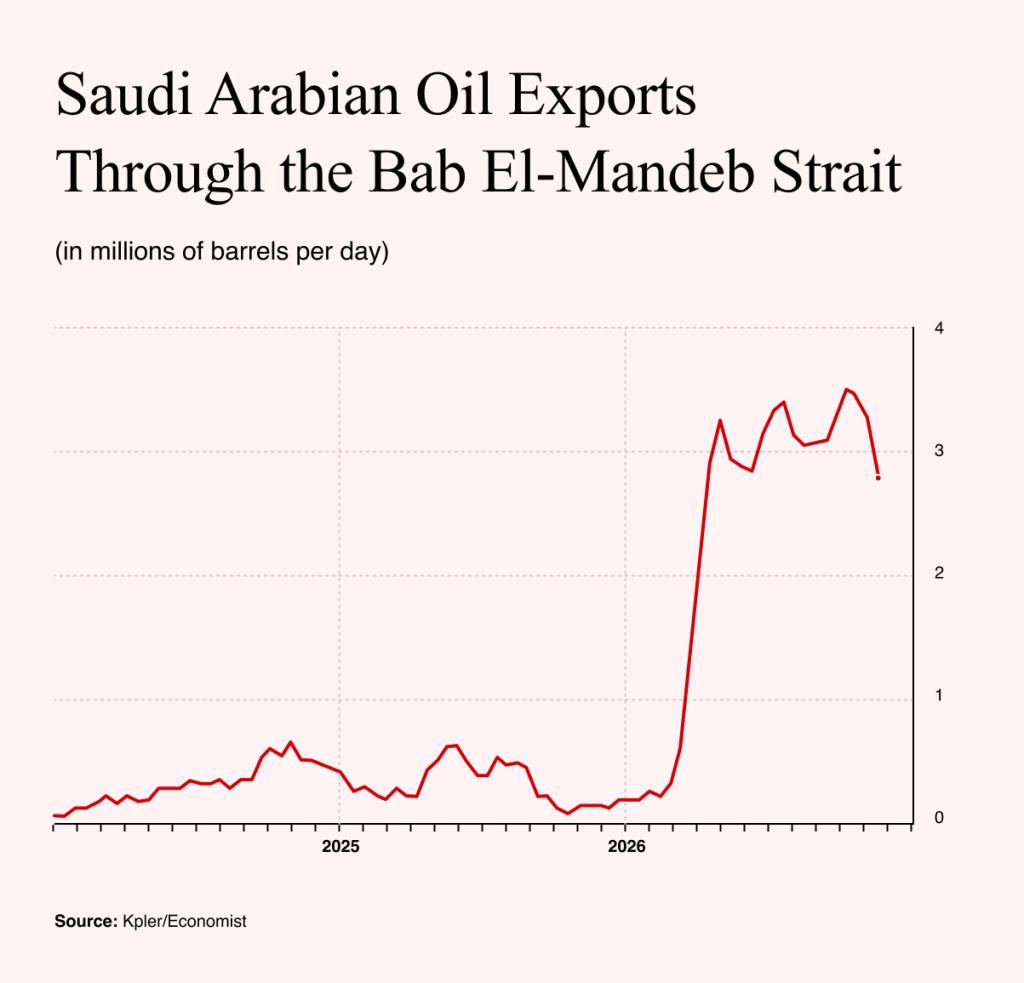
This presents another challenge for the oil market because a second key shipping route runs around Yemen, linking the Saudi Red Sea port of Yanbu with the Indian Ocean and Asian customers via the Bab el-Mandeb Strait. Saudi Arabia has diverted a significant share of its exports to this route. Since April, roughly half of its average daily exports from last year – around three million barrels per day – have been shipped this way.
Source: Kpler/Economist
The Houthis' actions, despite several attacks on merchant vessels, do not mean that Saudi oil can no longer reach global markets. Cargoes can still travel north through the Red Sea and the Suez Canal into the Mediterranean.
For Asian customers, however, this creates a major logistical challenge, as tanker voyages take almost twice as long. This is further complicated by the fact that the largest tankers cannot transit the Suez Canal.
How Long Can the Oil Market Hold Out?
Months of supply shortages have also depleted both strategic and commercial reserves.
The United States, for example, has drawn down its Strategic Petroleum Reserve to the lowest level in more than 40 years, with inventories expected to fall further as additional volumes authorized by Donald Trump in March continue to be released.
Given that global supply is currently running about 13 million barrels per day below normal levels, US reserves – now totaling 308 million barrels – are far from inexhaustible. That is particularly true because around 70 million barrels cannot be tapped, as they are needed to maintain the proper operation of the country's underground storage facilities.
Other countries also maintain strategic reserves, so oil is unlikely to become scarce overnight. Prices, however, are likely to keep rising, making it increasingly difficult for buyers who cannot outbid their competitors to secure supplies. How high prices ultimately climb will depend largely on how long the renewed disruption in the Strait of Hormuz persists.
Much of the market's stability so far has also been driven by weaker demand. But the scope for further declines in consumption has narrowed sharply. China alone is now importing around five million fewer barrels of oil per day than at the beginning of the year. According to The Economist, consumption has also fallen to record lows across several poorer Asian countries.
JPMorgan therefore estimates that if shipping through the Strait of Hormuz does not return to normal by the end of the summer, oil prices could quickly exceed $120 per barrel.
Dan Pickering of consultancy Pickering Energy Partners likewise estimates that if both the Bab el-Mandeb Strait and the Strait of Hormuz were effectively closed, oil prices could challenge April's peak of around $125 per barrel as early as August.
Is a Fuel Crisis Looming?
The problem extends beyond crude oil. Before it can be used, it must be refined into fuels, and global refining capacity is already under considerable strain.
One reason is that disruptions to shipping through the Strait of Hormuz have upended established supply chains. Another is that several Arab refineries have had to scale back operations after Iranian attacks or because storage facilities filled up as the blockade prevented refined products from reaching export markets.
The global fuel market has also been complicated by Ukrainian attacks on Russian tankers and refineries. Russia, traditionally one of the world's largest exporters of both crude oil and diesel, has already banned diesel exports to safeguard domestic supplies.
Natasha Kaneva, head of global commodities research at JPMorgan, told CNN that global oil processing is now around 10% lower than before the war with Iran.
Susan Bell, vice president of refining research at Rystad Energy, noted that global fuel inventories are far lower than crude oil stocks. They have fallen by 14% since the beginning of the year to around 1.2 billion barrels.
That is one reason refining margins – the spread between crude oil and fuel prices – have risen sharply. Before the war they stood at around $8 per barrel in the United States. They have now climbed to $40–$50, making it increasingly clear making it increasingly clear where the next bottleneck lies.