How the Randall Case Exposed the Limits of Religious Freedom in Britain
The Rev Dr Bernard Randall preached a sermon on Christian teaching. Britain's counter-terrorism authorities called it "religious extremism", setting off a five-year landmark battle over the limits of religious freedom.
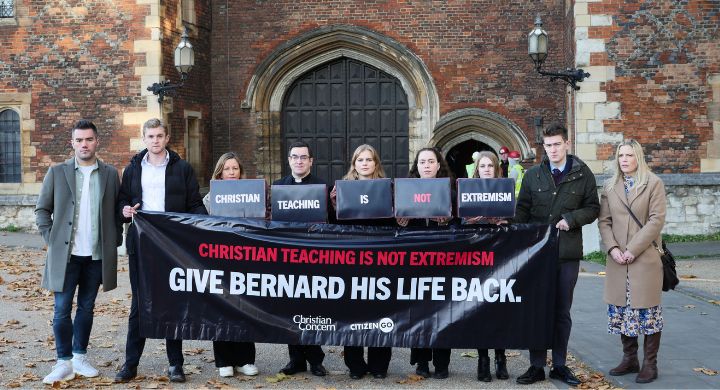
Rev Dr Bernard Randall (center) pictured with the \"Teaching\" sign alongside supporters from Christian Concern, a nonprofit Christian advocacy group. Photo: Christian Concern
|
There is an element of the Kafkaesque in the case of Rev Dr Bernard Randall, who was referred to Prevent, the national safeguarding program that forms part of the UK's counter-terrorism strategy, after preaching a sermon as chaplain of the private Christian school Trent College. The school invited in controversial LGBT group Educate and Celebrate in 2019, leading a pupil to ask Randall whether they had to accept what the group said. In response, he delivered a sermon titled “Competing Ideologies”.
He reaffirmed the Church of England's teaching on marriage, while insisting that everyone should be treated with dignity and that the views of others deserved respect. In contrast, Educate and Celebrate taught that schools should “smash heteronormativity”. The government-funded charity was later dissolved after a series of scandals, including one of its patrons being convicted of child sex abuse. Following the sermon, Randall was referred to Prevent over concerns about alleged “religious extremism”.
In August of the same year, he was dismissed from the college. He appealed that decision and was then reinstated, but only under stringent conditions that curtailed his freedom as chaplain and amounted to censorship.
https://www.youtube.com/watch?v=IHrAstzV4Ss&t=1s
Trent College Versus the Rev Randall
In January 2020, Randall brought proceedings against the school, alleging direct and indirect discrimination under the Equality Act 2010, harassment, victimization, breaches of the European Convention on Human Rights and, later, unfair dismissal. The college subsequently sought to reduce the chaplaincy role to just seven term-time hours per week.
After he rejected the proposal, he was made redundant. In July 2021, he was instructed to undergo an independent safeguarding assessment by a psychologist who usually dealt with sexual abuse. He declined, arguing that the request implied he had been at fault, and was barred from ministry and faced a serious misconduct complaint as a result. The following year, he filed a misconduct complaint against the Bishop of Derby, Libby Lane, but Justin Welby, the then Archbishop of Canterbury, refused permission for a formal investigation and dismissed the complaint.
An employment tribunal upheld Randall's dismissal in February 2023, and Welby again ruled in July that no further action should be taken against Bishop Lane. In November 2023, Randall's complaint was finally referred to the designated officer for investigation, extending a process that had already left him unable to return to ministry.
The tide began to turn in 2024. Randall's appeal before the Employment Appeal Tribunal was postponed pending the outcome of the landmark Kristie Higgs case, another Christian Legal Centre-backed case that became an important precedent on religious freedom in the workplace. In March 2025, Randall appealed the tribunal's decision on 13 grounds, and employment appeal tribunal judge James Tayler ruled that the original judgment was “unsafe” because a lay member had made numerous anti-Christian posts on social media and ordered an urgent retrial. Trent College was also ordered to pay £20,000 ($27,000) in legal costs. Following that ruling, the college reached a confidential legal settlement with Dr Randall, bringing to an end a dispute that had lasted more than five years.
The legal battle has finally ended and Dr Randall has won his employment case. While he has not yet returned to preaching, his victory means he is now free in principle to resume ministry, subject to the approval of his diocese. Had he climbed into the pulpit of a Church of England parish and preached before securing that approval, he would have been breaking the law.
Wider questions remain. A Church of England school tried to punish its own chaplain for preaching a sermon on the traditional teachings of that church. The Church of England itself not only failed to stand up for those teachings, but barred a minister from preaching its own official doctrine. The state, for its part, not only allowed a charity that attacked the traditional foundations of society into schools, but funded it as well. Its courts, which are supposed to be scrupulously neutral, were instead found to be biased. It is encouraging that the system eventually found in favor of Dr Randall, yet every institution opposed him.
The case also lays bare the intolerance of so-called gender ideology. Dr Randall's sermon was moderate and in many ways liberal, yet it provoked an intolerant response that cost him his job, his ability to preach and many years of his life in court. His sermon, which would have been largely uncontroversial at any other time in history, was treated as a matter for counter-extremism officials. The charity invited into the school, by contrast, was allowed to teach children despite the radicalism of its own beliefs. It was not Christianity that demanded unquestioning faith, but this new ideology that was treated as beyond discussion.
In an increasingly hostile climate towards Christianity in Europe, Dr Randall's decision to fight and stand by his convictions shows that the flame of Christian witness remains. His persistence over the years, and the dissolution of the charity he stood against, should encourage others that courage and fortitude will still be rewarded.