A revolt by the CDU’s eastern state premiers threatens Friedrich Merz’s flagship pension reform and leaves him with no painless way out.
Mario Voigt (CDU, from left), Minister-President of Thuringia; Sven Schulze (CDU), Minister-President of Saxony-Anhalt; and Michael Kretschmer (CDU), Minister-President of Saxony, are meeting for a joint boat ride on Lake Geiseltal. Photo: Hendrik Schmidt/picture alliance via Getty Images
|
Approved by the cabinet only a few weeks ago, Friedrich Merz’s much-trumpeted pension reform is already under fierce attack before it has even reached a vote in the Bundestag. The challenge is coming from within his own party, with the CDU premiers of three eastern states urging opposition in the midst of an election campaign.
Michael Kretschmer of Saxony, Sven Schulze of Saxony-Anhalt and Mario Voigt of Thuringia have declared that they will not support one part of the reform. Workers should continue to be allowed to retire at 63 without pension deductions after 45 years of contributions.
These are hardly three peripheral CDU figures. All three CDU premiers in eastern Germany are now in open revolt. Together, they are opposing a provision that Merz has declared indispensable to his reform.
The chancellor has maneuvered himself into a position from which he cannot win, regardless of how the dispute ends. His trilemma is straightforward.
If Merz pushes through the abolition of the provision, he will breach an explicit commitment in the coalition agreement and risk further weakening the CDU in the east.
If he gives way, he will undermine his own assertion that the package can work only if every component is implemented.
If the entire reform collapses, he will lose a central project of his chancellorship and the only modest success his government has so far been able to point to. In the end, he may even lose his office.
The Coalition Agreement
The CDU, CSU and SPD explicitly agreed in their coalition agreement: “Retirement without pension deductions after 45 years of contributions will continue to be possible.”
Yet the pension commission appointed by the government now recommends precisely the opposite in its 33 proposals. Merz has committed himself to implementing every recommendation and has insisted that the package can work only as a whole. The eastern premiers can therefore argue with some justification that they are not the ones abandoning the course agreed by the governing coalition. It is the CDU’s party and government leadership in Berlin that has changed direction.
The federal CDU leadership, headed by Merz and including parliamentary group leader Thorsten Frei and secretary general Franziska Hoppermann, bases its case primarily on demographics, competitiveness and intergenerational fairness. Its central argument is that allowing people to retire without deductions after 45 years of contributions encourages them to leave the labor market early, even as skilled workers are in short supply and a shrinking number of contributors must finance a growing number of pensioners.
The party therefore presents the abolition of the provision as a necessary element of a balanced overall package. Why it reached this conclusion only a year after signing the coalition agreement remains unclear.
Traditional CDU Social Policy
Kretschmer, Schulze and Voigt counter Berlin’s arguments with a traditional Christian Democratic approach to social policy. Anyone who has worked and paid contributions for 45 years has earned the right to retire. They do not oppose pension reform in principle, but insist that those with 45 years of employment should retain the option of retiring at 63. This is particularly relevant to people in skilled trades.
The CDU associations in the eastern states want long working lives to be recognized because such employment histories are far more common there than in western Germany. Many eastern Germans began apprenticeships at 16 and then went straight into steady employment without spending extended periods in further education or at university.
Women in eastern Germany have also traditionally had high rates of labor force participation. As a result, many employees there complete 45 years of contributions before reaching the regular retirement age of 65. Removing the option of retiring at 63 would therefore affect far more than a small number of exceptional cases. It would hit a significant group of long-standing contributors, many of whom are also important CDU voters.
Reliance on the State Pension
According to Labor Minister Bärbel Bas, around 75% of eastern Germans rely exclusively on the statutory pension system for their income in retirement, compared with about 52% in western Germany. In the west, statutory pensions are more often supplemented by occupational pensions, private savings, property, financial assets or inheritances. Such additional sources of income are far less common in the east.
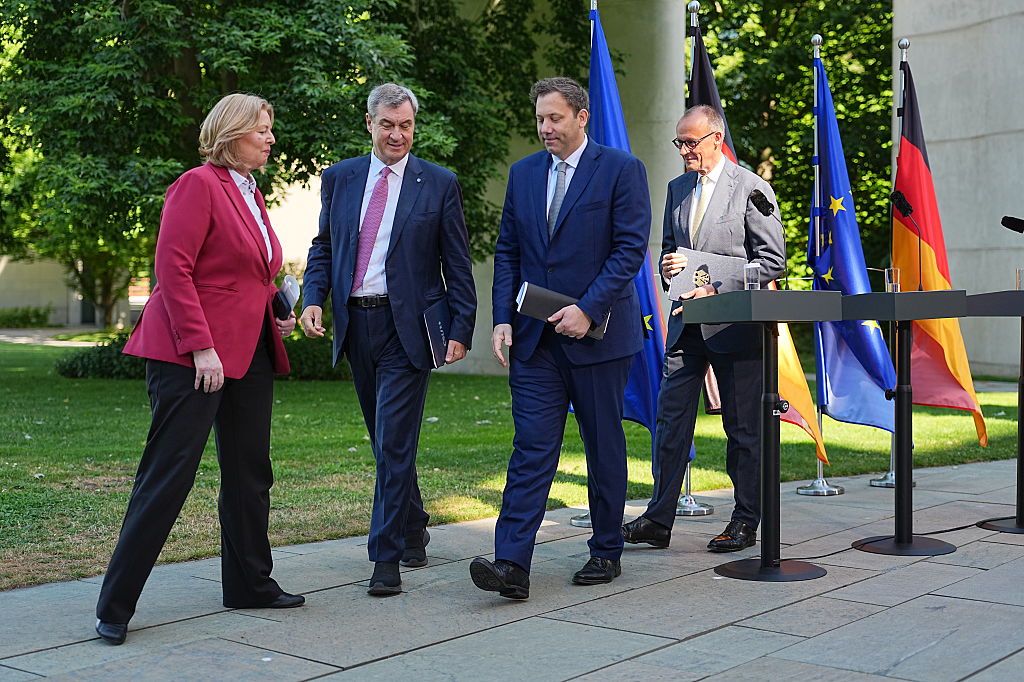
From left: Bärbel Bas, Markus Söder, Lars Klingbeil and Friedrich Merz at a press conference last month, when the government appeared to have settled its differences over pensions. Photo: Michael Kappeler/dpa/picture alliance via Getty Images
The pension commission’s argument that statutory pensions in eastern Germany are sometimes comparatively high therefore carries little weight with the eastern premiers. For many people in the region, they argue, the statutory pension represents their entire retirement income.
There is also a political calculation. The CDU can scarcely afford to create the impression in eastern Germany that it is making long-serving workers, tradesmen, shift workers and women who entered the workforce at an early age pay the price for a reform designed in Berlin.
Electoral Pressure in the East
The situation is particularly serious in Saxony-Anhalt, which will hold its state election on 6 September 2026. In the latest Infratest dimap poll, the AfD stands at 41%, while the CDU under Sven Schulze is on 24%. Giving way to Merz would allow the AfD to portray itself as the sole defender of eastern Germans who have spent a lifetime working and paying contributions.
Thuringian Premier Mario Voigt is also under considerable pressure. The AfD was most recently polling at 40% there, compared with 22% for the CDU.
Although Thuringia is not due to hold another election until 2029, Voigt must constantly demonstrate that his unwieldy governing coalition can deliver tangible results for the state and the wider region. The joint declaration is therefore both a statement of social policy and an assertion of political independence by the CDU’s eastern associations.
Voigt made the point openly. The premiers had not been elected to make themselves popular in Berlin, but to represent the interests of their states.
Political Power, Not Arithmetic
Saxony, Saxony-Anhalt and Thuringia together hold 12 of the Bundesrat’s 69 votes. The chamber must approve those parts of the pension reform that have consequences for the states. The three cannot block the legislation on their own. Even with the support of Brandenburg and Mecklenburg-Western Pomerania, the eastern states would command only 19 votes.
Moreover, no final bill has yet been presented, so it remains unclear which provisions will require the Bundesrat’s explicit approval.
The influence of the three premiers is therefore political rather than numerical, at least for now. They could rally other states, shape the position of CDU members of the Bundestag and carry the conflict into the heart of the Saxony-Anhalt election campaign.
A formal veto remains uncertain. It is far more realistic that they could shift the political balance enough to force Merz to seek a compromise before the vote.
The Stakes for Merz
A compromise could be presented as a return to the terms of the coalition agreement rather than as a complete capitulation. If the dispute causes the entire pension package to collapse, however, the damage would be considerably greater.
Merz has described pension reform as one of the most difficult and important projects of his government and has promised that it will be passed by the end of 2026. The failure of another major initiative could once again fuel doubts about his ability to unite his party, its parliamentary group, the states and his coalition partners.
For Merz, the summer recess will end no later than 6 September, when Saxony-Anhalt goes to the polls. An agreement with the eastern premiers cannot wait until then. The likely election result will already be difficult enough for the CDU without an internal battle over pensions.