
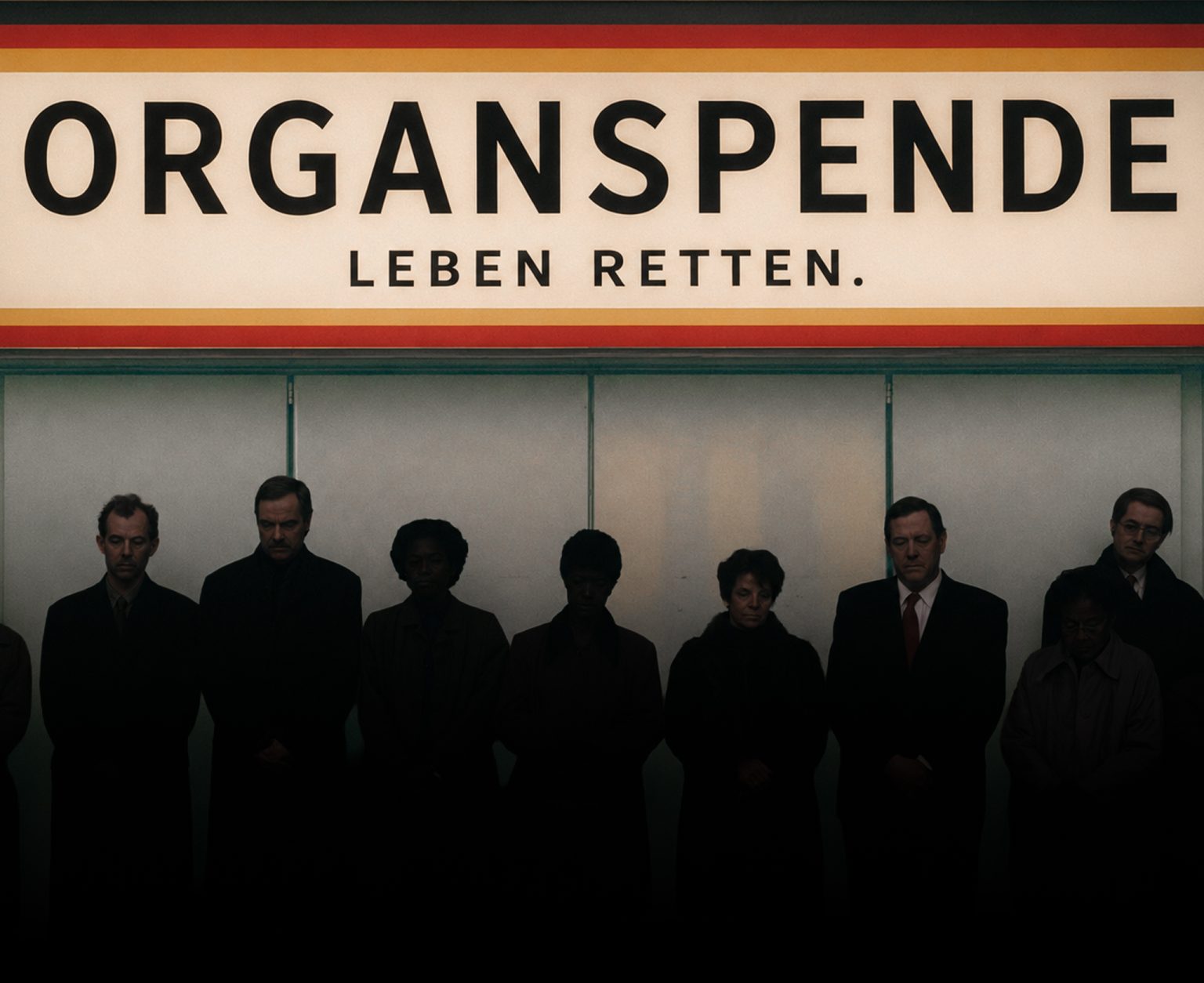
Germany’s parliament is preparing to reopen a question it answered only six years ago: May the state interpret a person’s silence as permission to remove organs after death?
A cross-party group of 245 of the Bundestag’s 630 members has submitted a bill introducing "presumed consent". From 2030, every adult capable of deciding would count as a potential donor unless they had recorded an objection. Doctors would check the national register, then ask relatives whether the deceased had left a written objection or clearly expressed one orally. The family would have no independent right to refuse.
Current German law requires consent from the deceased or the next of kin. If no decision has been documented, relatives are asked to reconstruct what the deceased would have wanted. Under the proposed system, the absence of a known decision would instead amount to presumed permission.
The Bundestag rejected a similar proposal in 2020 by 379 votes to 292. Parliament opted for more public information and a digital register, which opened in March 2024. By spring 2026, around 550,000 people had registered their decision.
Germany recorded 985 deceased donors in 2025, equivalent to 11.8 per million inhabitants. At the end of the year, 8,199 patients were waiting for an organ. Six hundred and thirty-three people had died while on a waiting list. The country has also widened paired and anonymous living kidney donation, and earlier reforms placed transplant officers in hospitals.
Europe’s Opt-Out Patchwork
Opt-out describes a legal default, not a uniform transplant system. Spain enacted presumed consent in 1979, but donation rates only began rising after the National Transplant Organisation was established in 1989 and hospitals appointed specialist coordinators. In 2025, Spain recorded 2,547 deceased donors, or 51.9 per million people. Presumed consent alone does not explain that result.
Slovakia provides the clearest counterexample. It also presumes consent, keeps no register of willing donors and requires hospitals to check a national register of objections before procuring organs. Yet the country recorded only 65 deceased donors in 2025 – about 12 per million inhabitants, almost identical to Germany’s 11.8.
Croatia shows what stronger organization can add. Anyone who did not object while alive is considered a potential donor, although an explicit objection from the family is respected in practice. Croatia recorded 110 deceased donors in 2025, or 28.2 per million. Its relatively high donation rate has been linked to the appointment of hospital transplant coordinators in 1999 and a national coordinator in 2000, alongside round-the-clock coordination, standardized donor-identification protocols and specialist training.
The United Kingdom exposes another limit. All four nations use soft opt-out laws, but donation under deemed consent still requires family support. In 2025/26, relatives withheld it in 602 of the 1,092 cases in which consent was presumed. The overall rate of family consent or authorization fell to 57%.
Consent and the Meaning of a Gift
Germany’s Catholic bishops support organ donation as a life-saving act, yet insist that it remain a voluntary gift based on informed consent. Bishop Georg Bätzing has argued that the absence of an objection cannot establish whether someone ever considered the medical and ethical questions involved.
The Protestant Church likewise describes organ donation as an act of Christian charity. It rejects the assumption that the state may infer such charity from silence and maintains that human dignity continues to encompass the body after death. Under the proposed law, silence would acquire a meaning the deceased may never have intended.