Cloned bodies without brains, neural networks made of living cells and robotic heads capable of human expressions are no longer just science fiction. Scientists and startups are pushing the boundaries of medicine, technology and bioethics.
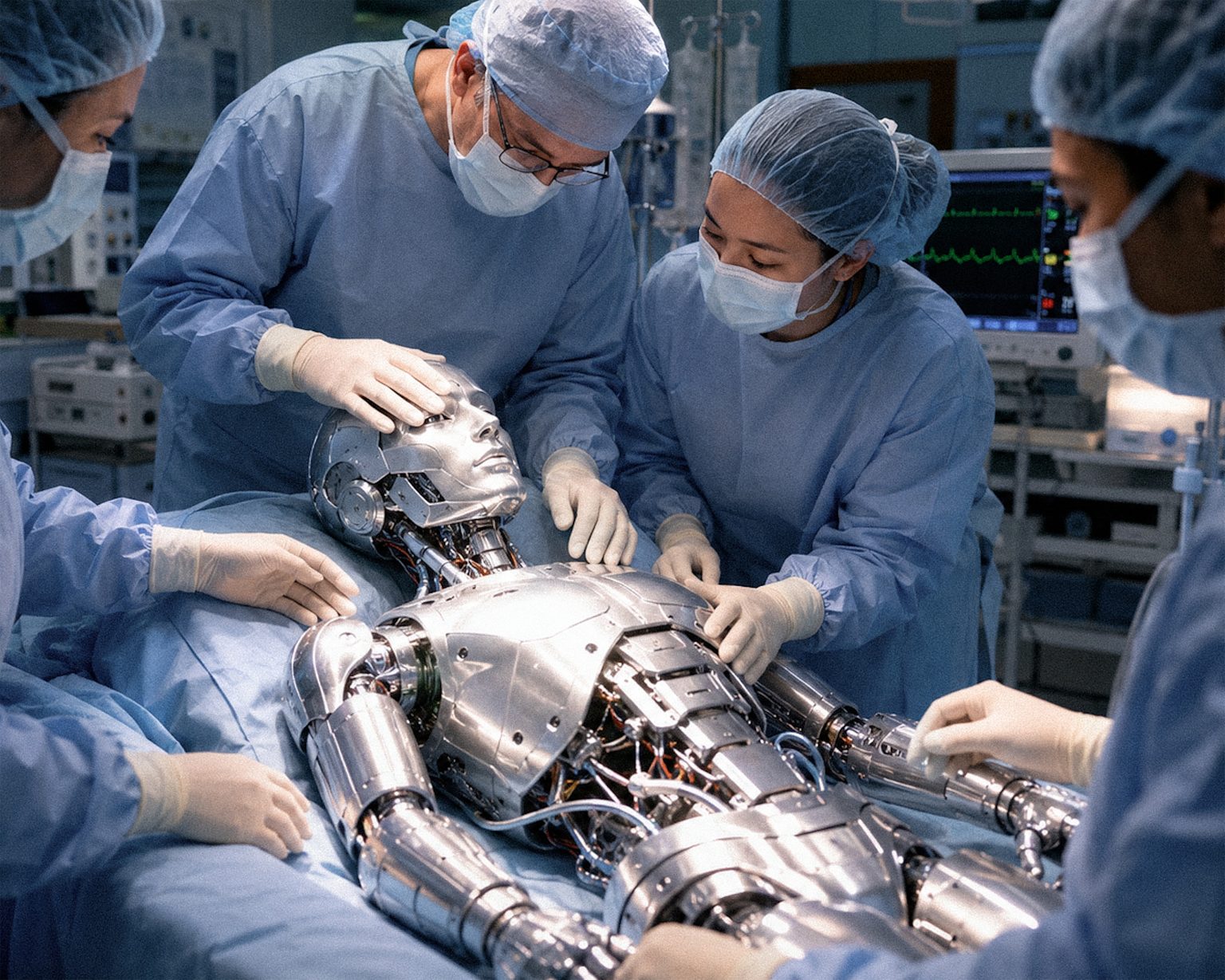
Medicine and robotics are converging as researchers explore new ways to replicate, replace and augment the human body. Photo: Statement/AI
|
In recent years, news about innovations in robotics has been overshadowed by artificial intelligence as the two technological sectors increasingly converge. Whether it is Elon Musk’s planned drone swarms, Chinese robot wolves, humanoids at Japanese airports or Ukraine’s burgeoning drone industry, AI plays a significant role in hardware development.
In biology, genetics and medicine, humanity is also witnessing rapid advances in knowledge that raise far more troubling ethical questions. Reverse aging [reversing the biological age of cells, ed.], achieved last year by Chinese scientists in macaques, still appears some way off for humans, while human gene editing remains widely considered ethically unacceptable.
However, even this stance is gradually shifting. In December 2025, US company Nucleus Genomics introduced IVF+, an in vitro fertilization package, which includes modifying an embryo’s genetic code to prevent rare diseases.
In addition to anti-aging procedures slowly becoming a treatment option for humans as part of cancer therapy, companies from the AI sector are also entering the field of gene editing.
As recently as June this year, scientists at Columbia University in the US successfully performed genetic modification on embryos. When it comes to extending life, Bryan Johnson is a pioneer in the West; he has reportedly begun growing his own clones with the goal of creating a supply of organs.
But while the concept of growing individual replacement organs is gradually entering the mainstream, another field is attempting to produce entire clones – except for the head.
Bodies Without Heads
A headless clone created in this way is known as a “bodyoid”, but it is important to note that this remains a theoretical concept. Cloning itself is also considered unethical under current guidelines. However, a bodyoid would be developed under laboratory conditions without a head or brain, which should prevent the emergence of consciousness or the experience of pain.
California-based company R3 Bio is working to turn the concept into reality. The company has begun “growing” headless primate clones that it says could initially serve as test subjects for drug trials, but co-founder Alice Gilman told Wired that its ultimate goal is to create human versions as sources of tissues and organs.
The startup’s largest investor, Singapore-based investment fund Immortal Dragons, shares this vision.
Headless “Sacks” as an Organ Supply?
“We believe that replacement is likely better than repair when it comes to treating diseases or regulating the aging process in the human body,” the fund’s CEO, Boyang Wang, told Wired. “If we can create a non-sentient, headless body for a human, it will be a great source of organs,” he stated.
“The advantage of using more ethical models consisting solely of organ systems would be that testing could be scaled up significantly,” Gilman explained.
Pluripotent stem cells would be used to grow these organs, and this process is likely feasible, stem cell biologist Paul Knoepfler explained to Wired. The University of California Davis professor further clarified that these begin as human skin cells that are reprogrammed to an embryonic state.
“By modifying these stem cells, scientists could deactivate the genes necessary for brain development. The resulting embryo could then be incubated until it develops into organized organ structures,” he explained.
The Zombie Paradox
Similar procedures have long been theoretically possible, but in the October issue of First Things, bioethicist Aaron Kheriaty pointed out the almost unimaginable ethical transgressions involved in using in vitro fertilization (IVF) to create bodyoids.
Kheriaty was responding to an article in MIT Technology Review in which the authors proposed constructing an artificial womb for incubating bodyoids.
“Strictly speaking, artificial wombs are not necessary for the development of bodyoids. Such a reprogrammed embryo could theoretically be created in a laboratory and implanted into a woman’s uterus, just as is done with IVF. However, the idea that a being considered subhuman should be born of a human mother seems too terrifying for even these pioneers of bioethics to consider”, he noted.
The debate over the so-called “replacement parts” that would result from supposedly ethical cultivation is therefore far from settled. Kheriaty also pointed to successes in creating “embryoids”, which reportedly do not develop brains.
“We don’t know for sure, since they are usually destroyed after fourteen days, that is, before the heart and brain begin to develop,” he explained, highlighting the bioethical dilemma. However, he has not yet commented on further hybridization, even though it is far more disturbing than growing zombies.
While growing entire “almost-humans” is currently technically complex – and the field is therefore still in its infancy – individual tissues are already routinely engineered. The term “tissue engineering” has been in use since the 1980s. But scientists are not only exploring how such tissues might replace parts of the human body. They are also investigating whether living neural tissue could perform some of the functions of a computer.
It is precisely in this area of biomedicine that another form of scientific progress is emerging, one that raises serious concerns among ethicists. In addition to embryoids and bodyoids, quasi-human tissues known as organoids can also be grown. Nerve tissue is among the most promising areas of research.
In 1999, engineer William Ditto created what is known as a “wet computer”. Unlike “dry” computers, which operate using metal and electricity, a “wet” device functions using neurons – nerve cells.
The creation of a “wet” computer based on leech neurons represented a remarkable advance in science and technology. At the same time, it once again raised questions about whether the operation of these neural circuits might cause something akin to pain in organisms that did not develop naturally.
Ditto’s computer was capable only of addition. Despite its simplicity, it provided a springboard for other pioneers who went on to develop this “wetware” further.
A quarter of a century later, an entire field is emerging whose work brings to mind the cyborgs of science fiction: organoid intelligence (OI). Ditto’s successors realized that neural networks connected via brain-computer interfaces could be far more powerful than their “dry” counterparts.
The word “cyborg” itself is an abbreviation of “cybernetic organism”. Elon Musk’s Neuralink successfully tested a brain-computer interface as early as January 2024 – on a living human outside the laboratory.
A key component of OI is the three-dimensional matrices through which artificially grown neurons develop. These do not need to be shaped like a brain and can therefore be integrated into other devices. In the future, they could be of great use to companies such as SpaceXAI or OpenAI, which continues to struggle with a shortage of hardware.
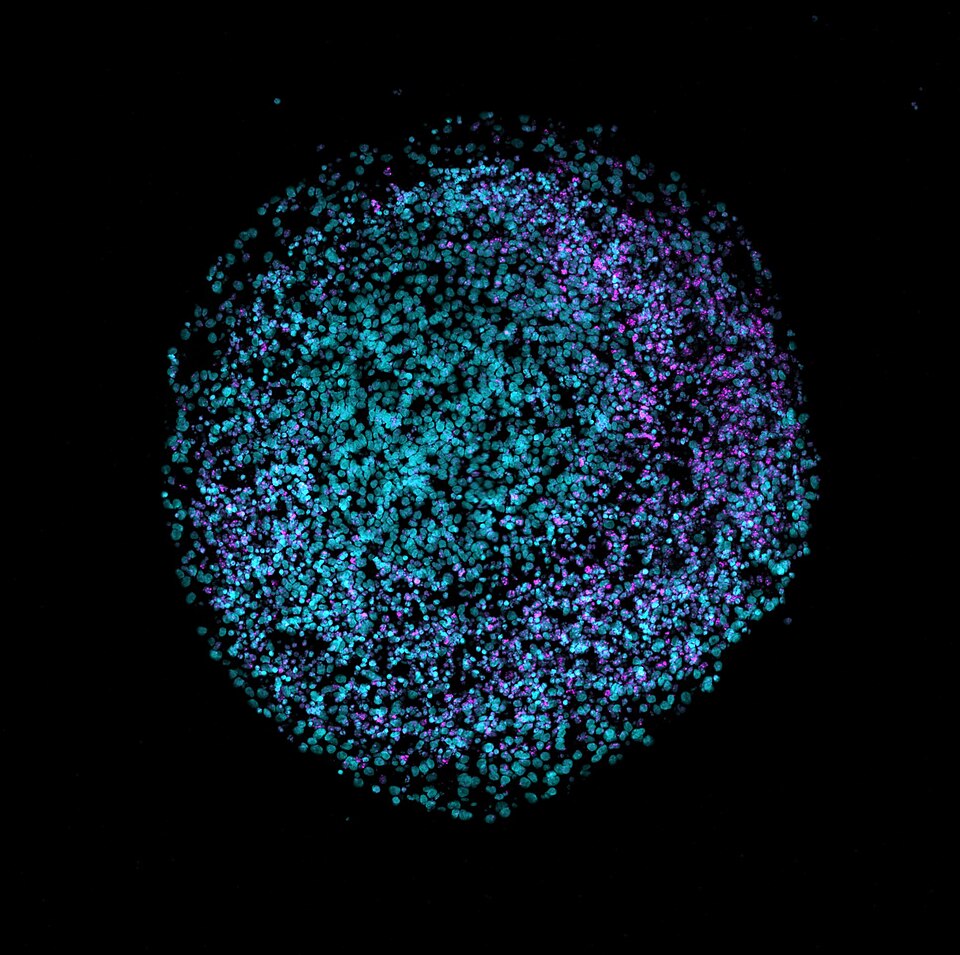
2D cryosection of a human brain organoid stained with DAPI (turquoise) and VIPR2 (magenta). Source: Nreis1/Wikimedia Commons
Last August, a team from Johns Hopkins University in Baltimore, Maryland, demonstrated that, at the microscopic level, these neural networks are capable of organizing themselves into “the basic building blocks necessary for basic learning and memory.” The researchers were led by Dowlette-Mary Alam-ed-Din, director of the Center for Alternatives to Animal Testing (CAAT).
In addition to modeling artificial brains of sorts from real cells – intended as a research aid for better understanding development and various diseases – bioengineers have also laid the groundwork for harnessing human thought processes that could be replicated in a machine.
Barely half a year later, their Chinese colleagues published a study available through ScienceDirect indicating that this is indeed possible. “Brain organoids derived from human stem cells exhibit self-organizing neural networks with dynamic activity and plasticity, thereby offering a biologically based alternative to conventional artificial intelligence systems,” stated the team led by Long Bai of Shanghai University.
The Chinese scientists’ long-term goal is to establish a “biohybrid platform” that will replicate known forms of machine learning, but with hardware based on brain cells doing the learning. The first warnings about a truly dystopian AI scenario were published by Science as early as November 2025.
A Head for the Headless
However, headless bodies and processors made from human cells will not be the only exhibits in this cabinet of curiosities. Chinese company AheadForm is working on another piece of the puzzle. Its name is a play on words: “ahead” means to be in front, while the company produces heads, complete with faces, to advance robotics.
For AI to interact physically with the world, however, it needs a body – just as the human soul needs a body that, while limiting it, also defines its existence in the material world.
Early attempts to produce robotic heads were not particularly successful, as demonstrated by the “feminine-looking” robot Sophia. The machine was developed by Hong Kong-based Hanson Robotics to resemble the ancient Egyptian Queen Nefertiti. A year later, Sophia was granted citizenship in Saudi Arabia.
To real people, however, such nearly human devices can appear repulsive, a phenomenon explained as early as the 1970s by Japanese robotics expert Masahiro Mori. It is known as the “uncanny valley”.
https://www.youtube.com/watch?v=sKrV2CVDXjo
Combining robotics and psychology, Mori found that the more realistic a non-human creature appears, the more attractive it is to humans – but only up to a certain point. Once that threshold is crossed, unease or even fear sets in.
In Sophia’s case, therefore, the visual features are exaggerated and often provoke revulsion.
This is where startup AheadForm comes into play. According to several commentators, it has overcome the uncanny valley. Models such as the Origin-F1 and Elf-Xuan look strikingly realistic, and the Shanghai-based company has paid close attention to detail.
“Silicone skin that you can’t tell apart from human skin, and 25 micromotors hidden beneath it that shape the face into realistic expressions. And RGB cameras built into the pupils, so when she looks at you, she actually sees you from where her eyes are,” explained technology commentator Ole Lehmann.
According to Lehmann, the robots learn to move using micromotors by looking at themselves in a mirror. They recognize the onset of a human smile 839 milliseconds before a person smiles by scanning micromovements in the skin.
So while human tissues are slowly being cloned and further dehumanized through the production of “wet” computers, robotics, by contrast, is becoming “more human” at a dizzying pace. However, only a limited number of millionaires can afford these as-yet-unimaginable biotechnological marvels.
Welcome to the comments section of the Štandard daily. Please take note of our guidelines, comments are moderated by us. You can contact the moderators at support@statement.com.
Participate in the discussion
Comments are available to subscribers only. If you'd like to join the discussion, choose a subscription starting at €6.72 per month.
All comments 0
Register
Comments are available to registered users only. If you'd like to join the discussion, register here.