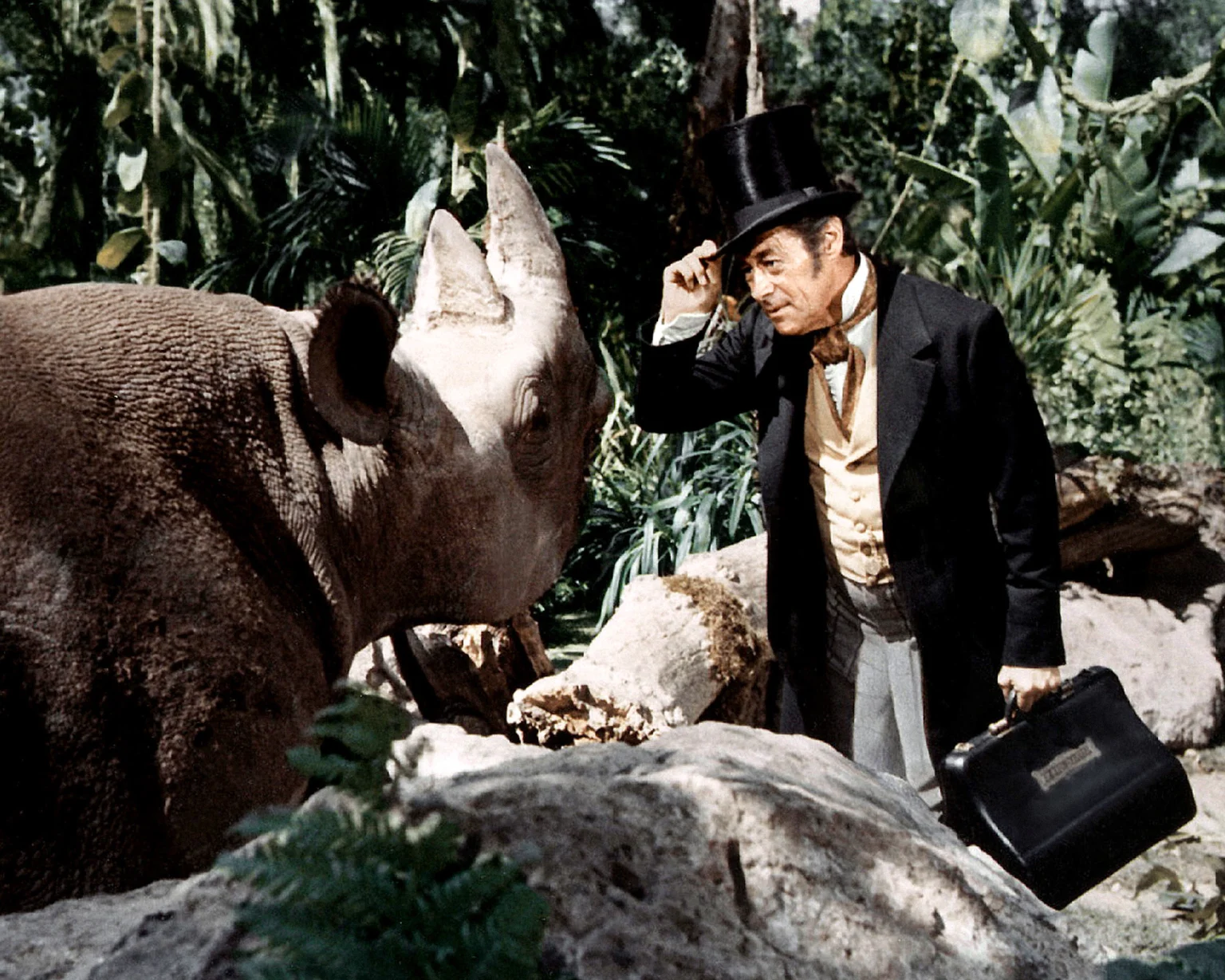
Can we talk to animals? Doctor Dolittle could. Now researchers are using language models to emulate the fictional doctor. The results are impressive, but a real conversation with the rhinoceros pictured here remains a distant prospect.
Rex Harrison as Doctor Dolittle in the 1967 film adaptation of Hugh Lofting’s children’s books. Photo: Mary Evans/AF Archive/Mary Evans Picture Library/Profimedia
|
Artificial intelligence has opened up new avenues for researchers trying to decipher animal communication and respond to it. AI models have identified individual forms of address among elephants and marmosets and revealed previously unknown structures in the click sequences of sperm whales. A generative AI model is already engaging in real-time call exchanges with zebra finches. Google has introduced DolphinGemma, a model that analyzes dolphin vocalizations and can generate dolphin-like sequences of its own.
Researchers remain a long way from a translation program that would allow genuine communication with animals. But they have taken the first step beyond listening and toward interaction.
The British writer Hugh Lofting imagined such a breakthrough more than a century ago. In his 1920 children’s book The Story of Doctor Dolittle, the physician John Dolittle sits in his kitchen one rainy afternoon when the parrot Polynesia tells him that animals do, in fact, talk to one another. Dolittle decides to learn their language. His lessons begin with Polynesia having him write down the bird alphabet.
https://youtu.be/49CmzIRX1k0?si=XQEltnC2HAsUI7HH
She then points out that animals communicate through far more than sound. Their ears, feet, tails and even movements of the nose can all convey signals. Dolittle observes, takes notes and practices. Later, he learns to answer them.
In the second chapter, Lofting describes a course of study for Doctor Dolittle that in some respects comes remarkably close to today’s AI-assisted research into animal communication.
The fictional doctor has one crucial advantage over modern researchers. Polynesia already knows what the sounds mean. She can teach Dolittle a bird call and tell him at the same time what it signifies. That is precisely what today’s researchers lack.
An AI system can identify patterns in millions of sounds. It can even determine who is calling, whom the call is directed at and the situation in which it is made.
But whether a particular sound actually means come here, danger or the name of another animal can at best be inferred from the animals’ behavior. In many cases, researchers are left with codes they cannot crack because they lack the key – Doctor Dolittle’s bird alphabet, so to speak.
Elephants and Marmosets Respond to Individual Calls
Research on African savannah elephants shows just how far this approach can go. Scientists analyzed the animals’ low-frequency calls using machine learning. The model identified acoustic features associated with the individual being addressed. The researchers then played wild elephants recordings of calls that had originally been directed either at them or at other animals.
The elephants responded far more strongly to calls addressed to them than to those meant for other animals. In their 2024 Nature study, the researchers concluded that the animals address members of their families with individually distinctive, name-like calls.
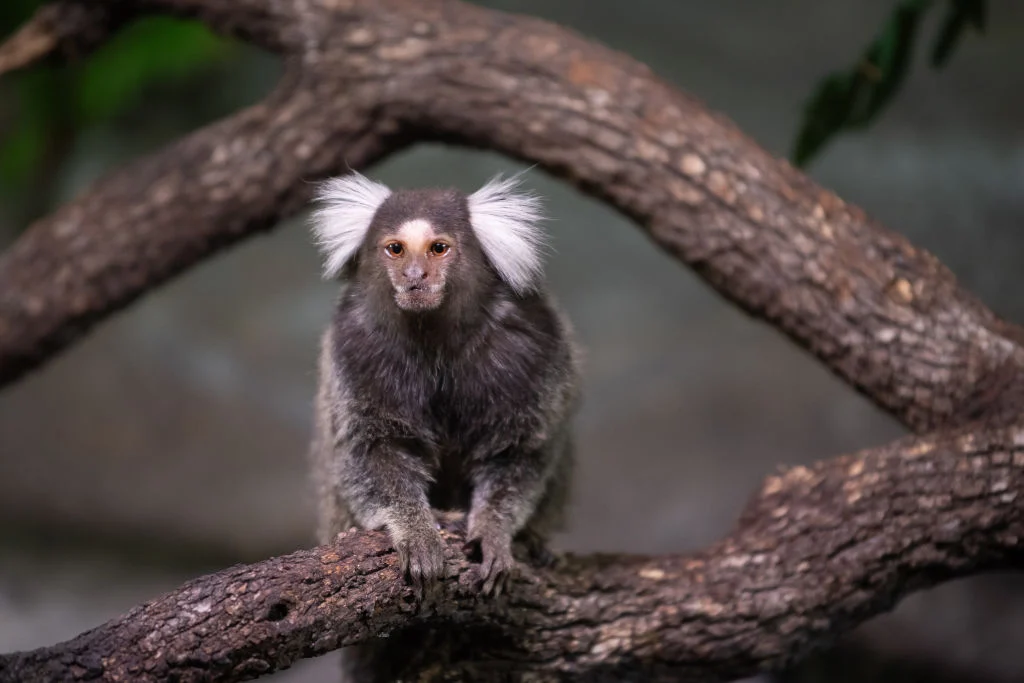
White-tufted-ear marmosets use distinctive phee calls when addressing specific members of their group. Photo: Marcos del Mazo/LightRocket via Getty Images
Researchers at the Hebrew University of Jerusalem found something similar in common marmosets. The small monkeys engage in regular call exchanges with other members of their species. A study published in Science concluded that so-called phee calls – long, high-pitched contact calls – contain information identifying the intended recipient.
Family members used similar acoustic features when addressing the same individual. The monkeys also responded more reliably to calls intended for them.
Whether either finding really amounts to the use of names remains disputed. An analysis published in July 2026 urges greater caution. A name must do more than identify an individual. It must also function symbolically, with its meaning shared by several members of the group.
A true name would also have to be used when others refer to the individual, not only when addressing it directly.
An Alphabet Without a Dictionary
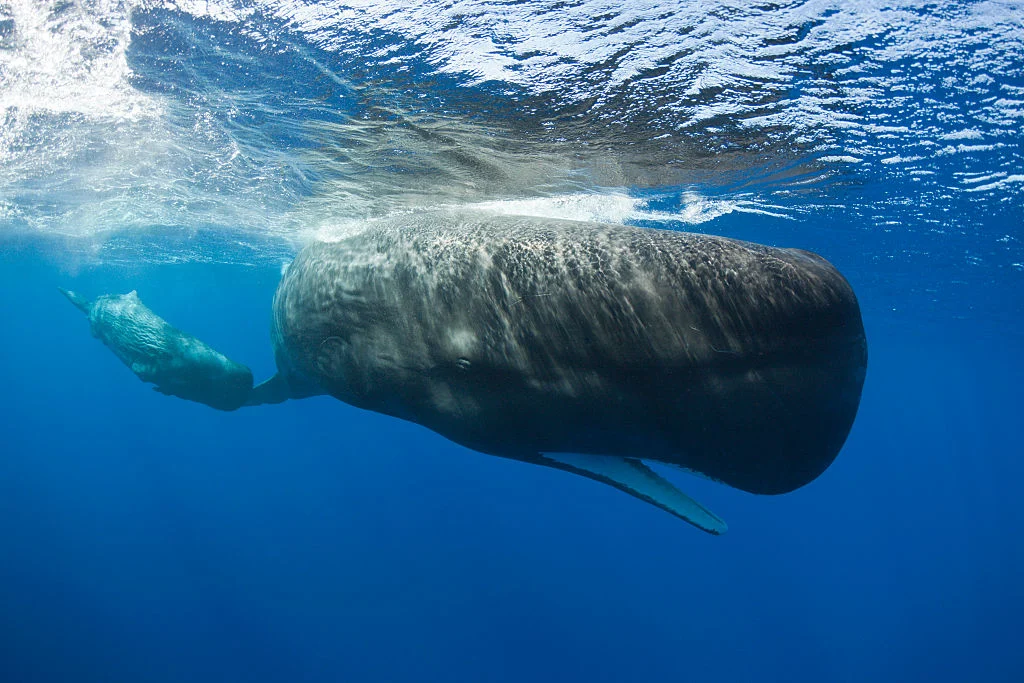
The problem is even clearer with sperm whales. They communicate underwater using short, rhythmic sequences of clicks known as codas. Researchers from Project CETI, the Cetacean Translation Initiative, and the Massachusetts Institute of Technology (MIT) examined 8,719 such codas produced by a sperm whale population in the eastern Caribbean.
The AI-assisted analysis showed that the whales vary their click sequences along at least four dimensions. In the 2024 study, the researchers describe a phonetic alphabet of sperm whale communication. An alphabet, however, is not yet a dictionary.
Sperm whales communicate through rhythmic click sequences known as codas, which researchers are using AI to decode. Photo: Reinhard Dirscherl/ullstein bild via Getty Images
The acoustic building blocks can now be described with considerable precision, but what many codas convey remains unknown.
Project CETI therefore collects not only sounds but also data about the animals, their movements and their social interactions. By combining this information, researchers hope to find a key to the whales’ communication system.
Zebra Finches Call, AI Answers
An experiment involving zebra finches goes one step further. Researchers led by Sarah Woolley of Columbia University in New York, working with the non-profit Earth Species Project, analyzed more than 1.5 million calls made by female zebra finches.
They found that the birds do not simply run through a fixed repertoire during a vocal exchange. The timing and acoustic structure of their calls change in response to the vocalizations of the other bird.
The researchers then built a generative audio model called ZF-AIM. The AI hears a bird’s call and generates a new vocalization in real time. Zebra finches responded to the system with call patterns that in important respects resembled natural exchanges with other members of their species. The timing and structure of the AI’s reply in turn affected the bird’s reaction.
This creates a closed communication loop. The bird calls. The AI processes the sound and replies. The bird reacts and, through that reaction, influences the AI’s next response.
What is still missing is meaning. Researchers can show that the animals treat the artificial voice as a partner in the exchange. They cannot yet say what the bird and the machine are talking about.
An Artificial Vocabulary for Dolphins
With dolphins, the two strands of research come together. Google developed DolphinGemma in collaboration with the Wild Dolphin Project, a US research organization studying wild dolphins, and the Georgia Institute of Technology. The model processes recordings of wild Atlantic spotted dolphins and is designed to learn which sound sequence is likely to follow another. It can already generate new dolphin-like vocalizations.
https://youtu.be/T8GdEVVvXyE?si=vf_KVwUT1LmsoV6u
At the same time, researchers have spent years trying to establish a tiny shared vocabulary with the animals. Specific artificial signals have been assigned to objects dolphins play with, including a rope, a scarf and Sargassum seaweed. Researchers use the corresponding whistle when passing the object to one another, with the aim of teaching the dolphins the association so that they eventually use the sound themselves when they want a particular object.
During one experiment, a dolphin did indeed produce a sound that the AI identified as the signal for Sargassum. The Wild Dolphin Project nevertheless does not describe this as communication. The animal may simply have imitated the whistle.
There was no indication that the dolphin was actually asking for Sargassum. This is precisely where the line lies between an imitated sound and an understood word. The former can be demonstrated. The latter cannot – at least not yet.
Bees Show What Real Communication Looks Like
An experiment that did not rely on modern generative AI shows what genuine human-to-animal communication can look like. Researchers at the Free University of Berlin developed a robotic bee capable of imitating the waggle dance of honeybees. Bees use this dance to tell other members of the colony the direction and distance of a food source.
The robot performed a dance specified by the researchers. Live bees followed it and subsequently left the hive, flying in the direction the robot had conveyed. Humans had therefore succeeded in sending a message through the animals’ natural signaling system and deliberately altering their behavior.
This works with bees because the waggle dance is comparatively well understood. AI researchers are now trying to lay the groundwork for similar exchanges in far more complex systems.
The Earth Species Project refers to this emerging field as Animal Language Processing. Its NatureLM-audio model was developed specifically for bioacoustics. It can identify and classify animal sounds and detect structures even in species it has not encountered before. Researchers hope it will yield further insights into communication with animals.
Doctor Dolittle began making progress with Polynesia on a rainy afternoon. All he needed was a notebook and a patient parrot. Today’s researchers have millions of recordings, sensors, sophisticated language models and immense computing power.
What they are missing is, in effect, a Polynesia. Until they find one, every supposed meaning has to be tested against the animals’ behavior.
Only when an artificially generated signal demonstrably and reproducibly elicits a predicted response, and the animal in turn responds in an intelligible way, can it truly be called communication. Until then, Hugh Lofting’s Doctor Dolittle retains his monopoly on talking to animals.
Welcome to the comments section of the Štandard daily. Please take note of our guidelines, comments are moderated by us. You can contact the moderators at support@statement.com.
Participate in the discussion
Comments are available to subscribers only. If you'd like to join the discussion, choose a subscription starting at €6.72 per month.
All comments 0
Register
Comments are available to registered users only. If you'd like to join the discussion, register here.