New Paper Reveals: Fertility Crisis Is Cultural as Well as Economic
It is often assumed that economic factors lie behind the fertility crisis. But a new paper unveils a stark reality: people want fewer children – and even still cannot have as many as they wish.
Across the West, children are increasingly just not a part of young adults' plans. Photo: Stock Photo via Getty Images
|
Europeans are having fewer children, a fact which is not in dispute. The comforting explanation – at least for parts of the right – is that aspiring parents still desperately want the traditional two-child family, but have been thwarted by house prices, childcare costs and economic insecurity. Fix those things, the theory goes, and the babies will return. Provide economic incentives, another school of thought holds, and people will have more babies.
But a new paper from the US National Bureau of Economic Research suggests a less convenient possibility: Europeans, and indeed Westerners in general, may simply want fewer children than they used to.
That casts a different, more troubling light on the crisis: after all, if people want children but cannot have them, low fertility is largely a practical problem. Build houses, subsidize childcare, provide parental leave and encourage employers to accommodate family life.
If, on the other hand, people no longer particularly want children, then the problem is cultural. Governments are much less comfortable admitting that, because cultural problems cannot be solved with policy levers like tax breaks or whatnot.
The paper in question, by economists Raquel Fernández, Inés Berniell and Milagros Onofri, examines two large international surveys conducted roughly a decade apart.
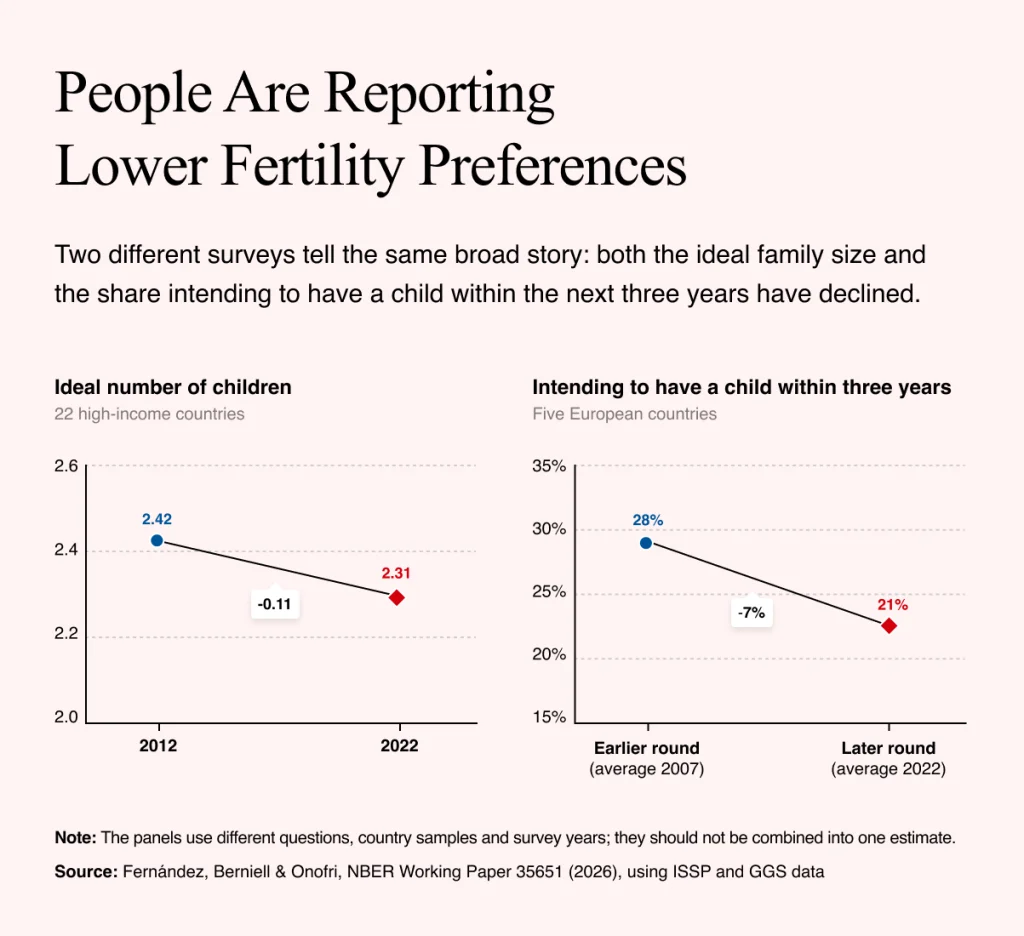
In the first, covering 22 wealthy countries, respondents were asked what they considered the ideal number of children for a family. The average answer fell from 2.42 children in 2012 to 2.31 in 2022. The decline occurred in 17 of the 22 countries.
The second survey asked people in Austria, the Czech Republic, France, Germany and Sweden whether they intended to have a child within the next three years. The proportion saying yes fell from 28% to 21%.
Source: Fernández, Berniell & Onofri (2026), NBER Working Paper No. 35651, using ISSP and GGS data
That is, obviously, not a small decline. It means that, in little more than a decade, roughly one quarter of those who might previously have expected to have a child soon had abandoned that intention.
One obvious response to this might be that people are simply postponing parenthood. A 28-year-old who intends to have a child at 31 rather than 29 has not necessarily decided to have fewer children.
And so, the researchers examined that possibility. But, frighteningly, intentions did not increase among older respondents, where the supposedly postponed births should eventually appear. The decline was also evident among the childless, people with one child and people with two or more.
In other words, this was not simply a case of the same number of desired babies being shifted a few years down the calendar.
Children and the Good Life
Why have preferences changed? The paper considers several of the usual explanations: the cost of housing, conflict between work and family life, the unequal division of household chores and dissatisfaction within relationships.
Surprisingly, most of these explain relatively little once the different factors are considered together.
Instead, three changes in attitude stand out.
First, more people appear to believe that children interfere with the freedom of their parents. Among women, the paper claims that this change accounts for about half of the measured fall in the ideal number of children. The modern adult has more freedom, more entertainment and more opportunities for travel and consumption than any previous generation. Children place limits on all of them, or so a growing number of prospective parents appear to believe.
Second, fewer people think that either a man or a woman needs children to live a fulfilled life. This was the single largest contributor to the fall in short-term fertility intentions.
This may be the most important finding in the paper. Parenthood was once regarded as an ordinary and essential part of adult life. Indeed in many EU countries, there was a long-standing stigma around childlessness. Perhaps because of that, the generally understood position was that while person might fail to become a parent through circumstance, deliberately excluding children from one’s future was relatively unusual, and indeed to be remarked upon.
That assumption has collapsed. A good life may now be built around career, friendship, travel, hobbies, pets, politics or personal freedom. Children have moved from being a normal stage of life to being one possible lifestyle choice among many.
Third, more progressive attitudes toward mothers working while their children are young are associated with lower fertility ideals, particularly among university-educated respondents.
This does not prove that women working causes fertility to fall. The paper is careful to say that its exercise is not causal. These attitudes may simply be different expressions of a broader change: away from family as the organizing institution of adult life and toward individual fulfillment through work and autonomy.
But Still, People Want More Children Than They are Having
None of this, however, means that Europeans are actually having exactly as many children as they want.
A separate 2025 analysis of the Generations and Gender Survey examined women in 11 European countries, including eight EU member states.
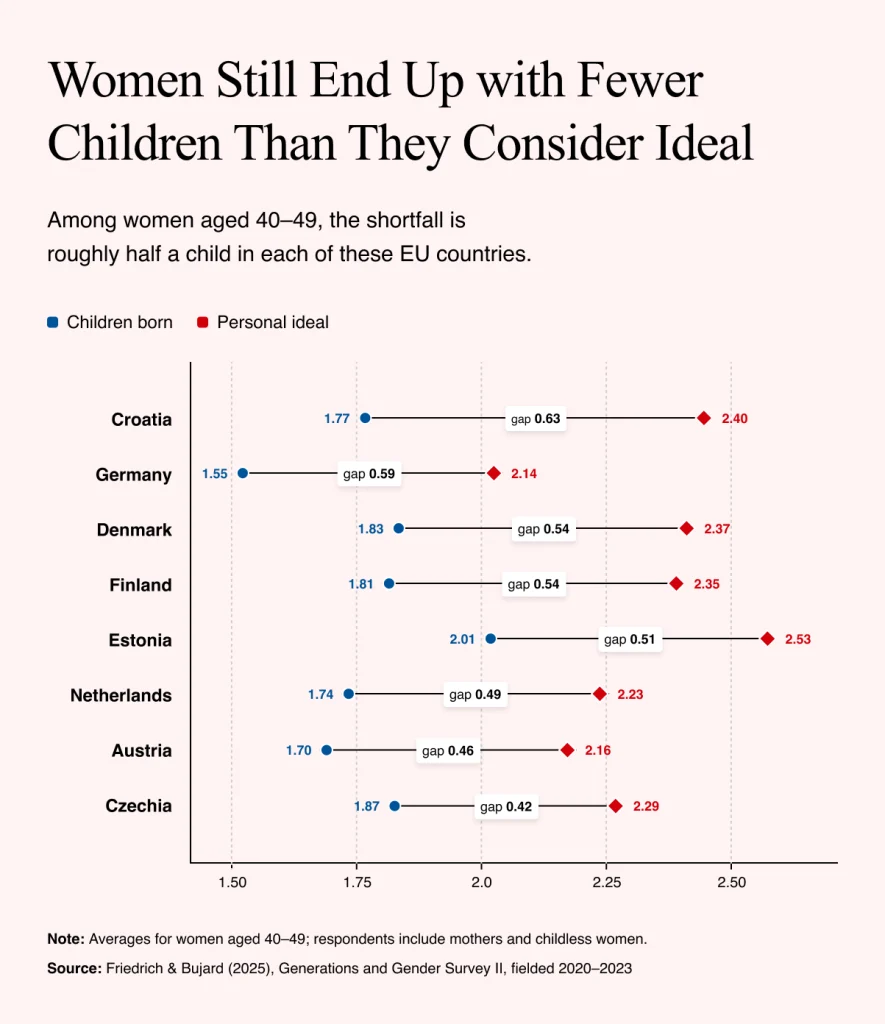
Among women aged 40 to 49 – by which point most childbearing has been completed – the gap between the number of children they considered ideal and the number they had actually borne ranged from 0.42 in the Czech Republic to 0.63 in Croatia.
Source: Friedrich & Bujard (2025), Generations and Gender Survey II, 2020–2023
German women in that age group had an average of 1.55 children but described 2.14 as ideal. In Finland the figures were 1.81 and 2.35. In Estonia they were 2.01 and 2.53.
So yes: Europeans generally have fewer children than they regard as ideal.
But something else happens as women age. Their stated intentions gradually converge with reality, while their ideal remains higher. A German woman in her forties might say that 2.14 children would have been ideal, but report that she now intends to end up with only 1.62 – barely more than the 1.55 she already has.
People, in other words, adjust their plans as opportunities disappear. The desired third child becomes impractical. Perhaps the suitable partner never materializes.
Both interpretations – that people want more children than they are having, while wanting fewer than ever before – are therefore correct. Taken together, they explain the Western fertility crisis.
Europeans want fewer children than Europeans did a decade or a generation ago. At the same time, they still have fewer children than they themselves would ideally prefer.
That distinction should alter the political debate. Better housing, cheaper childcare and more secure relationships might help people to have children they already want. They are arguably therefore still worthwhile for that reason alone.
But such policies cannot restore a culture in which parenthood is regarded as central to a good life.
And that, rather than the absence of one more family tax credit, may be the real fertility crisis.
Welcome to the comments section of the Štandard daily. Please take note of our guidelines, comments are moderated by us. You can contact the moderators at support@statement.com.
Participate in the discussion
Comments are available to subscribers only. If you'd like to join the discussion, choose a subscription starting at €6.72 per month.
All comments 0
Register
Comments are available to registered users only. If you'd like to join the discussion, register here.