Psychologist: We Are Raising a Generation That Cannot Tolerate Boredom
Cutting down on social media accounts, turning off notifications, limiting screen time and giving up reels are, according to social psychologist Magdalena Petrjanosova, some of the simplest ways to loosen technology's grip on daily life.
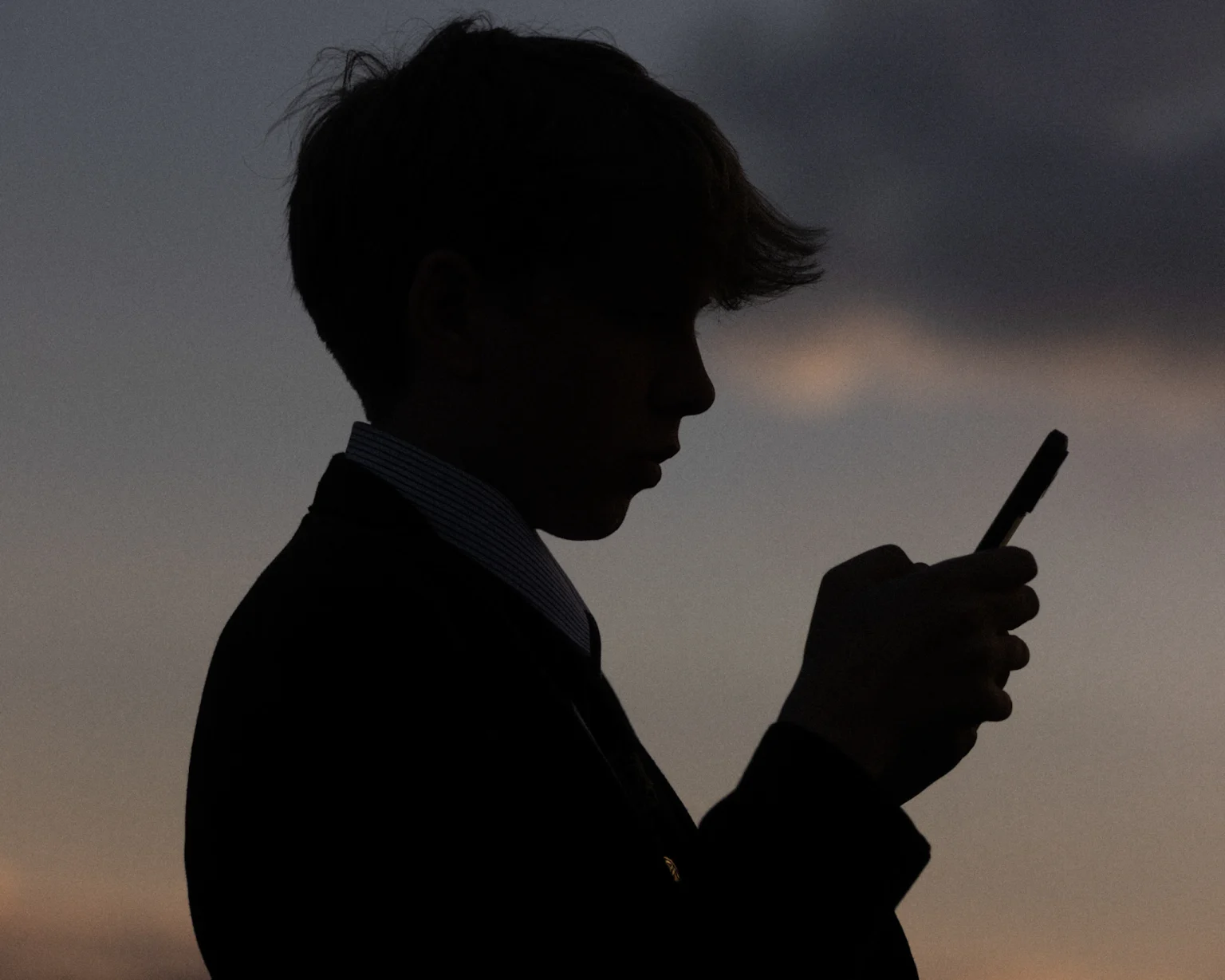
Screens capture children\'s attention early, often before they have developed the skills to put them down. Photo: Anna Barclay/Getty Images
|
Long before children can read or speak in full sentences, many are already handed a tablet to stop them from crying. What looks like a harmless shortcut for exhausted parents, according to a growing body of research, may be quietly shaping how a child's brain develops, from motor skills to speech to the ability to sit still without stimulation. The consequences do not end in childhood: the same pull toward constant stimulation follows people into adulthood, reshaping attention, sleep and relationships along the way.
Magdalena Petrjanosova, a social psychologist and independent researcher at the Institute for Social Communication Research of the Slovak Academy of Sciences, studies exactly this territory. Her research looks at digital and social media use, online behavior, digital well-being and civic participation, with a particular focus on how young people navigate the internet, what benefits it brings them and what risks they must learn to manage. In this interview, she talks through what screens do to a developing brain, why adults are rarely better at resisting their phones, and what would actually need to change at home, and beyond it, to loosen technology's grip on daily life.
Are we living in a digital environment for which our brains are simply not prepared?
If by digital environment we mean interacting through screens and spending long hours on social media, then, from a psychological perspective, I would say this is not good for most people. It affects adults in one way, and children, whose brains are still developing and in whom the effects are clearest, in quite another. Young adults are affected differently again, since they alone must divide their time between their phones and everything else in their lives.
We often talk mainly about children. But should we not start with the adults, who set boundaries for them and, at the same time, serve as their role models?
We should, but that is far harder. With a few exceptions, I believe the entire population is addicted to social media, or to the internet more broadly. It reminds me of the 1980s and 1990s, when smoking was rampant everywhere, at home, at work and in public spaces, in a way that is hard to imagine today. Smoking was simply normal.
I recently read an analysis showing that the harms of both active and passive smoking were already known at the time, yet it took decades for tobacco restrictions to be written into law. I think we are seeing something similar with digital technology today. Adults all use it, and it is everywhere, accessible around the clock through a smartphone. Children no longer ask whether they will get a smartphone, but when.
Guidelines recommend that children spend virtually no time in front of a screen before the age of three. What does a screen actually do to such a young child?
Much the same as it does to adults. Children stare at the screen as if hypnotized, because something there is moving, colorful and making noise. It captures their attention completely. Frustrated parents sometimes give a child a tablet while still in the stroller, simply to stop the crying, or let them watch a cartoon on the tablet while being fed. It works, but at a high cost. Research has already shown that in such children, the areas of the brain responsible for movement, for gross and fine motor skills and for speech develop poorly, precisely because these skills go unpracticed while a child is watching videos on a tablet.
It is also a question of content. I have noticed that cartoons today move at a much faster pace than they used to. Even as an adult, I find them overstimulating and cannot sit through one from start to finish. Can cartoons like these, with so little dialogue, really do anything to help develop a child's mind?
I remember from my own childhood a time when there was just the one television with two channels, and that was all there was. If we did not like what was on, we went outside to play instead. Today we have an endless supply of children's programming, which children devour, but the quality is often very poor.
The second problem is the pace, both of the editing and of the story itself. At preschool level, compare Winnie the Pooh with Paw Patrol, for example. Studies have shown that adults who watch a car chase at the cinema drive faster on the way home afterward. Our nervous system reacts to what is happening around us and does not distinguish between what is on the screen and what is real. Constantly changing images and a fast pace put the nervous system on alert and can trigger a stress response rather than allow a child, or an adult, to relax.
Magdalena Petrjanosova, a social psychologist and independent researcher at the Institute for Social Communication Research of the Slovak Academy of Sciences. Photo: Patricia Falbova/Statement
Short-form videos on social media work on the same principle. So why can we still spend tens of minutes watching them?
People assume that after a while on Instagram or Facebook they will feel better and more relaxed, but the opposite happens. Once the scrolling stops, a dopamine crash sets in, and we end up feeling worse than before. The most harmful format is the short, few-second video, the reel. The brain keeps registering something new, often funny or seemingly interesting, and each time releases a small hit of dopamine. That is why it is so hard to stop.
But there is a catch. Pleasant as the feeling is, these small, frequent doses desensitize us, so that over time we need more to feel the same effect. It is rather like someone who rarely drinks alcohol feeling cheerful after a deciliter of wine, while someone who drinks regularly needs far more to feel anything at all. We see the same principle in every addiction, where the dose has to be increased gradually to achieve the desired effect. If we do not get that dose, unpleasant feelings follow, irritability among them.
What effect does constantly comparing ourselves with people on social media have on our mental health?
That is another layer of the problem. Online, we tend to share only the good things, because we want positive feedback. This means that when we look at what other people post, we are comparing our own lives with an unrealistic picture of theirs, and naturally we come off worse. The more we do this, the worse it is for our mental health. You cannot measure yourself against AI-enhanced holiday photos, or against happy mothers with beautiful children, because nobody posts the two sleepless nights that came before, courtesy of a crying baby. Fortunately, as part of the wider societal conversation about mental health, people have recently started sharing their failures too, and this is meeting with a positive response. Perhaps that unrealistic picture will gradually become a little more realistic.
Social media was supposed to bring us closer together. Could it, paradoxically, be making us lonelier instead?
We spend a large part of our lives interacting through screens, both at work and in our personal lives. On the one hand, online platforms let us stay in touch with people far away, which is wonderful, but talking face to face is something else entirely.
The biggest problem is that people often maintain superficial relationships through screens instead of communicating with those closest to them, their children, their families. We are losing that deeper connection. Someone can have hundreds of friends on Facebook or followers on Instagram and still have no one to talk to in person. Ideally, we would have to give up social media altogether, but that is easier for generations who remember life without it. Younger generations find it much harder.
What skills might we be losing as more and more of our communication moves into the digital world?
All the ones we no longer practice. Many young people, for example, no longer know how to make a phone call, because they text everyone instead. When they do have to deal with something over the phone, they feel embarrassed and do not know what to say in the moment or how to respond, because with text messages we have time to think before we reply. If we stop communicating with people face to face, we gradually lose our social skills.
The same will happen with artificial intelligence. If we let chatbots write our papers for us, or even just our tedious emails, we will gradually lose the ability to write ourselves. This widespread adoption of artificial intelligence looks to me like the start of a major shift, and, as a social psychologist, I view it in a rather dystopian light.
That is a pretty strong word. What do you mean by "dystopia"?
I love science fiction, and whenever machines, computers or artificial intelligence take too central a role in these stories, things end badly. That said, I do not think there is any single thing we should fear. I am more concerned about the sheer scale of the change unfolding before our eyes, and especially about how fast it is accelerating.
I feel there is too little public debate about whether we even want this kind of development, what it will bring us and what risks it carries. The Pope has recently spoken out critically about artificial intelligence, futurists and philosophers occasionally sound warnings, and people who have left major tech companies have repeatedly drawn attention to the risks as well.
In everyday life, though, efficiency and profit appear to be the deciding factors. New chatbot models emerge constantly, alongside increasingly realistic fake videos and combat drones controlled by artificial intelligence. In this race, the focus is on who can move faster and succeed first, and almost no one is asking about ethical guidelines. Everything is moving so quickly that legislative attempts at regulation are hopelessly behind.
But is the internet not also an extremely useful tool? Where does meaningful use end and problematic behavior begin?
Of course the internet is very useful. But in an age of social media, endless memes and online TV shows, it is very hard to devote your time and attention to those useful possibilities. In my research, many young adults talked about meaningful internet use. The internet lets you take excellent online courses and gain knowledge you would not otherwise have access to, for example, and many of these courses, offered by universities around the world, are even free. It is rather like studying from home, except that at the end you get no degree, only knowledge.
It depends on what you are actually doing online. Reading serious journalism is qualitatively different from playing violent video games. Even spending all day with reputable news outlets is not ideal, though, because many of them have joined in the scramble to seize and hold your attention by almost any means. News used to be broadcast only in the evening, for example, whereas now there is an entire system of minute-by-minute updates and notifications, formats designed to keep you on the website for as long as possible. It is not only social media but even serious news outlets that are competing for our attention, and I find that problematic.
So is it even possible to say how much screen time is too much for an adult?
It is hard to say. In my own case, fortunately, my eyes eventually start to hurt, so my body tells me when enough is enough, even when I am writing an academic paper. The trouble is that many people make their living at a computer. People who work from home, in particular, are often not just in front of a screen for eight hours a day but for 12, because personal matters get mixed in throughout the day. The line between work and leisure, between working hours and personal time, has blurred, leaving people mentally and physically drained. Very few professions today involve no screen time at all.
It is also very hard to stick strictly to an eight-hour working day, because there is a widespread assumption, and often direct social pressure, that everyone should be reachable at all times and respond immediately.
In your research, you spoke with young people between the ages of 18 and 24. What surprised you most about their digital habits?
That research had one major limitation: I was not able to reach a sufficiently diverse group of participants, in that I lacked young working adults. My interviews were mostly with students, although many of them also worked alongside their studies. What surprised me was that some had as many as 12 communication platforms, all sending them constant notifications. This put considerable pressure on their mental health, because they had to manage their studies, and in some cases a job as well, while accustomed to being online constantly, replying immediately and checking anything new the moment it appeared. Some described this as simply normal for their generation, while others had realized that being permanently online was harming them and were looking for solutions.
Why does anyone need 12 communication platforms anyway?
Because each one serves a different group of people. In their eyes, Facebook is for older people, but their grandmother or mother is on it, so they need Messenger too. That is already two apps on the phone. They use LinkedIn for work, belong to various WhatsApp groups, use Signal for more private conversations and keep their main profile and most of their activity on Instagram.
For peace of mind, though, the worst thing is having information and requests flood in from several channels at once. If we do not want the digital world to overwhelm us completely, we need to set clear boundaries. We could start by cutting down the number of communication channels, turning off notifications and giving up reels. These are small steps, but effective ones.
But is it not somewhat unfair to place all the responsibility on the user, when the platforms themselves are designed to keep us on them for as long as possible?
That is exactly what bothers me. The entire burden falls on the individual. With digital technology, though, somebody has removed the metaphorical door we could once slam shut. There are now calls for tech companies to bring back these "pause buttons", moments that make it easy to stop. Some platforms already alert users after an hour of video and offer them the option to stop, and others set limits on sleep time or on work and study time. Mostly, though, this applies only to accounts registered to minors, or is available to parents through parental controls.
So what responsibility do you think companies like Meta bear?
None. Tech companies, in my view, will not change anything of their own accord, because they profit handsomely from making users more prone to addiction and from promoting polarizing content. Holding them to account at state level therefore strikes me as close to laughable. There is currently an out-of-court settlement involving Meta, which was sued by 29 US states in total. That already represents a certain amount of leverage, and the EU could probably bring similar pressure to bear. Meta is to pay $18bn and, more importantly, must introduce several restrictions on minors' accounts, aimed at curbing endless scrolling day and night.
The fundamental objection to this settlement is that age restrictions can be got around, and the underlying way social media operates, harmful to both individuals and society alike, will remain unchanged. Adults cannot be banned from using social media, since that would infringe on their fundamental rights and freedoms.
Does it make sense to ban cell phones in schools or to impose age restrictions on social media?
It will not solve the underlying problem, but I think both measures matter. If restrictions do not work well, we can talk about how to improve them. That is still better than doing nothing. At the same time, we need to be mindful, at the individual level, of the kind of world we are modeling for our children. If a parent is on their phone all day, it will be difficult to enforce any limits on the children.
It is worth raising these issues, at a parent-teacher association meeting, for example, and speaking up about wanting to protect your child. But that is hard to do if other parents are not setting any rules for their own children. It often turns out, though, that other parents feel exactly the same way, and if even half of them join forces, they can bring about change locally.
At the same time, we need to give children an alternative. Simply taking away their phones is not enough. We have to create, or provide, other activities for them, and above all teach them to manage their own emotions without a digital crutch. If a child was handed a tablet every time they cried or grew bored, how are they supposed to learn to regulate their own nervous system? They will hardly manage that on their own as adults. We no longer let children cry it out or wait patiently for anything. Instead, we soothe them with sweets and screens.
In other countries, a growing number of parents are filing lawsuits claiming that these platforms have harmed their children's mental health. Can such lawsuits force tech companies to change how they operate?
In my opinion, no. The current lawsuits against Meta may look promising, but tech companies have promised changes before. Facebook and Instagram, for example, were officially closed to children under 13, yet this restriction proved extremely easy to get around. My own research found that young people were using these platforms long before that age.
It is also difficult to prove that a child's mental health problems stem specifically from social media use. In legal disputes, it is therefore often easier to establish something like the unauthorized collection of minors' personal data instead.
It has long been said that we pay for free internet services with our data. Companies collect this data and use it further. Adults usually consent to this voluntarily, or simply cannot be bothered to go through the privacy settings in detail and just click "I agree".
If tech companies are not going to fundamentally change their products, and governments have limited options, what can an individual actually do?
We will see. Perhaps we really are on the verge of change, just as we eventually were with tobacco. For now, on an individual level, you can try a digital detox, which people say helps. Most people do feel noticeably better after cutting back on screen time or on specific platforms, but they often slide back into excessive use soon afterward, for several reasons. What are you supposed to do if all your friends communicate through social media? How do you manage without a smartphone if train tickets can only be bought through an app? It usually takes the app failing for even a moment before we stop to wonder whether it was too hasty to do away with ticket windows staffed by real people at so many stations.
One simple, quick step is to track the time we spend online. Seeing the figures can help us realize that this may not be how we want to spend our lives. Every smartphone will show you how much time you spent on it that day and on what, and there are also dedicated apps that can help you manage your time online and rein in your usage.
Another good trick is to switch your screen to black and white, which really does put you off scrolling. Turn off notifications too, since they keep distracting you long after you have already checked who was messaging you. Stop using platforms like TikTok, which are built entirely around short videos. It helps not to have everything on your home screen, moving apps to the last screen or into folders, for example, or removing some apps from your phone altogether so that you can only view them on a computer, rather than opening them automatically whenever you have a spare minute. This creates exactly the kind of pause described above, the moment to stop and consciously decide whether you really want to spend, say, another hour on Instagram rather than the 10 minutes you originally planned. Tech companies could build in such "time-out" features themselves, but they deliberately do not.
Abroad, there is also talk of a return to button-operated "dumb phones". Have you noticed this trend in Slovakia as well?
I first heard about it roughly 10 years ago, when it was being discussed by students at Harvard, in the US, who had realized they could not spend all day on their smartphones if they wanted to perform well at a prestigious university that many others had failed to get into, or could not afford. With a dumb phone, they no longer had to resist the temptation, because they had eliminated it from the outset. Of the roughly 30 respondents in my own study, only one told me he deliberately uses a dumb phone. I am not aware of this being a major trend here. People are far more likely to try a digital detox.
With children, the situation is even more complicated, because parents are also competing with peer pressure. How long do you think it makes sense to delay getting a child their first smartphone?
Based on everything I have read, we put off getting our own child a phone for a long time, but all the other children already had one, which made things difficult to negotiate. It is further complicated by the fact that many parents in our circle set no limits at all for their children, neither on time nor on content, so the children end up comparing themselves with one another. I say explicitly, at home, that the best parents are not the ones who allow everything, but the ones who take responsibility and manage screen time while the child is not yet ready to do so themselves.
It is very complicated. You can give your child a different kind of screen, one without mobile data, and assume they will simply listen to the audiobooks you have downloaded for them. But on the very first day of school, another child will show them how Wi-Fi works, and suddenly they have access to places you did not think they were ready to explore alone. These days children routinely know how to disable parental controls, or spot the Wi-Fi password you thought you had hidden. Setting rules is not enough. You also have to explain why they exist.
So how should parents manage technology use at home without it turning into a never-ending battle over restrictions?
You have to lead by example. It matters that you do not go to bed with your phone, or wake up with it. Your phone should never be more important than your partner or your children. In some families, everyone uses their phones, and the internet, only in one designated room, and stays away from screens everywhere else. A child sitting beside you in the living room is unlikely to watch pornography, even if classmates showed it to them at school and they are curious enough to want to keep watching. Nor are you likely to lose yourself in a work call at 8 p.m. At the same time, we do not cut ourselves off from social contact altogether.
It matters, for instance, that we do everything we can to stop a teenager staying shut in their room all day, alone with a phone or computer, even at night. In that situation, you have no idea at all how they are spending their time, or with whom. They could become addicted, whether to social media, video games or online gambling, or they could become radicalized.
At the same time, it matters that you have the kind of relationship with your children where they trust you and come to you with a problem, if someone is bullying them online, say, or they have seen something upsetting or inappropriate for their age. You can, after all, only partly control what they see on their own device, and you have no control at all over what they see on a friend's phone. Studies on the percentage of children under 10 who have already seen pornography reveal shocking figures, and these children often had no one to talk to about it.
We live in an era where investment is primarily focused on digitization and faster internet connections. Should we, as a society, also focus on establishing the right to stay offline?
Definitely, yes, but it is difficult. Many companies issue employees with work phones and laptops and then expect them to be reachable 24 hours a day, including weekends and vacations. That is about the worst thing for mental health, because you are constantly wondering whether your boss might call after all, and you can never fully switch off.
Emails sent on Friday afternoon with a note saying not to read them until Monday have exactly the same effect. If notifications are turned on, you already know they are there. It is genuinely difficult to take personal responsibility and leave them until Monday, when everything around us not only allows constant availability but expects it. That is why, in my view, it is not enough to simply tell people to have more willpower. We also need an environment that actually makes it possible for them to disconnect.
Welcome to the comments section of the Štandard daily. Please take note of our guidelines, comments are moderated by us. You can contact the moderators at support@statement.com.
Participate in the discussion
Comments are available to subscribers only. If you'd like to join the discussion, choose a subscription starting at €6.72 per month.
All comments 0
Register
Comments are available to registered users only. If you'd like to join the discussion, register here.