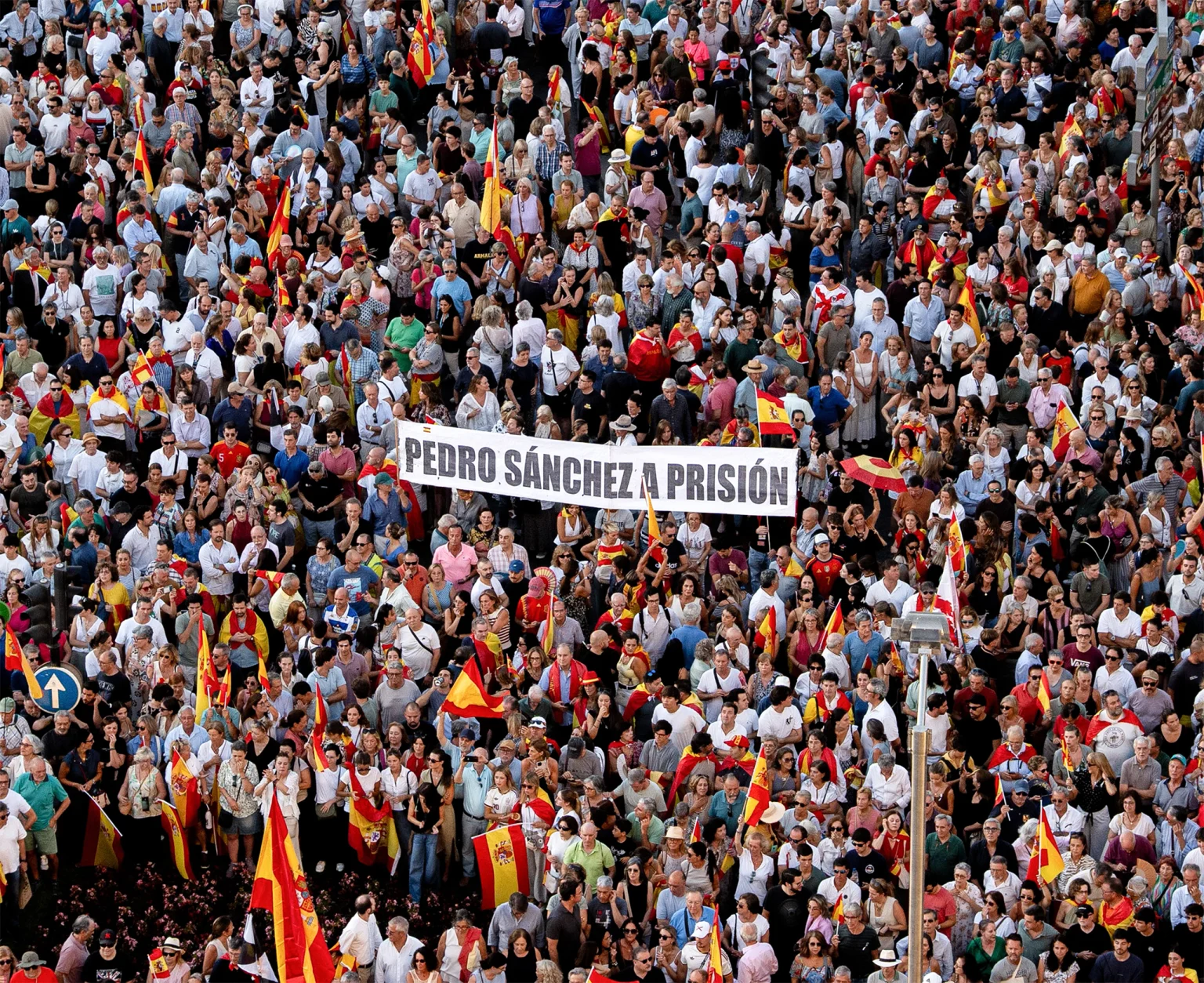
Among those taking part in Madrid were Partido Popular leader Alberto Núñez Feijóo, Vox leader Santiago Abascal, Community of Madrid President Isabel Díaz Ayuso and Madrid Mayor José Luis Martínez-Almeida.
With debate growing over the possible return of the enclaves of Ceuta and Melilla to Morocco, a manifesto read out at the rally explicitly affirmed that Ceuta belongs to Spain and stressed the country’s territorial integrity. The organizers, the Spanish Federation of Municipalities and Provinces (FEMP), said 260 municipalities across Spain had taken part in the rallies.
Who Was Behind the Crossing?
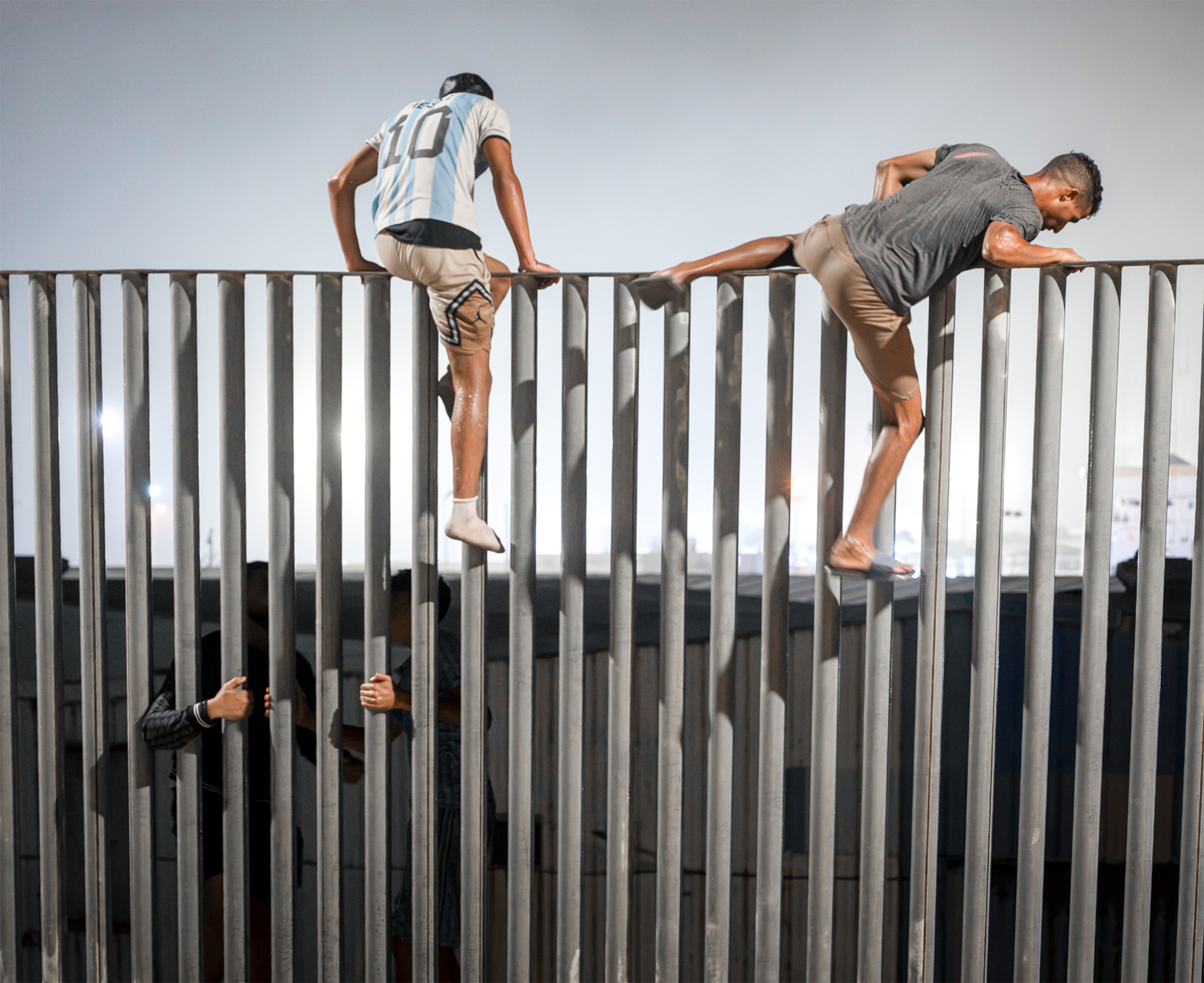
More than four weeks after the invasion of Ceuta by an estimated 80,000 illegal migrants, the protests are channeling broader public anger in Spain over the handling of the situation on the ground. They also come amid a heated debate over a leaked report by the police’s National Center for Immigration and Borders (CENIF), published by El Español, which suggests the involvement of Moroccan gendarmes.
According to the report, the gendarmes led thousands of migrants toward the border of the small Spanish city in North Africa. The document is also said to contain numerous images showing people in civilian clothing directing flows of migrants.
The report is particularly explosive because its very existence has since been denied by Spain’s director general of police, Francisco Pardo, who told Interior Minister Fernando Grande-Marlaska that no such document exists. Its contents also directly contradict the account given by Spanish Prime Minister Pedro Sánchez.
Sánchez had recently alleged that Israel, Russia and far-right circles had provoked the mass border crossing by deliberately spreading false information online – claims for which he was unable to provide factual evidence. Russia and Israel were interfering in the affair only because Spain had accused Israel of “genocide” in the Gaza Strip and condemned Russia’s war of aggression against Ukraine, Sánchez said.
Israel reacted with outrage. Sánchez’s statements were “a brazen lie”, Israeli Foreign Minister Gideon Sa’ar said.
The socialist prime minister also used the occasion to criticize an “international far-right movement” that “always uses” migration “to attack and divide not only Spain, but Europe as well”.
Sánchez himself cannot explain how almost 80,000 people were able to cross the border spontaneously and apparently unnoticed by Spanish authorities. At the same time, he now even shields the Moroccan government from any suggestion that it knew about or was complicit in what happened, while continuing undeterred to send messages urging his fellow citizens in the enclave to hold firm.
To mark Ceuta Day, Sánchez praised the people of Ceuta via X for the “calm, solidarity and responsibility” they had shown over recent weeks. His government, he said, was deploying every available resource so that the city could regain “full normality” as quickly as possible.
Inside a City Under Strain
Those words must sound like mockery to the residents of Ceuta, given how completely everyday life in the city has spun out of control. In view of the reality on the ground, there is little sign of either full normality or calm. Worse still, an entirely new normal is taking shape in the city and threatens to harden into an intolerable permanent state.
While the Spanish government is busy looking around the world for someone to blame for the mass illegal border crossing, journalists on the ground depict an occupied city sinking into filth, overwhelmed services and mounting aggression.
An estimated 10,000 illegal migrants have remained in Ceuta. The city has become unsafe for its roughly 80,000 local residents. Since the migration influx, the authorities have recorded 23 sexual offenses, an eightfold increase.
Children can no longer play alone in the streets or go to school by themselves. Women can no longer safely go out alone. There have been repeated protests by local residents over recent weeks. Some residents are preparing to defend themselves and have even set migrant encampments on fire.
Tensions are also running high among migrants living on the streets and seeking access to the far too few accommodation facilities now being set up at breakneck speed. Police have already fired warning shots when migrants attempted to storm one of the camps. Ceuta’s beaches are occupied, while reports of rising violence continue unabated.
The demand directed at the government in Madrid is clear: every remaining illegal migrant must be deported, without exception. Sánchez is accused of doing nothing to bring the situation to an end.
On the mainland, meanwhile, officials point to the legal reality that blanket deportation is simply not possible and that the migrants are entitled to individual procedures.
“Well, now they are here!” – the remark associated with former German Chancellor Angela Merkel in the face of millions of migrants in her own country – fits the Spanish government’s response just as neatly.
Madrid, too, appears already to have resigned itself to the fact that it will not get rid of the remaining migrants and now needs to find ways to accommodate their continued presence.
From Emergency to Administration
Ceuta itself has no solution to the problem. Instead, what began as a one-off assault is turning into a problem that is here to stay.
Aid organizations are setting up tents, and infrastructure is being put in place to provide for the migrants. The growing presence of international aid groups in the city is therefore seen not as part of the solution but as part of the problem. It inevitably leads to one conclusion: this situation will not be over for a long time.
The question remains: where, then, are these estimated 10,000 people, most of them men, supposed to go? Since they are evidently not being returned to Morocco – on what legal basis could they be? – the authorities are now beginning to register and process them officially.
The massive protests now taking place on the Spanish mainland over the handling of the situation are also being fueled by justified fears, particularly among people in southern Spain.
There is a growing likelihood that, not least to relieve pressure on Ceuta, more and more of these illegal migrants will reach mainland Spain not only by boat but also through fully organized, official transfers, in an effort to calm the protests in Ceuta itself.
That would bring about precisely what European critics of migration have repeatedly warned against: crossing the EU border illegally pays off. The longer someone manages to stay, the greater the likelihood of eventually securing permanent residence.
The consensus among European interior ministers, proclaimed only days after the mass border crossing in Ceuta – that Spain had handled the situation wonderfully and that most of the migrants had returned voluntarily – is once again revealing itself as the farce it always was.
Sánchez’s refusal even to discuss Moroccan complicity or support amounts to blanket absolution, if not a blank check.
Those paying the price are not only the residents of Ceuta and mainland Spain, but Europeans as a whole. Spain’s current policy massively encourages illegal immigration and the unconditional regularization of illegal stays, as has happened in recent months, thereby opening access to other European countries within the Schengen area.
Italian Prime Minister Giorgia Meloni is proving entirely right in both her criticism from the outset and her decision to introduce border controls for people entering Italy from Spain.
The only remarkable thing about the Ceuta affair so far is that no left-wing German politician has yet loudly demanded that refugees from Ceuta be flown to Germany out of sheer charity.
But that, too, is surely only a matter of time.