Merz Calls on Germans to Take Inspiration from China and Work More
Singapore’s founding Prime Minister Lee Kuan Yew warned decades ago that Germany’s comfortable postwar model could not last. But China’s experience suggests longer hours are not the whole answer.
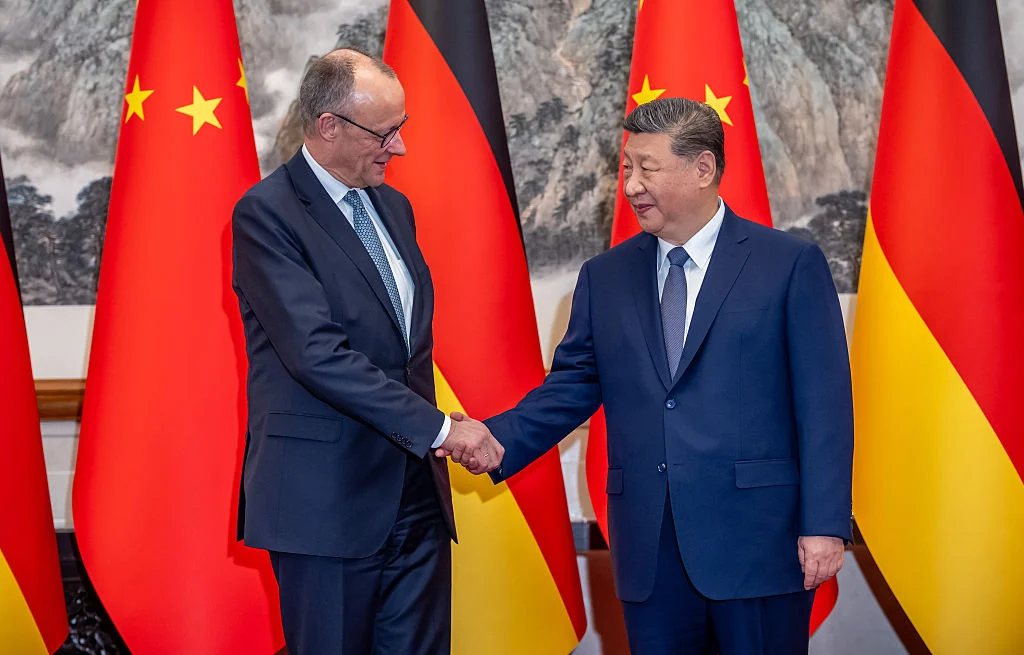
German Chancellor Friedrich Merz meets Chinese President Xi Jinping in Beijing on 25 February 2026 during the visit that would later inspire Merz to argue that Germans must work harder to compete with China. Photo: Michael Kappeler/Pool/Getty Images
|
For days, a clip of Friedrich Merz arguing that Germany needs to emulate China to restore its economic prosperity has been circulating online. In it, he says: “We are simply no longer productive enough. Everyone may say, ‘I am already doing a lot.’ That may be true. But when you return from China, ladies and gentlemen, you will see things more clearly. With work-life balance and a four-day workweek, we cannot sustain long-term prosperity in our country. We simply have to work harder.”
On the surface, there is something to agree with. According to the OECD, Germany already had one of the highest rates of sick leave among advanced economies before the pandemic. German employees were absent through illness for an average of 14.8 working days in 2024. Meanwhile, OECD data shows that Germans worked 1,335 hours per worker in 2023, compared with 1,496 hours in the UK and 1,805 hours in the US.
Merz is therefore right to ask whether Germans need to work more. But he is conflating working hours with productivity, and the two are not the same thing.
Productivity measures how much output workers produce in a given amount of time, rather than simply how many hours they spend at work. Working longer can increase total output, but it does not necessarily make each hour of work more productive.
In fact, Germans remain considerably more productive per hour than the Chinese. According to Penn World Table data compiled by Our World in Data, Germany produced $78.20 of economic output per hour worked in 2023, adjusted for purchasing power and inflation, compared with $12.20 in China.
On this measure, an hour worked in Germany produced more than six times as much economic output as an hour worked in China. Labor productivity does not simply measure how hard an individual works. It also reflects factors such as technology, machinery, capital investment, infrastructure and the structure of an economy.
There is nevertheless a striking difference in working hours between Germany and China. According to Germany's Federal Statistical Office, German employees worked an average of 34 hours per week in 2025, while full-time employees worked 39.9 hours. In China, employees of enterprises worked an average of 48.6 hours per week in 2025, according to the country’s National Bureau of Statistics. The measures are not perfectly comparable, but the difference is substantial.
Yet Merz leaves out the other side of the equation: how heavily Germany taxes work. In 2026, the 42% income-tax rate begins at just €69,879 ($81,500) in taxable annual income. Germany’s progressive tax system also produces what Germans call “kalte Progression”, or “cold progression”: when wages rise merely to compensate for inflation, workers can face a higher effective tax burden and see no increase in their purchasing power.
The burden becomes even clearer once social contributions are included. In 2025, the tax wedge for a single German without children earning the average wage reached 49.3% of total labor costs, the second highest among the OECD’s 38 member countries and far above its 35.1% average.
China also has a progressive income-tax system, but its rates start at 3%, rising through 10%, 20%, 25%, 30% and 35% before reaching a maximum 45% rate on taxable income above 960,000 yuan ($142,000). These figures are not directly comparable with Germany’s tax wedge, since Chinese workers and employers also pay social contributions.
That makes Merz’s message rather peculiar. Germans may indeed work fewer hours than the Chinese, but they still produce considerably more economic output per hour. At the same time, Germany has constructed one of the developed world’s heaviest tax and social-contribution burdens on labor. Then its chancellor wonders why people are reluctant to work more.
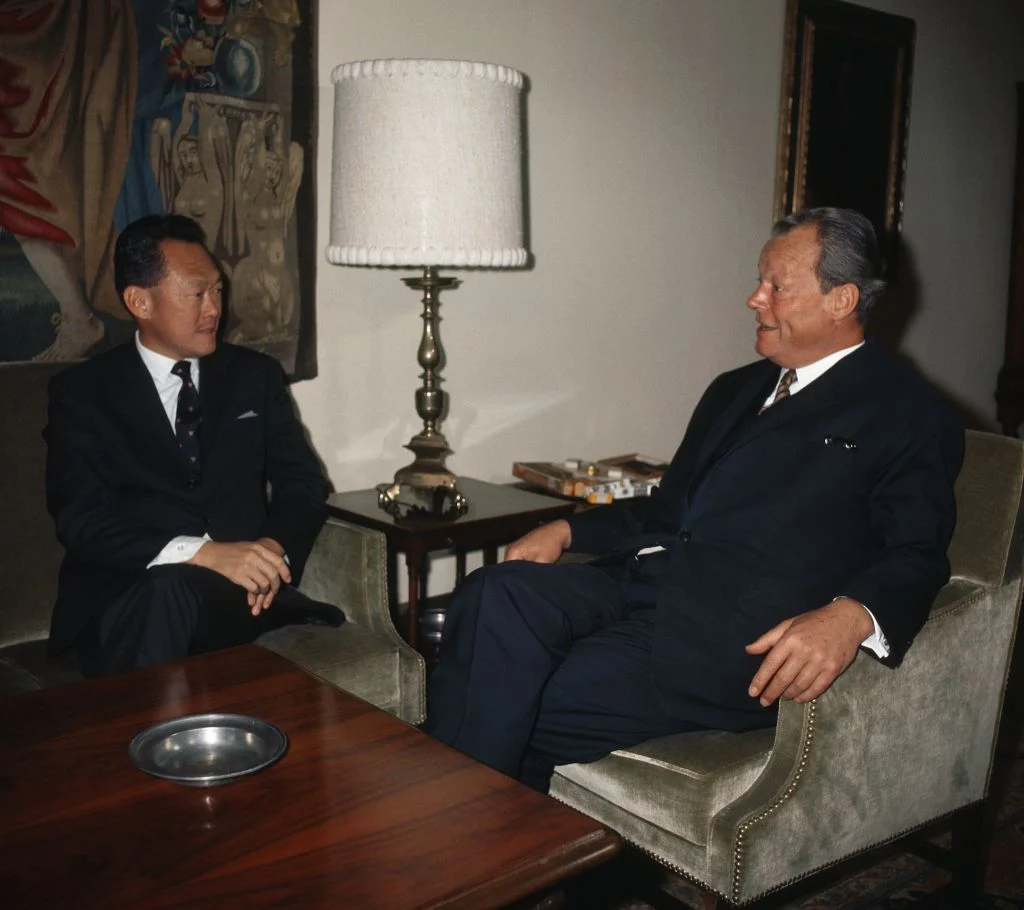
Singaporean Prime Minister Lee Kuan Yew meets German Chancellor Willy Brandt in Bonn in October 1970. Photo: Alfred Hennig/picture alliance via Getty Images
Lee Kuan Yew Saw It Coming
Merz is hardly the first person to warn Germans that their comfortable postwar settlement could not survive competition from Asia. Twenty-one years ago, Singapore’s founding Prime Minister Lee Kuan Yew predicted what was coming. Asked by Der Spiegel in 2005 whether globalization threatened Western European society, Lee said that Europeans faced “ten bitter years” and would eventually have to accept that “the cosy European world which they created after the war has come to an end”.
He specifically singled out Germany. Its old social contract, Lee argued, had been based on Germans working hard to restore the country’s prosperity in exchange for an expansive welfare state. That arrangement was transformed when billions of workers in China, India, Eastern Europe and the former Soviet Union entered the global economy. His prescription was uncomfortable: Germans would have to work harder, invest more in research and development and “keep ahead of the Chinese and the Indians”.
Two decades later, Merz returned from China with much the same message, giving Lee’s warning an almost prophetic quality.
But there is another side to the story. China itself is discovering the limits of how far an economy can push its workers. Chinese enterprise employees worked 48.6 hours a week on average in 2025, despite Chinese law formally providing for a much shorter standard working week. The notorious 996, which involves working from 9 a.m. to 9 p.m. six days a week, is an extreme working culture that has generated considerable resistance among Chinese workers.
That has led to a cultural backlash. The phenomenon known as tang ping, or lying flat, describes young Chinese withdrawing from the relentless competition for professional and material advancement. Recent research among students at elite Chinese universities describes it as a retreat from the conventional culture of hard work, while studies of Chinese workers have associated excessive working hours with work-family conflict and poorer mental health.
Perhaps, then, the lesson should run in both directions. Germany could learn from China’s industrial ambition, speed, investment and willingness to build. China could learn something from Germany about the value of leisure, worker protections and a life that does not revolve entirely around employment.
The choice between a 34-hour working week and 996 is a false one. A successful economy needs people to work, but it also needs to make additional work worthwhile and to produce more value from every hour worked.
There is a final irony. Germany was once Europe’s undisputed industrial powerhouse. For decades, Germany and the rest of the West benefited from shifting manufacturing and supply chains toward China. Now, as Germany struggles with industrial decline, high energy costs and weak growth, its chancellor is returning from China to tell Germans that they should emulate the work ethic of the country that absorbed so much of that production.
Welcome to the comments section of the Štandard daily. Please take note of our guidelines, comments are moderated by us. You can contact the moderators at support@statement.com.
Participate in the discussion
Comments are available to subscribers only. If you'd like to join the discussion, choose a subscription starting at €6.72 per month.
All comments 0
Register
Comments are available to registered users only. If you'd like to join the discussion, register here.