Germany’s economy is barely growing, while bureaucracy, taxes and social security contributions continue to rise. Thorsten Alsleben, managing director of the Initiative Neue Soziale Marktwirtschaft, explains which policies could turn the economy around.
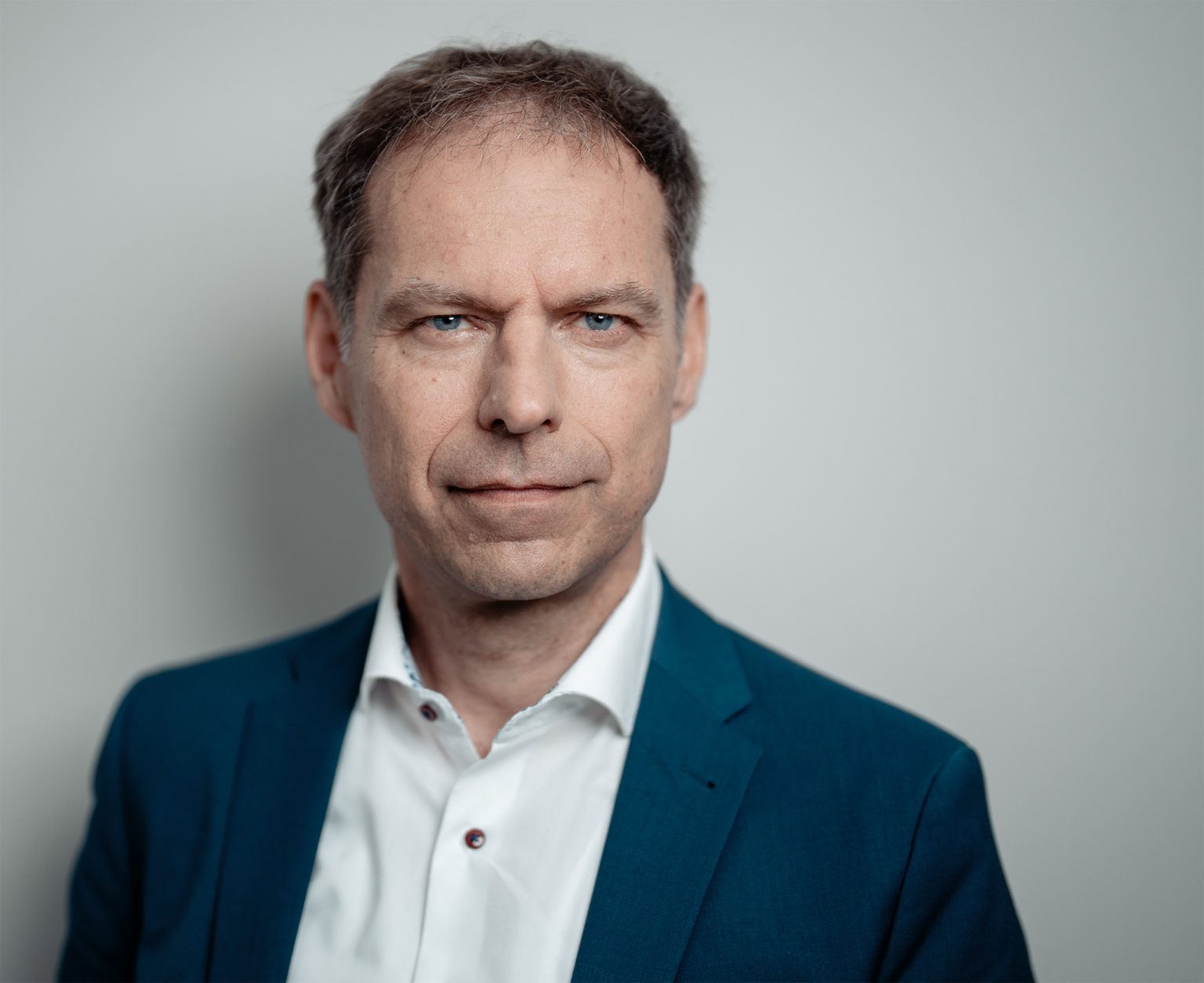
Thorsten Alsleben is the managing director of the Initiative for a New Social Market Economy. In an interview with Statement, he explains which factors could boost the German economy. Photo: Steffen Böttcher/INSM
|
Germany’s economy has all but stalled under the weight of bureaucracy, high energy costs and a heavy tax burden. Private companies are laying off increasing numbers of skilled workers while the public sector continues to expand. Together, these trends illustrate the depth of the country’s economic malaise.
Thorsten Alsleben is a lawyer and trained television and radio journalist. He spent 11 years at ZDF, first in Düsseldorf and then for nearly nine years in Berlin, where he covered economic, social and fiscal policy as a political correspondent. After briefly working on the senior staff of the Federal Ministry of Labor, he became the Berlin representative of Kienbaum, Germany’s oldest management and human resources consultancy.
From 2014 to 2023, Alsleben served as chief executive of the Mittelstands- und Wirtschaftsunion, the business wing of the Christian Democratic Union and Christian Social Union. Since April 2023, he has led the employer-funded think tank Initiative Neue Soziale Marktwirtschaft (INSM). He is married and has three school-age children.
In an interview with Statement, Alsleben sets out how Germany could restore growth. He calls for fewer civil servants, more affordable energy, greater personal responsibility in healthcare and substantial income tax relief.
Mr Alsleben, almost all new jobs are currently being created in the public sector. How can the federal administration be reduced in size without slowing down public services even further?
We need to do two things. First, civil servant status should be reserved for staff performing essential security-related functions, such as police officers and members of the judiciary. Beyond that, the public sector doesn’t need civil servants.
We don’t know how artificial intelligence or a redefinition of the state’s role will affect its responsibilities in 10 or 20 years.
We can achieve greater flexibility only by employing staff rather than appointing civil servants. This can be implemented for new hires, although it will take time.
Second, for every two employees who leave, no more than one should be hired to replace them. The duplication of structures within federal ministries offers considerable potential for savings. Successive office-holders have introduced new pet projects without abolishing those of their predecessors.
What does it mean for the economy when industry, commerce and business are shrinking while the public administration is growing?
The additional public-sector jobs conceal the seriousness of the situation. In industry, value creation and salaries are higher than in many public-sector and publicly funded occupations. Tax revenues and social security contributions are therefore higher as well.
The public administration doesn't create value. It administers. It could help others become more productive. In practice, however, it often makes life more difficult for companies and individuals through additional bureaucracy, regulation and oversight.
Why has the bureaucratic burden been growing for decades, even though every federal government promises to reduce it?
This is also a societal problem. We are a society with an extreme aversion to risk. We always ask what the worst possible risk might be and how we can prevent it in every individual case. But we don’t ask which opportunities we’re sacrificing or how severely we’re restricting freedom.
Whenever an accident happens somewhere, there are immediate calls for a rule that applies to everyone. Fear plays a powerful role in Germany.
This was evident in the debate over nuclear power after Fukushima, as well as in the debate over the TTIP free trade agreement and fears about chlorinated chicken. These aren’t rational debates.
The Green Deal Must Go
Which regulations would you like to abolish?
The German Supply Chain Due Diligence Act, without question. It doesn’t prevent human rights violations in developing countries, but it causes considerable damage to the German economy. The corresponding EU legislation shouldn’t be allowed to enter into force either.
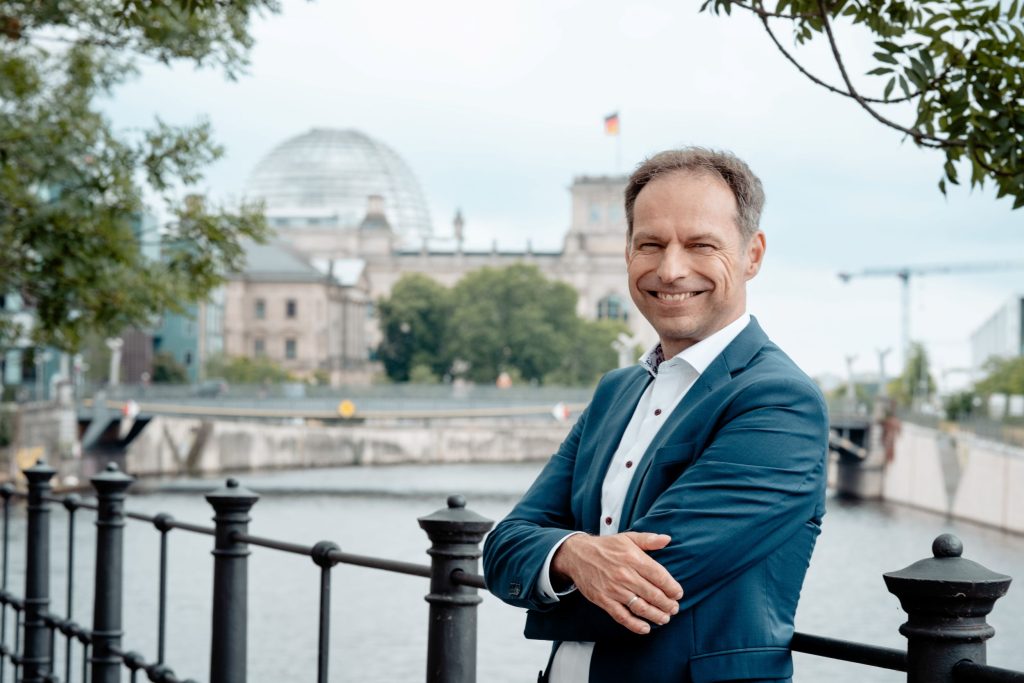
Thorsten Alsleben works in Berlin, at the heart of German politics. He is calling for more energy, less bureaucracy and lower taxes. Photo: Steffen Böttcher/INSM
There are also measures associated with the Green New Deal, including some absurd regulations, as well as the EU taxonomy and its rules governing bank lending. Banks can decide for themselves which loans are sensible and sustainable.
The only ones likely to suffer if these rules were abolished are the consultancy firms that currently make very good money from them.
Which three measures could give the German economy fresh momentum in the short term?
Bureaucracy is the greatest disadvantage of doing business in Germany. Reducing it would cost the state nothing and would have an immediate effect on growth.
Second, we need tax cuts for corporations and partnerships. The planned five-percentage-point reduction in corporate income tax should take effect in full as early as next year. We also need net income tax relief of between €25bn and €30bn.
Third, social security contributions must be brought back toward 40%.
There’s scope to do even more in healthcare. That’s why I’m pleased that Carsten Linnemann has taken over the ministry. He wants to make the system more efficient without compromising care.
What might such a healthcare reform look like?
There are many inefficiencies and duplicate structures within the health insurance system. We could merge dozens more health insurers. However, requiring people to pay a larger share of their healthcare costs would achieve far more.
People who pay part of the cost themselves think more carefully about whether a visit to the doctor is necessary. This could also work within the statutory health insurance system if health insurance contributions were reduced in return. People must ultimately be left with more money than before.
The burdens imposed by the current reform may be understandable, but its sole purpose is to prevent health insurance contributions from rising further. That offers no prospect of improvement. We need contributions to fall.
How could that work?
With my private health insurance, I receive a bill, pay it and am then reimbursed for part of the cost. The reimbursement often arrives before I’ve even made the payment.
Why shouldn’t such a model also work for people covered by statutory health insurance? People already pay their own Amazon and tradesmen’s bills. The same should be possible with medical bills.
At present, doctors bill through the regional associations of statutory health insurance physicians and their budget systems. This, too, involves a large administrative apparatus. With direct billing, patients would at least know how much their treatment costs.
Germany Needs More Energy
Alongside taxes and social security contributions, high energy prices are placing a burden on companies and households. What would a genuine energy transition look like?
The energy transition has failed. Germany is uncompetitive on both household and industrial electricity prices.
At the same time, security of supply is at risk, and we must expect power outages. Nor is Germany a particular model when it comes to carbon dioxide emissions, because we lack low-carbon reserve capacity and power stations capable of providing baseload power.
We must increase the energy supply substantially. Functioning coal-fired power stations must not be shut down. They already pay for their carbon dioxide emissions. At some point, those costs may mean that they’re no longer economically viable.
But as long as they remain viable, they should stay on the market. It makes no sense to close coal-fired power stations and then build gas-fired plants at great expense. As a matter of principle, any form of energy generation that is economically viable should remain on the market.
Does that include a return to nuclear energy?
Yes. Numerous countries are expanding nuclear power, including China, which the Greens often praise for its expansion of renewable energy, as well as many European countries.
The state doesn’t need to build nuclear power stations itself. But it should make such investments legally possible and simplify the approval process. We would then see whether investors come forward. If not, that too would be a market-based outcome.
At the same time, we must stop subsidizing renewable energy. Renewables have already received ample start-up subsidies. They must now prove themselves in the market and also bear the costs of reserve capacity, storage and power lines.
If they remain commercially viable under those conditions, that’s excellent. However, this would mean that Germany won’t meet its national target of climate neutrality by 2045 unless carbon dioxide emissions from coal- and gas-fired power stations are captured and stored.
Artificial intelligence, data centers, green steel and a growing number of air-conditioning systems will increase electricity demand further. Is Germany prepared for this?
Not at all. There’s a clear connection between energy consumption and prosperity. If we artificially restrict the supply of energy, we reduce our prosperity.
Shutting down economically viable power stations in such circumstances is a cardinal sin of energy policy. If we continue with this policy, we will accelerate deindustrialization.
Industry is the last anchor of our prosperity. Combined with artificial intelligence, we could unlock enormous potential for growth. To achieve that, we need to establish data centers in Germany.
Without sufficient affordable energy, Germany will become poorer. There will then be less basic welfare support, less education and less environmental protection. Highly skilled and productive people will leave the country. That's already happening today.
Working Longer
What do economic and demographic developments mean for pensions?
The first pension reform last November was a disaster because it merely increased costs. The second, by contrast, marks a fundamental shift from a pay-as-you-go system toward a funded system.
For the younger generation, accustomed to exchange-traded fund savings plans, this is nothing unusual. After 10 to 15 years, the funded component will have such significant positive effects that we’ll be able to discuss pension levels under the pay-as-you-go system in a different way.
Individuals should decide where their money is invested. The decisive consideration must be the highest possible return combined with security.
Will people have to work longer in future?
The retirement age should be linked to life expectancy. As we live longer, we must generally work longer.
Different retirement ages for different professions would create a new bureaucratic monster. Jobs and the demands they place on people change, so they would have to be reassessed every year.
Nor is the rule allowing people to retire earlier after 45 years of contributions fair. Why should someone who has worked in construction for 43 years and was seriously ill in between be placed at a disadvantage compared with someone who has worked in an office since the age of 16?
Someone whose health has been ruined by physical work should instead receive an adequate disability pension. The criteria must be strict. But those who meet them must receive generous support.
Would longer working lives, weaker protection against dismissal and lower welfare benefits make the social climate harsher?
Not if taxes and social security contributions are reduced at the same time. Employees would then take home more money and have greater freedom.
Market-based reforms are often described as a valley of tears. Perhaps they’re more like a mountain ridge: reaching the other side takes effort, but the view makes it worthwhile.
The promise must be that people will have greater freedom, less bureaucracy, lower taxes and contributions and lower energy prices once again.
The housing market shows what happens when regulation continues to increase. I personally stopped renting out two apartments because of the extensive regulation. Neighbors bought them and used them to enlarge their own apartments.
The rental market has therefore lost two homes. Without such regulation, they would still be available to rent.
At its heart, the market economy works very simply. When supply rises, prices fall. That applies to housing just as it does to energy and other goods.
Thank you for speaking to us.
Placeholder For Topreaded Placeholder For Topreaded
Placeholder
Placeholder
Placeholder For Topreaded Placeholder For Topreaded
Placeholder
Placeholder
Placeholder For Topreaded Placeholder For Topreaded
Placeholder
Placeholder
Placeholder For Topreaded Placeholder For Topreaded
Placeholder
Placeholder
Placeholder For Topreaded Placeholder For Topreaded
Here is placeholder for Article excerpt Here is placeholder for Article excerpt Here is placeholder for Article excerpt Here is placeholder for Article excerpt
Here is placeholder for Article excerpt Here is placeholder for Article excerpt Here is placeholder for Article excerpt Here is placeholder for Article excerpt
Here is placeholder for Article excerpt Here is placeholder for Article excerpt Here is placeholder for Article excerpt Here is placeholder for Article excerpt
Welcome to the comments section of the Štandard daily. Please take note of our guidelines, comments are moderated by us. You can contact the moderators at [email protected].
Participate in the discussion
Comments are available to subscribers only. If you'd like to join the discussion, choose a subscription starting at €6.72 per month.
All comments 0
Register
Comments are available to registered users only. If you'd like to join the discussion, register here.