War Fears Loom Large as Poland Probes Suspected Sabotage
A series of suspicious incidents have Polish authorities looking east. As the country commemorates the outbreak of the Second World War, senior statesmen are asking which lessons have been learned since then.
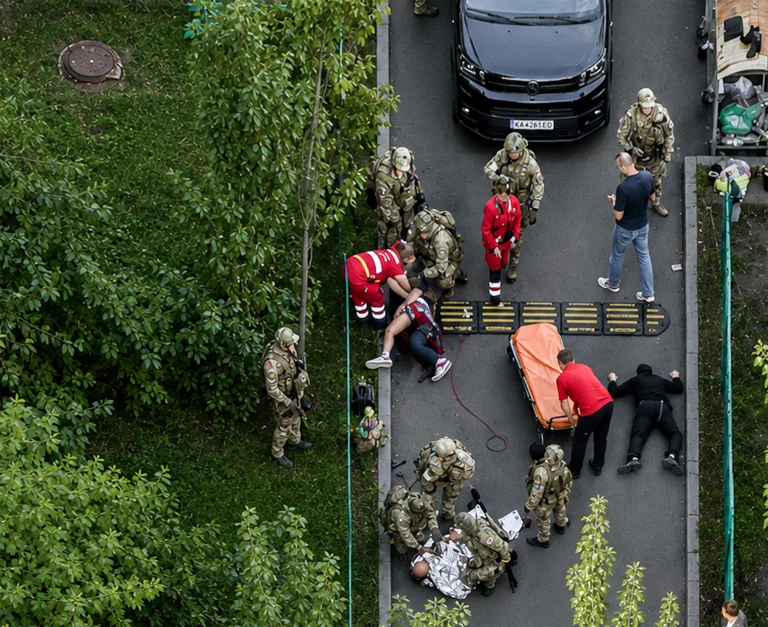
Polish security services investigate the WB Group plant in Skarzysko-Kamienna after a fire at the drone components facility raised suspicions of foreign sabotage. Photo: Adam Kumorowicz/CTK/PAP/PROFIMEDIA
|
Polish prosecutors have launched an investigation into the potential involvement of a foreign intelligence service after a fire broke out at a facility belonging to one of Europe’s largest defense contractors, WB Electronics, in Skarzysko-Kamienna on 31 August.
The fire, which the National Prosecutor’s Office said destroyed warehouse facilities, causing an estimated 15m zloty (about €3.5m/$4m) worth of damage, broke out shortly after midnight. It occurred at a plant used to produce drone components for armed forces, including those of Poland and Ukraine.
A prosecutor from the Krakow office of the Department for Organized Crime and Corruption of the National Prosecutor’s Office opened the case the same day. Authorities are investigating possible foreign intelligence activities against the Republic of Poland and have described the incident as potentially terrorist in nature.
The prosecutor’s office said that the fire was intentional and was started by a charge containing flammable materials. The suspected arsonist remains at large.
The fire came just one day after another large blaze destroyed an aircraft industry facility in the eastern Polish city of Lublin. The state-owned outlet TVP Info reported in the aftermath that “intelligence services from the East” are suspected of being behind the fire that broke out on 30 August.
The apparent increase in suspected sabotage incidents comes as Poland maintains heightened security measures introduced late last year over concerns about hybrid attacks on critical infrastructure. These include the Operation Horizon security initiative and elevated national alarm levels.
Polish Prime Minister Donald Tusk last month extended heightened security measures until 30 November. The second of four alarm levels remains in force nationwide, while the third applies to railway lines managed by the national rail operator.
Operation Horizon initially saw the deployment of 10,000 military personnel across Poland to beef up security at critical infrastructure sites, with the aim of preventing “sabotage attacks”.
The operation was announced last November by Polish Defense Minister Wladyslaw Kosiniak-Kamysz, following damage to a railway line connecting the Polish capital Warsaw to the eastern city of Lublin.
The railway line, which is used by passengers and for the delivery of aid to Ukraine, was allegedly sabotaged by Ukrainians working for Russian intelligence services. The alleged perpetrators fled across the border to Belarus before they could be arrested and are still at large.
Two further aerial incidents have stoked national security fears this week. Kosiniak-Kamysz on Monday issued a statement claiming that Russia was testing Poland’s deterrence and air defense systems.
“Before noon, 30 km north of Leba, our fighter jets intercepted a Russian Il-20 reconnaissance aircraft. There was no violation of our airspace over the Baltic”, he wrote on X.
In a separate incident on Monday, a helicopter severed a power line near the Siarkopol Chemical Plant in Tarnobrzeg. TVN24 reports that the helicopter landed after downing the line but took off again shortly after. Police are currently searching for the pilot, and while the incident has not been identified as sabotage, it has nevertheless fueled speculation.
Poland marked the 87th anniversary of the outbreak of the Second World War on Tuesday, 1 September, an occasion that Tusk used to urge Western countries to take a “firm stance” against Russia.
The Polish prime minister referenced the instances of suspected sabotage from recent days, describing his country as the victim of “numerous provocations”.
“We probably experienced further acts of sabotage, arson and subversion a few dozen hours ago. Such provocations affected Finland, Lithuania, Latvia and Estonia, as well as, on numerous occasions, Poland, Romania, Denmark and, most recently, Germany”, Tusk said, adding that it would soon become clear whether it was the Russian security services who organized what he referred to as the “drone provocation” in Leipzig.
Germany on Tuesday concluded that Russia was responsible for the attempted drone attack at Leipzig/Halle Airport on 4 August. German Interior Minister Alexander Dobrindt said police investigations and intelligence findings showed that those involved had acted on behalf of Russian state agencies.
A drone carrying explosives was found near a Ukrainian cargo plane, with investigators saying that its detonator failed. Ten days later, another drone was found near the airport along with further explosives.
Welcome to the comments section of the Štandard daily. Please take note of our guidelines, comments are moderated by us. You can contact the moderators at support@statement.com.
Participate in the discussion
Comments are available to subscribers only. If you'd like to join the discussion, choose a subscription starting at €6.72 per month.
All comments 0
Register
Comments are available to registered users only. If you'd like to join the discussion, register here.