Yair Netanyahu Strains Israel's Ties with the West
Israel has few dependable allies left in Europe. Yair Netanyahu’s attacks on British and Spanish sovereignty risk driving away some of its staunchest supporters.
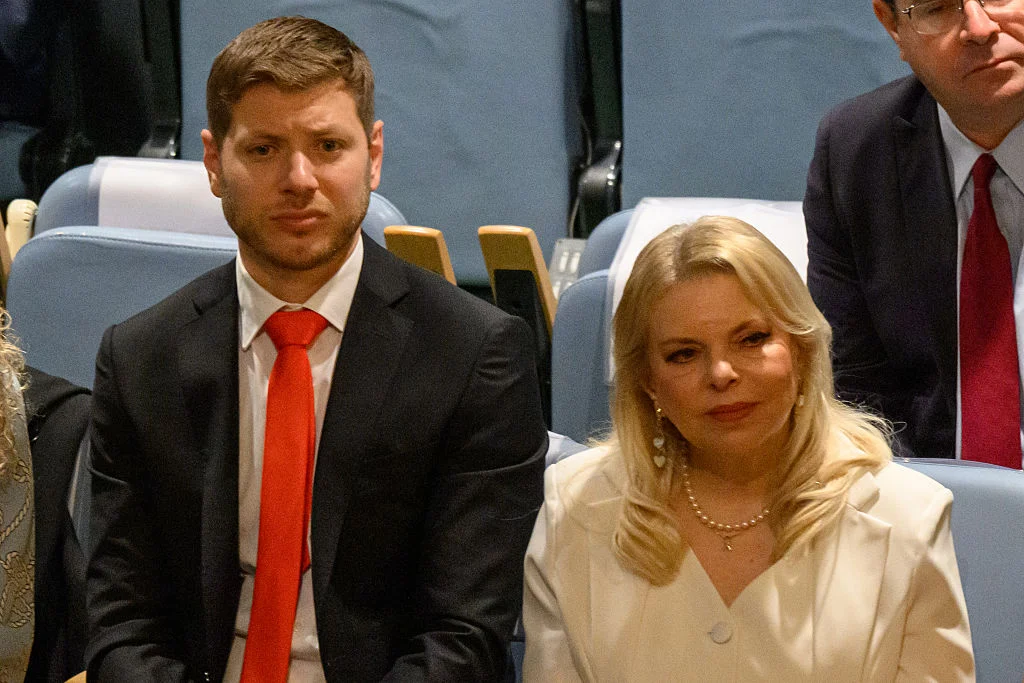
Yair Netanyahu (left) and his mother, Sara Netanyahu, listen as Israeli Prime Minister Benjamin Netanyahu addresses the UN General Assembly in New York on 26 September 2025. His comments on the Falklands and Ceuta have angered some of Israel’s staunchest supporters among Europe’s conservatives and nationalists. Photo: Alexi J. Rosenfeld/Getty Images
|
The response to Yair Netanyahu’s latest intervention has been nothing short of outraged. This time, however, the anger is not coming from the left, but from parts of the nationalist right and conservatives who have traditionally been among Israel’s strongest supporters.
The reason is that Benjamin Netanyahu’s 35-year-old son decided to pick a fight over one of the most sensitive issues in British foreign policy: the Falkland Islands.
On Friday, Yair Netanyahu declared: “The Falkland Islands belong to Argentina." It was not an accidental intervention. He had already expressed the same position in September 2025 and doubled down when British conservatives objected.
His justification was essentially transactional. Argentine President Javier Milei is one of Israel’s strongest international supporters, while Britain’s Labour government has become increasingly critical of Netanyahu’s government. Britain formally recognized Palestine in September 2025, suspended negotiations on a new free trade agreement with Israel and imposed sanctions targeting extremist Israeli settlers and organizations.
Yair Netanyahu therefore asked why Israel should support Britain over Argentina. After the backlash, he reduced diplomacy to a simple rule: support your friends, not those hostile to you.
From a narrowly Israeli nationalist perspective, one can understand the calculation. Milei is a friend. Andy Burnham’s government increasingly is not.
There is only one rather large problem. Israel’s allies in Britain – and Andy Burnham’s opponents – include nationalists too.
The Falklands are particularly badly chosen territory on which to test the patience of the British Right. They have been under British control for over 180 years. Almost the entire population is made up of British citizens.
Argentina invaded the islands in April 1982. Britain sent a task force thousands of miles across the Atlantic to retake them. By the time Argentina surrendered, 255 British servicemen had been killed. The victory became a symbol of Britain's return to prosperity and security after decades of economic drift and territorial diminishment.
Nor is British sovereignty simply imposed on an unwilling population. In a 2013 referendum, Falkland Islanders were asked whether they wanted to remain a British Overseas Territory. Of 1,516 valid votes, 1,513 voted yes and three voted no. That was 99.8%, on a turnout of 92%.
It is not difficult, then, to understand why Netanyahu’s intervention went down so badly.
Restore Britain leader Rupert Lowe responded that Netanyahu had enough problems to concentrate on in Israel and declared that the Falklands “are British, and will remain that way”. He said a Restore Britain government would go to war if necessary to defend them and later asked Israel to clarify its official position on Falkland sovereignty.
British podcast host Konstantin Kisin called Netanyahu’s intervention “a stupid and childish thing to say”, arguing that it alienated Israel’s friends. Commentator Andrew Fox, who is well-known as a supporter of Israel, similarly argued that “burning bridges is a really dipshit thing to do” and pointed out that Yair had failed to serve in the Israeli military since 7 October.
And therein lies the more interesting problem.
Spain Has Already Had This Argument
Britain is not the first European country where Israel’s nationalist allies have discovered the limits of their friendship. Spain had its own version of the dispute only weeks ago during the migration crisis in Ceuta, one of two Spanish cities on the North African coast claimed by Morocco.
As tens of thousands of migrants attempted to enter Ceuta from Morocco, Israel’s ambassador to the United Nations, Danny Danon, attacked Madrid. Spain, he wrote, “never misses an opportunity to lecture Israel”, before asking why it continued to maintain what he called “colonial enclaves in Africa”.
That was explosive territory. Morocco claims both Ceuta and Melilla, while Spain regards them as integral parts of the country. They have been ruled by Spain for centuries. The United Nations does not list either as a non-self-governing territory awaiting decolonization.
The hashtag “Free Ceuta” was subsequently amplified by Israeli and pro-Israel accounts, some of which described Spanish sovereignty as an occupation. Israel’s acting ambassador to Spain, Dana Erlich, eventually distanced the Israeli government from Danon’s remarks, saying they did not represent the position of the State of Israel.
But for Spanish conservatives and nationalists, the damage had been done. Vox is one of Spain’s most consistently pro-Israel parties. Yet defending Spanish sovereignty over Ceuta and Melilla against Moroccan claims is equally central to its nationalism.
Yair Netanyahu himself had already waded into the same dispute. In 2019, he posted a map of Ceuta and Melilla and told Arabs and Muslims looking to “free occupied Arab Islamic lands” that the Spanish territories would be “a good start”. He later proposed a bargain: Israel would stop funding organizations demanding that Spain surrender Ceuta and Melilla if Spain stopped funding organizations demanding that Israel surrender areas of the West Bank, which they call Judea and Samaria.
What may seem like clever retaliation from Israel looks rather different from Madrid. A Spanish nationalist who supports Israel because he believes nations should defend their borders is hardly going to applaud when Israeli figures question Spain’s borders.
Now the same thing has happened with Britain. The pattern is becoming difficult to miss. When a European government clashes with Israel, prominent Israeli voices are tempted to retaliate by questioning that country’s territorial integrity. With Spain it was Ceuta and Melilla. With Britain it is the Falklands.
It may provide momentary satisfaction. It is also an extraordinarily effective way of alienating Israel’s most dependable friends in Europe.
None of this means that the British or Spanish right is suddenly turning against Israel. In fact, the intensity of the reaction suggests almost the opposite. These interventions provoke such anger precisely because they come from a country that has enjoyed unusually strong support among European conservatives and nationalists.
That support has survived enormous controversy over Gaza and the Netanyahu government. But friendship cannot mean submission.
Yair Netanyahu appears to regard foreign relations as an exchange of political favors. Milei supports Israel; therefore, Israel should support Argentina. Labour criticizes Israel; therefore, Britain deserves no support over the Falklands.
Follow that logic to its conclusion, however, and the alliance begins to unravel. If Spain’s territorial integrity becomes negotiable because Pedro Sánchez is hostile to Israel, why should Spanish nationalists regard Israel’s territorial claims as sacrosanct? If Britain’s sovereignty over the Falklands depends on whether its current government sufficiently supports Netanyahu, British nationalists are equally entitled to make their support for Israel conditional.
That is a question Israel should probably not encourage its friends to start asking.
The nationalist right’s relationship with Israel has been built partly on a shared belief that sovereign nations have the right to defend their borders, their people and their national interests. Ceuta and the Falklands expose the uncomfortable limit of that alliance.
When national interests collide, every nationalist eventually remembers which nation comes first.
Here is placeholder for Article excerpt Here is placeholder for Article excerpt Here is placeholder for Article excerpt Here is placeholder for Article excerpt
Here is placeholder for Article excerpt Here is placeholder for Article excerpt Here is placeholder for Article excerpt Here is placeholder for Article excerpt
Here is placeholder for Article excerpt Here is placeholder for Article excerpt Here is placeholder for Article excerpt Here is placeholder for Article excerpt
Welcome to the comments section of the Štandard daily. Please take note of our guidelines, comments are moderated by us. You can contact the moderators at [email protected].
Participate in the discussion
Comments are available to subscribers only. If you'd like to join the discussion, choose a subscription starting at €6.72 per month.
All comments 0
Register
Comments are available to registered users only. If you'd like to join the discussion, register here.