Conversions to Islam are surging in British prisons, with strong evidence suggesting that criminal gangs are forcing some inmates to become Muslim.
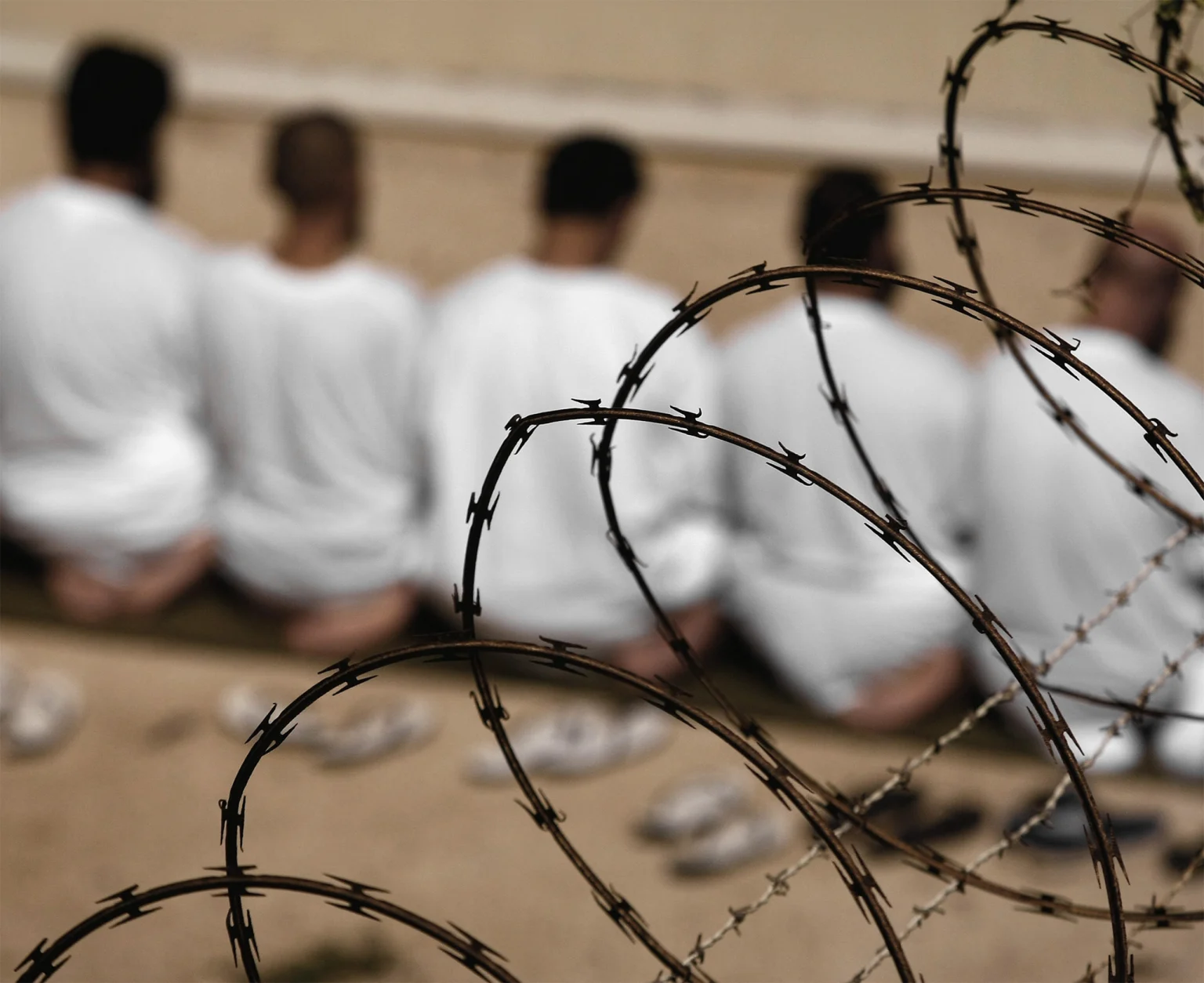
Prison staff and former inmates have reported cases of criminal gangs pressuring prisoners to convert to Islam. Photo: John Moore/Getty Images
|
A worrying trend has emerged in British prisons. In England and Wales, there were 15,594 Muslim prisoners in September 2023, accounting for 18% of all inmates, despite Muslims making up only around 6.5% of the general population.
More strikingly, Ministry of Justice (MoJ) data shows that around one in five Muslim prisoners are white. Nick Timothy, the shadow justice secretary, has pointed to the figures to express concern about conversions to Islam behind bars, urging the government to investigate allegations that some prisoners are being forced to convert.
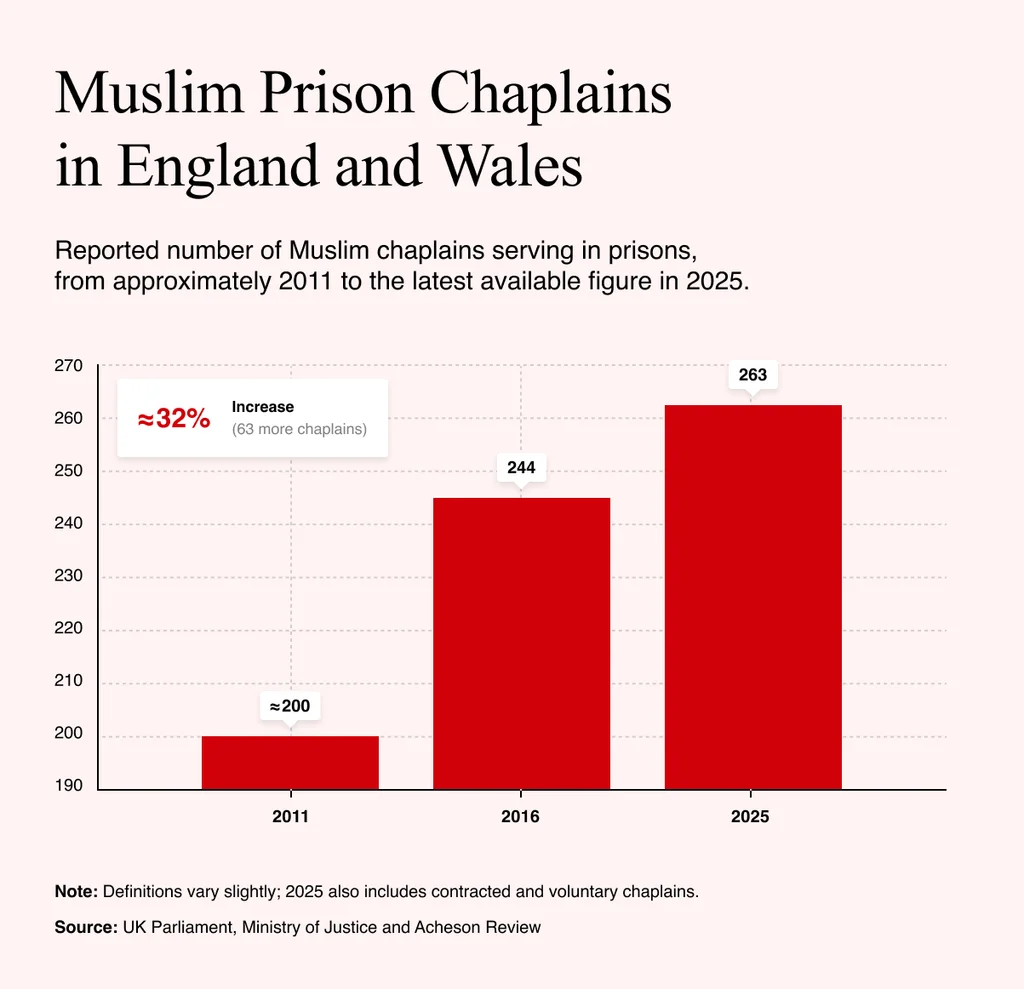
The growing presence of Islam within British prisons is also reflected in religious provision. Ian Acheson’s 2016 government review recorded 244 Muslim prison chaplains, comprising 69 full-time, 65 part-time and 110 sessional chaplains. By September 2025, Ministry of Justice figures recorded 263 Muslim chaplains serving prisons in England and Wales.
The latest figure uses a somewhat broader definition, including contracted and voluntary chaplains, so the totals are not directly comparable. They nevertheless demonstrate the scale of Muslim religious provision across the prison estate.
But raw numbers tell us little about why Muslims are disproportionately represented in prison or why Islam has proved so attractive to some of those incarcerated.
Source: UK Parliament, Ministry of Justice and Acheson Review
Faith, Protection and Prison Perks
A landmark 2010 report by HM Chief Inspector of Prisons found that 30% of the 164 Muslim prisoners interviewed had converted to Islam while in prison.
Their reasons ranged from the spiritual to the practical. Some converts described finding discipline, peace, repentance and a sense of purpose through Islam. Others were attracted by the “support and protection” offered by membership of a group with a powerful identity.
There were material considerations too. The report recorded perceptions among prisoners that identifying as Muslim could bring advantages inside prison, including better food during Ramadan and additional opportunities to leave their cells for religious activities. Some converts were described as “convenience Muslims”.
Yet convenience and conviction are not necessarily mutually exclusive. A prisoner might initially be attracted by practical considerations and subsequently become a committed believer.
More recent research reinforces the importance of sincere religious motivation. A 2021 study found that prisoners frequently turned toward Islam to seek forgiveness, repent for their crimes, regain psychological stability and find purpose and emotional support.
Among its English sample of 191 Muslim prisoners, 28% were converts, while another 56% had intensified their existing Islamic faith while incarcerated. The researchers concluded that faith, companionship and emotional support were more important motivations than perks, privileges or protection.
For some prisoners, Islam can provide precisely the discipline, community and moral framework that rehabilitation is supposed to encourage. But protection and belonging take on a different meaning when membership of the group is no longer entirely voluntary.
Not every conversion leads prisoners to break with their violent or criminal pasts. A series of high-profile cases involving terrorists who converted to Islam in prison before later carrying out terror attacks has raised concerns about the influence of radical Islam behind bars.
Examples include Richard Reid, the so-called “shoe bomber”. He was jailed for a series of petty crimes and muggings and converted to Islam while in prison. After his release, he joined Islamist extremists. In December 2001, he attempted to detonate explosives hidden in his shoes aboard a transatlantic flight. The plot failed.
Another is Muktar Said Ibrahim, who served time for robbery and was radicalized in prison. He later took part in the failed 21 July 2005 suicide bomb plot in London.
Khalid Masood also converted to Islam while in prison after serving sentences for violent offenses. Although there is no evidence that he was radicalized there, he later became an Islamist extremist. In 2017, he drove a car into pedestrians on Westminster Bridge before murdering Police Constable Keith Palmer with a knife. He was shot dead by armed police.
Although rare, these cases show that conversion to Islam in British prisons can, in some cases, coincide with or precede a trajectory toward Islamist extremism. It is not hard to see how the same radical networks that can influence and recruit prisoners behind bars might also exert pressure on vulnerable inmates to convert.
Concerns about forced conversion are not new. The 2010 Inspectorate report recorded claims from staff at one high-security prison that Muslim gangs put pressure on non-Muslims to convert and on existing Muslims to adopt a stricter interpretation of Islam.
The inspectors did not find evidence to substantiate allegations of forced conversion in the establishments they examined. Anne Owers, then chief inspector of prisons, also warned against treating every Muslim prisoner as a potential extremist.
She argued that an excessively security-driven approach risked alienating ordinary Muslim inmates and creating a “self-fulfilling prophecy”, in which the prison experience itself deepened the disaffection that could leave some prisoners more susceptible to extremism.
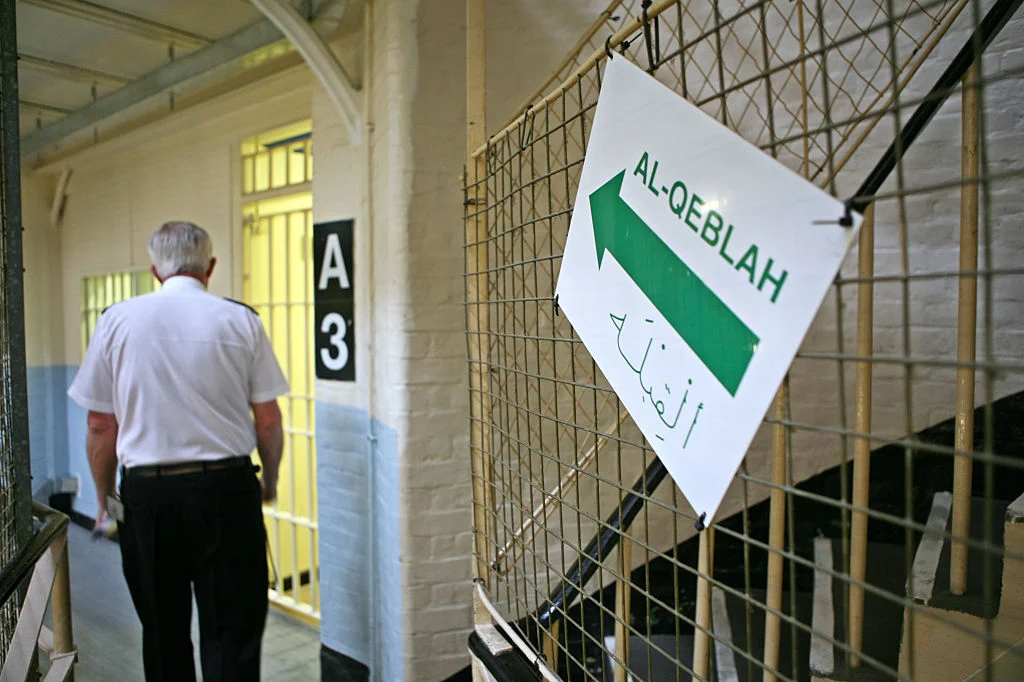
A prison guard walks past a sign for the mosque inside Wandsworth Prison in London, as questions grow over the role of Islam, conversion and coercion within Britain’s prisons. Photo: Andrew Aitchison/In Pictures Ltd./Corbis via Getty Images
When Extremism Turns to Violence Behind Bars
That warning deserves to be taken seriously. But so do concerns about radical Islam. In 2020, Baz Hockton, who had been imprisoned for knife offenses and converted to Islam while incarcerated, took part in what has been described as the first terrorist attack inside a British prison.
Hockton and convicted terrorist Brusthom Ziamani put on fake suicide bomb vests and armed themselves with makeshift weapons before attempting to murder a prison officer at HMP Whitemoor.
Hockton had been radicalized behind bars. His case provides a particularly stark example of what can happen when violent criminality, prison conversion and Islamist extremism intersect.
One former inmate said that convicted Islamist terrorists were well respected by many Muslim inmates and were able to befriend and radicalize Muslims imprisoned for other crimes. Another said that Muslim gangs had merged with drug gangs, giving them considerable power inside prisons. According to the account, they were even willing to accept sex offenders into their ranks, despite the stigma attached to such offenders among other prisoners, because conversion to Islam was regarded as washing away their sins.
This creates an obvious difficulty for prison authorities. A group that offers one inmate friendship, protection and religious purpose may also teach radical ideas about Islam or coerce other prisoners into joining it. The same group structures that provide belonging can therefore become powerful instruments of pressure when they dominate life on a prison wing.
Given those concerns, one might expect the government to have established precisely how widespread coerced conversion is. Instead, the authorities have repeatedly acknowledged how little they know.
Acheson’s 2016 review identified a lack of hard data on prison conversions and their motivations, alongside broader weaknesses in the management of Islamist extremism. Two years later, in 2018, the MoJ blocked an academic study intended to investigate why prisoners convert to Islam and whether conversion could sometimes contribute to radicalization.
That leaves three very different phenomena bundled together under the label of prison conversion.
The first is sincere religious conversion. A prisoner finds faith, moral structure and community in Islam and may emerge from prison better equipped to abandon criminality.
The second is conversion for practical reasons. An inmate identifies as Muslim because membership offers companionship, protection, status or perceived advantages within the prison system.
The third is coercion. A vulnerable prisoner converts, or adopts a stricter form of Islam, because he fears intimidation or violence from a dominant group.
Conflating these categories helps nobody. Treating every Muslim convert as a potential extremist risks alienating genuine believers and obscuring Islam’s potentially rehabilitative role. But it would be equally naive to assume that Islam’s growing influence within British prisons is entirely benign, or that every conversion takes place free from pressure.
The evidence already establishes that Islamist extremists have attempted to exert control over other Muslim prisoners, that prison gangs can wield considerable power and that prisoners can be radicalized behind bars. What remains unclear is how frequently that power crosses the line from influence and aggressive encouragement into outright coercion.
After more than a decade of warnings about prison gangs, extremism and conversion, the fundamental question remains unanswered: how many prisoners are freely finding Islam behind bars, and how many are converting because they are afraid not to do so?
Welcome to the comments section of the Štandard daily. Please take note of our guidelines, comments are moderated by us. You can contact the moderators at support@statement.com.
Participate in the discussion
Comments are available to subscribers only. If you'd like to join the discussion, choose a subscription starting at €6.72 per month.
All comments 0
Register
Comments are available to registered users only. If you'd like to join the discussion, register here.