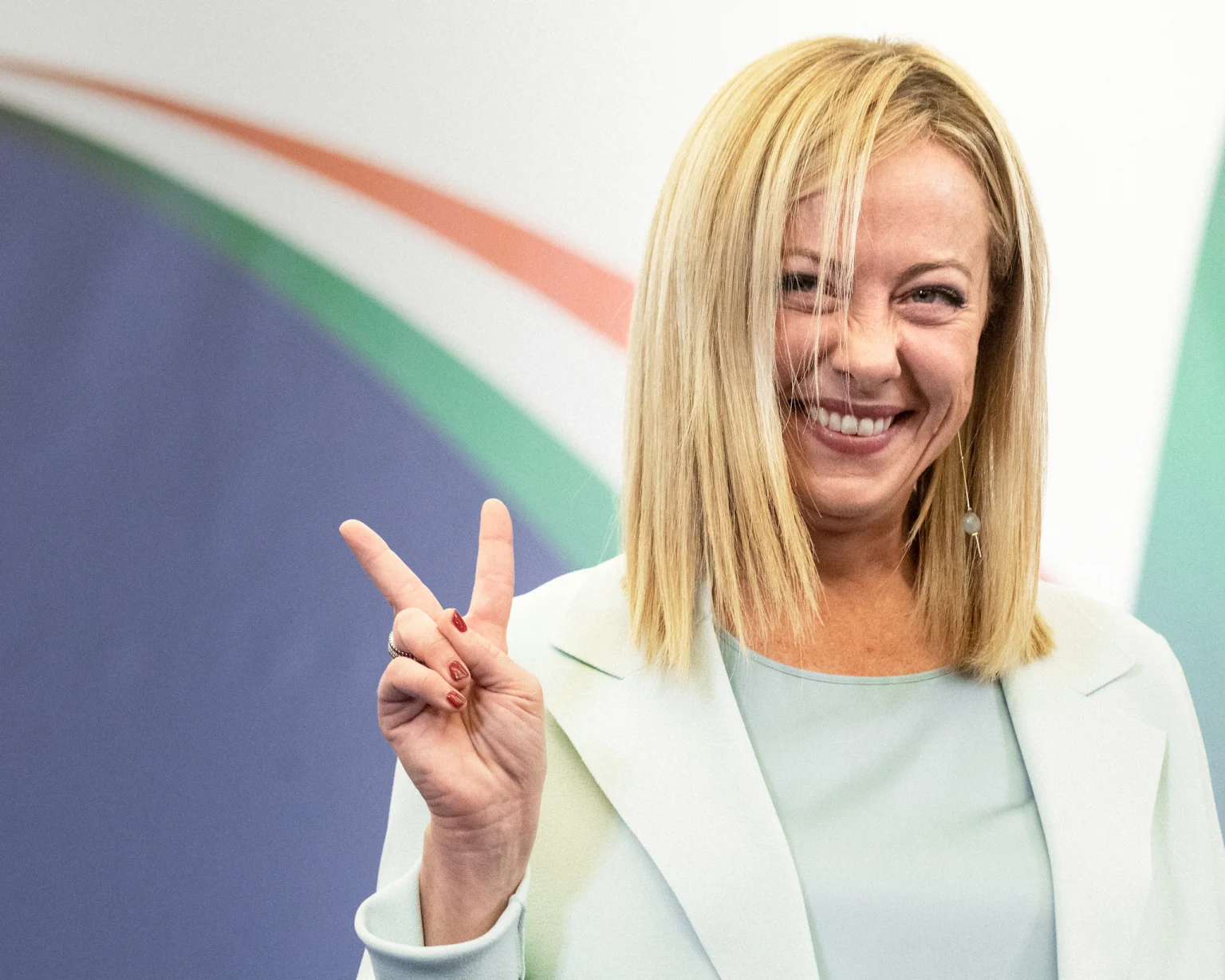
The gamble has paid off. Her party, Fratelli d’Italia, came out on top in the election with about 26% of the vote in the Chamber of Deputies, ahead of the Democratic Party at 19%. But Meloni clearly outperformed her future coalition partners. Salvini’s League garnered only 8.8% of the vote and Forza Italia 8.1%. A small party, Noi Moderati, rounded out the picture with 1%. The center-right coalition formed around the three main forces garnered nearly 44% of the vote and secured a comfortable parliamentary majority.
The balance of power was thus established from the outset: this was not a three-way coalition among equals. It was Meloni’s government, supported by Salvini and Berlusconi. This situation partly explains the subsequent stability of the executive branch.
On Saturday 22 October 2022, Giorgia Meloni became the first woman to serve as prime minister of Italy.
Meloni’s rise to power sparked considerable concern abroad. The timing naturally fueled historical analogies: the election took place almost exactly 100 years after the March on Rome, during which Mussolini’s party set out to seize power. The Fratelli d’Italia party still carries on the tricolor legacy inherited from the Italian Social Movement, a neo-fascist party founded after World War II, and Meloni champions a conservative agenda centered on the nation, the family and identity.
In the weeks leading up to and following the election, the international press repeatedly cited references to fascism and the illiberal threat. Some commentators feared a challenge to democratic institutions, individual rights or Italy’s European integration.
Four years later, however, Meloni has become one of the most experienced and sought-after leaders on the continent. This normalization is likely her first major political success.
Friday 4 September 2026 marks a historic milestone in this regard. Meloni has surpassed the record set by Berlusconi’s second government, which lasted 1,412 days. Since the founding of the Republic in 1946, Italy has had 68 governments, with an average tenure of about 14 months. The contrast with the 1,413-day Meloni administration is therefore striking.
This stability is not merely a matter of numbers. Meloni has managed to hold together three parties with different political orientations: the nationalist right of Fratelli d’Italia, Salvini’s sovereignist League and the liberal-conservative right of Forza Italia.
She has achieved this by avoiding, so far, confrontations that could bring down the government. Her European pragmatism, her support for Ukraine and her commitment to the transatlantic alliance have helped reassure foreign partners without alienating her electorate.
A Regained Voice in Europe
Meloni’s other major achievement is diplomacy. Italy has regained an ability to take the initiative that had been largely lost in the years leading up to her arrival.
On Ukraine, Meloni has adopted a resolutely pro-Western stance, even as some of her political partners maintained more ambiguous positions toward Moscow. In Brussels, she has gradually ceased to be seen as the representative of a marginal right-wing faction and has instead become an indispensable interlocutor.
Her relationship with Donald Trump has also given her a unique position. Meloni has maintained privileged access to the US president, presenting herself as one of the few European leaders capable of understanding Trump without breaking with Europe.
This closeness, however, has shown its limits. Trade tensions, differences over Ukraine and Washington’s policies have served as a reminder that the special relationship between Rome and Washington is not enough to overcome the conflicting interests on either side of the Atlantic. Recent diplomatic setbacks have further undermined this strategy.
Nevertheless, Italy has once again become a player that major capitals must reckon with.
Immigration is undoubtedly the area in which Meloni has been most successful in bringing her agenda to the forefront of the European debate.
Her agreement with Albania, signed in November 2023, is emblematic. The initial plan for centers designed to process asylum claims on Albanian territory faced significant legal obstacles. Rome then reoriented the program: since 2025, the facilities have been used as centers for individuals who have already received a return order.
The system remains limited and legally complex, but its political significance is real. The idea of return hubs located outside the territory of the European Union – once considered radical – is now being discussed at the European level.
An Italy Showing Signs of Vitality
The economic picture must be viewed with greater caution. Italy has not returned to spectacular growth: its gross domestic product (GDP) grew by only 0.5% in 2025, and the European Commission still forecasts only 0.5% for 2026. Public debt, at nearly 140% of GDP, remains a major obstacle.
However, several indicators are significantly more encouraging: unemployment has continued to decline and is expected to reach about 5.7% in 2026, according to the European Commission; the public deficit is expected to fall below 3% of GDP; and investment remains robust, thanks in particular to the European recovery plan.
The overall impression, therefore, is less that of an economic miracle than of a country that no longer appears to be in decline.
The export sector, industry, tourism and the agri-food sector are driving this momentum. In 2025, the entire Italian agri-food sector – agriculture, forestry, fishing and the food, beverage and tobacco industries – generated €89bn ($103.3bn) in value added, compared to €83.4bn ($96.8bn) in 2024. Italy also retained its top position in the European Union in terms of agricultural value added.
This economic momentum goes hand in hand with a proactive cultural policy. The Meloni government does not view national culture merely as heritage to be preserved, but as an economic and diplomatic resource.
The most emblematic illustration of this was UNESCO’s recognition, in December 2025, of Italian cuisine as an Intangible Cultural Heritage of Humanity. The decision particularly highlights the intergenerational transmission of culinary skills and their role in shaping community identity.
This recognition crowns a broader strategy to promote “Made in Italy”, in which gastronomy, agriculture, crafts, fashion, tourism and industry are all part of the same policy to project the country’s influence. Italy’s national identity was already a global brand and Meloni has chosen to embrace it rather than conceal it.
Far-Reaching Transformation Is Stalling
It is here, however, that the limitations of her record become apparent.
The major institutional reforms that were promised have not materialized. Judicial reform – notably the separation of career paths between trial judges and prosecutors – was rejected in the 2026 constitutional referendum. The proposal for the direct election of the prime minister also stalled after passing through the Senate. The reform of differentiated autonomy, for its part, was partially overturned by the Constitutional Court.
The government, on the other hand, has been much more effective in the areas of security and public order, as well as in certain tax measures and the reform of the social benefits system – particularly the initially highly controversial reform of the citizen’s income.
Family policy, however, remains one of the weak points of her record. While Italy is experiencing a profound demographic crisis, the measures taken remain insufficient to reverse a trend that ultimately threatens the labor market, public finances and the social model.
In a way, Meloni has been more successful in stabilizing Italy than in transforming it.
Opposition Now Coming from Her Own Right
The paradox of Meloni’s nearly four years in office is that the political threat looming over her now comes less from the left than from her own right.
Roberto Vannacci, a former general who became a MEP, founded the Futuro Nazionale party in February 2026 after breaking with the League. The new party advocates a more radical stance on immigration, national identity and Europe, while also challenging Meloni’s pro-Ukrainian policy.
Its rise has been rapid: an SWG poll released on 31 August gave it 7.5%, ahead of Forza Italia at 7.1%. Futuro Nazionale thus ranked fourth in the poll.
Vannacci specifically attacks the very compromise that has made Meloni successful: her pragmatism. To her opponents on the right, the prime minister has become too pro-European, too pro-Atlantic and too concerned with her international reputation.
This may be the main contradiction in her track record. By mainstreaming Italy’s national right, Meloni has won the battle for respectability, but she has also opened up political space for those who now accuse her of having abandoned some of her convictions.
Four years after her election victory, the verdict is thus far removed from the prophecies of 2022. Italy has not slipped into fascism. Nor has it become a new economic power. But it has regained stability, an international voice and new confidence in its own strengths.
2027 will be the year of the next Italian election, with elections to the Chamber of Deputies and the Senate. Will the process of normalization outlast Meloni herself? That would be good for stability. But Italy still needs to tackle some structural problems that no government has yet managed to resolve.