US Demographic Decline Could Begin Decades Earlier Than Predicted
A new study paints a bleak picture of fertility in the US, warning that America’s demographic decline could begin decades earlier than previously predicted.
If fertility rates continue to fall, America’s population could begin to decline by the mid-21st century. Photo: Shawn Thew/Pool/For The Washington Post via Getty Images
|
That American population growth has already slowed dramatically is a fact widely accepted, but a new study warns the future could be much bleaker than most forecasts suggest. Population growth will potentially “grind to a halt” or “go into reverse” decades earlier than predicted, without significant policy interventions, according to the Institute for Family Studies (IFS).
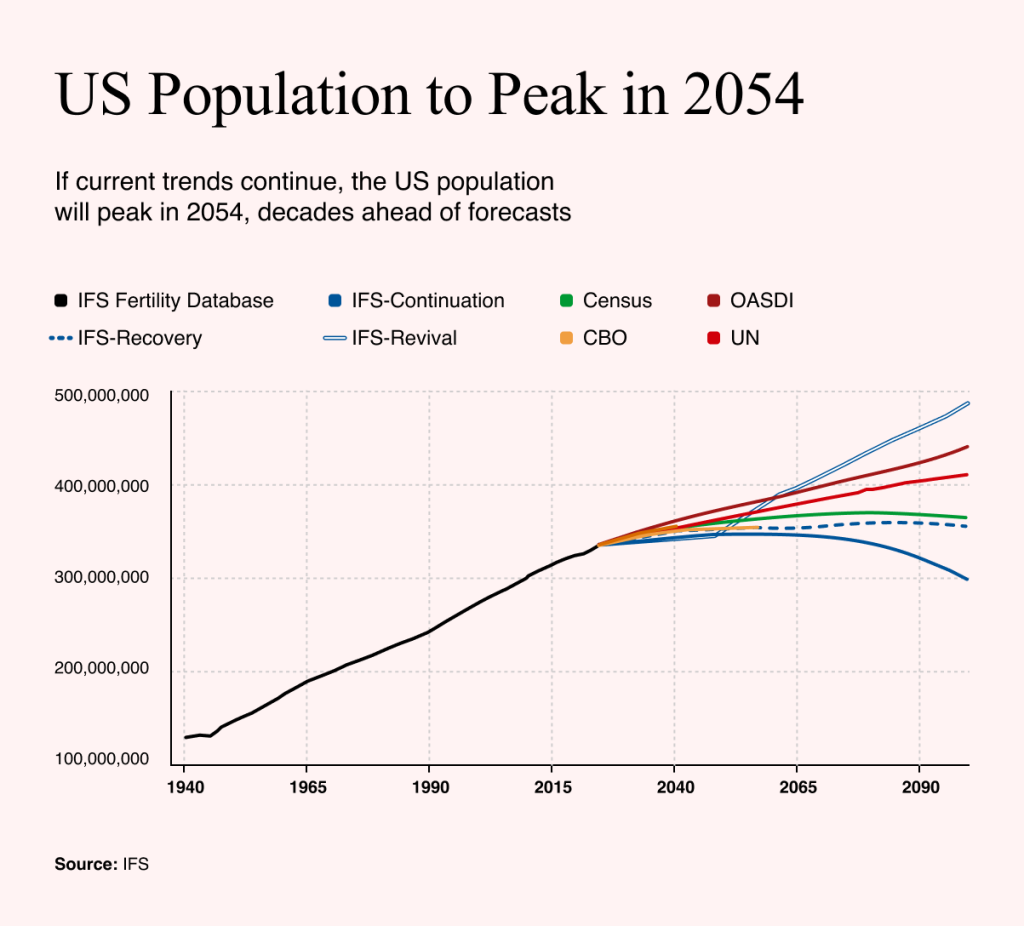
Fertility rates in the United States are already below the replacement level of 2.1 children per woman, standing at less than 1.6. If present fertility rates continue, the population of the US could peak in the 2050s before going into “relatively rapid” decline for the remainder of the 21st century, say the authors of the IFS report The Demographic Dead End: 2026 State of Fertility, Lyman Stone and Peter Foreshaw Brookes.
This decline would begin much earlier than projections from bodies like the United Nations Population Division and the US Census Bureau, which adopt what IFS says are “unrealistic assumptions” regarding a revival of fertility and the continuation of high levels of immigration.
The pro-family American think tank argues that without a renewal of family life in America, “the greatest days of freedom” will be behind the US.
However, in addition to its dour conclusion, the report provides fresh insights into how policy and cultural changes could spark a revival that would see population growth continue at marginal rates until the end of the century.
These include strengthening social bonds between friends and enlisting celebrities’ assistance, as well as targeted economic policies that would balance government intervention with fiscal restraint.
While America is often known as a nation of immigrants, the IFS analysis shows the foundation of its growth was family and fertility. Even in an era of mass migration from 1840 to 1925, births outnumbered immigrants by 4.5 to one.
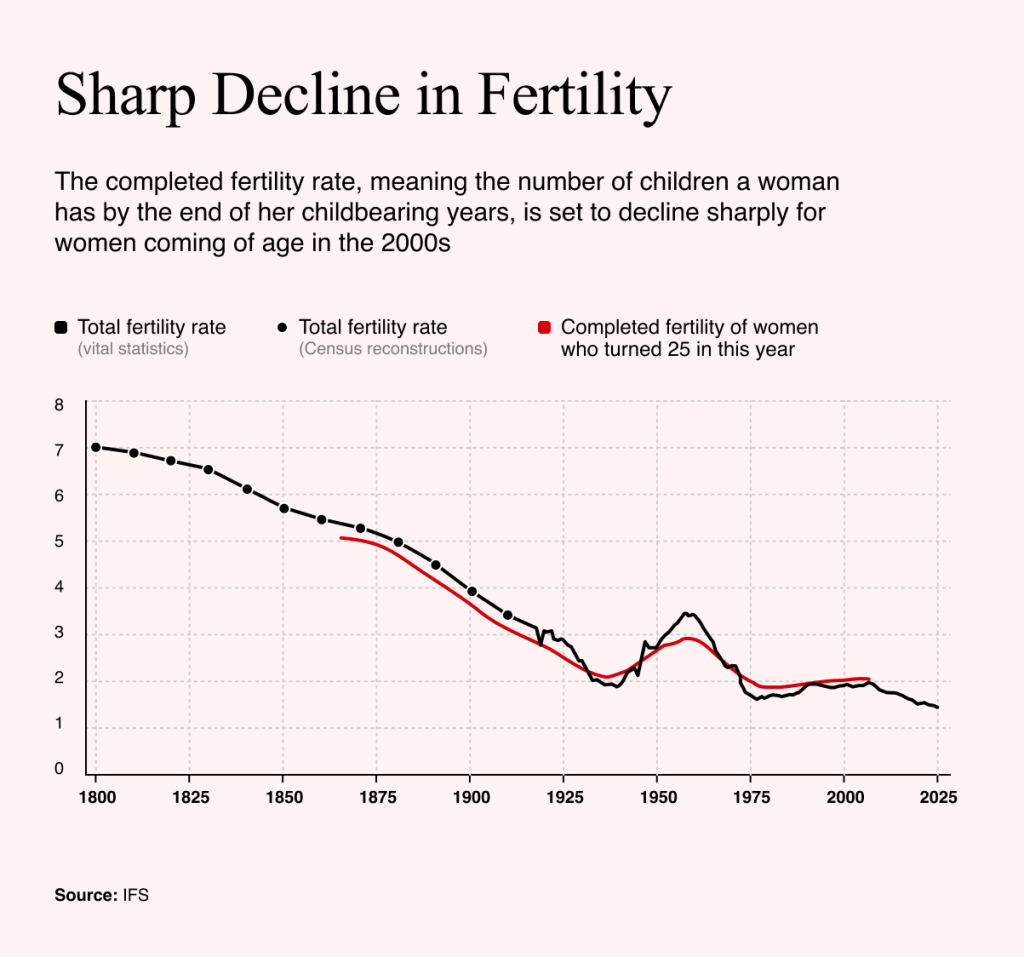
However, fertility rates have decreased dramatically over more than 200 years, declining from around seven in 1800 to fewer than 1.6 children per woman today.
Completed fertility rates, less volatile than annual fertility rates, also bear out this picture. These measure the number of children a woman has by the end of her childbearing years and indicate a sharp decline for women coming of age in the 2000s.
Family sizes are set to plummet too. The average number of children per woman who survive to age 15 has fallen from roughly 3.5 in 1800 to around 1.5 in 2025.
American fertility rates have seen a steep decline over the past 200 years. Source: IFS
According to the IFS breakdown of fertility rates by state, they are at their lowest in the largely liberal Northeast and, to some extent, the West Coast.
For instance, women in Massachusetts who turned 40 in 2025 had a completed fertility rate of just 1.6 children per woman.
This puts it on a par with many Eastern European countries, with the authors acidly commenting that family life in Massachusetts is “about as successful as family life just after the fall of the Soviet Union”.
As the IFS sums up the state of American fertility, it is “not good” and threatens to enter “interminable decline”.
The think tank is much more pessimistic in its predictions than those from the UN and various American government projections. It attributes this discrepancy to two assumptions commonly made in such projections: that fertility will recover and immigration will remain high.
To offer what it argues is a more realistic picture, IFS proposes three possible forecasts for American population growth: continuation, recovery or revival.
Under the bleakest outlook, the continuation scenario, fertility keeps falling, leaving the US rate barely above one child per mother by the end of the century and the population just below 300 million.
At the other extreme, the revival scenario, fertility rates return to the replacement level of 2.1 children per mother by 2060 and the American population closes in on half a billion.
Under the recovery scenario, the US may continue to “eke out” a slow pace of growth well into the 21st century, but still at a rate far lower than it has been for most of the country’s history.
However, without positive intervention, the US is on a course that will see it in “demographic – and therefore economic and political – retreat” through the latter half of the 21st century.
Under the IFS’s starkest projection, the US population will begin declining midway through the 21st century. Source: IFS
Parental Choice
But while the IFS paints a bleak picture, it does offer some grounds for hope. Most notably, although the rise in contraceptive use and the number of abortions is generally championed as an example of parents exercising their right to choose, the IFS data show that fertility is falling increasingly short of the number of children Americans say they want.
This is not simply a matter of choice. Americans consider an average of 2.1 children the ideal family size, yet would personally like to have 2.4 children on average.
Something is blocking Americans from having the number of children they desire. This suggests that, through judicious policy choices aimed at improving the financial and cultural landscape, America can still turn its fortunes around.
The Importance of Good Friends
One area the IFS casts fresh light on is the importance of helpful friends in driving fertility, at a time when the digital revolution may be reshaping – and harming – the landscape of American relationships and fertility.
While the link between religiosity and fertility desires and outcomes is well established, the associational effect of helpful friends may be even larger, IFS found.
For instance, among Americans under 30 with the least helpful friends, desired family size is 1.7 children. For those in the top 10% for social support, it is around 2.8 children, suggesting that helpful friends are associated with an entire extra child in desired family size.
Some parts of the US are already seeing the effects of a declining fertility rate.
Only 20%-30% of those with unhelpful friends intend to have more children, compared with 40%-50% of those with the most supportive social circles.
While the authors cannot rule out reverse causality – that people who want kids may seek out friends with kids – they argue that most people form friendships well before they start having children.
Peer culture, then, appears to be an important factor in shaping fertility desires and intentions, a conclusion reinforced by the IFS study of how celebrities’ family sizes influence their fans.
The institute found that each additional child born to an admired public figure was associated with a higher desired family size among respondents to its survey.
Policy Implications
These findings have significant policy and cultural implications, the IFS states, coming at a time when American social life is in decline. There has been a persistent drop in the number of close friends Americans report having, as well as a decrease in the amount of time they spend with friends.
While governments cannot mandate friendships, they can create an environment that encourages their development through pro-social policies and taxation, the authors say.
These include introducing excise taxes on Sunday data use to discourage nonessential phone use or offering lower tax rates on alcohol and food consumed in bars and restaurants rather than at home.
These recommendations comprise just two of a myriad of policy proposals the authors argue could incentivize Americans to have children.
So while the picture painted by the IFS report is bleak, with some people now in the workforce potentially seeing the population begin to shrink before they retire, the authors argue that demographic decline is a choice – and one the nation can therefore reverse.
It will not be easy due to the variety of variables that affect fertility, including social and cultural norms governments may struggle to change.
But if policymakers consider policy changes “equal in magnitude to the size of the problem we face, Americans need not have anything to fear”, the authors conclude.
Welcome to the comments section of the Štandard daily. Please take note of our guidelines, comments are moderated by us. You can contact the moderators at support@statement.com.
Participate in the discussion
Comments are available to subscribers only. If you'd like to join the discussion, choose a subscription starting at €6.72 per month.
All comments 0
Register
Comments are available to registered users only. If you'd like to join the discussion, register here.