Migrant Labor and Shrinking Populations Present a Conundrum for the Right
While the right seeks to crack down on immigration, it will have to come up with a solution for businesses dependent on cheap migrant labor to head off clashes.
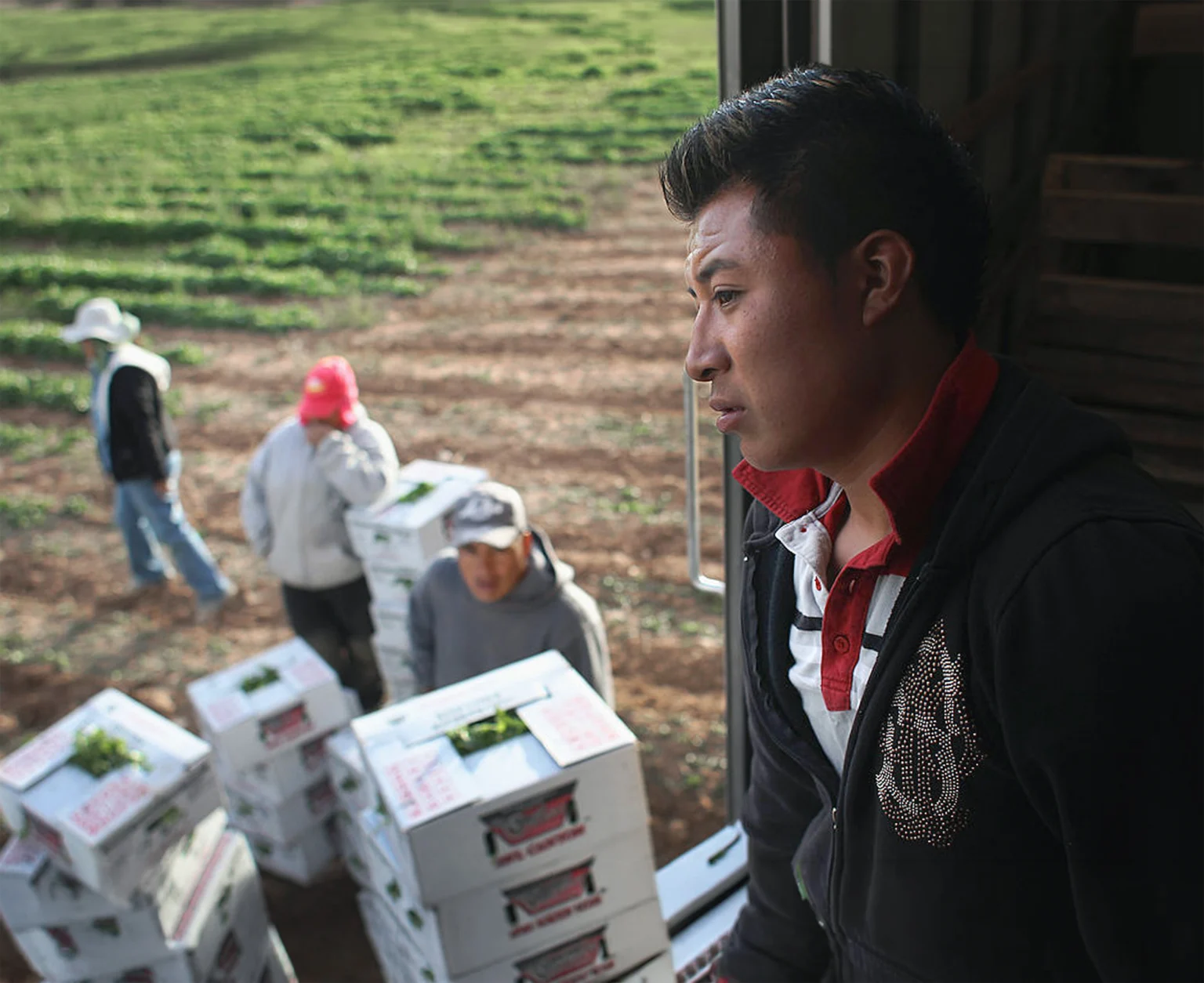
Migrant laborers are overrepresented in key sectors including farming, tourism and healthcare. Photo: John Moore/Getty Images
|
In the US, businesses battle with a Republican president, while in Spain capitalists support a socialist prime minister, both over their migration policies.
These are examples of the unusual alliances born of a destabilized political scene, but serve as a reminder to the right of the important role immigrant labor plays for many businesses.
Sectors including tourism, agriculture, care work and construction rely to a significant degree on migrant workers.
It is with business leaders in these sectors that US President Donald Trump, for instance, has run into the most trouble over his migration policy. Meanwhile Spanish Prime Minister Pedro Sánchez has won support for his exceptionally liberal policy from similar figures.
There are arguments based on the injustice of businesses exploiting vulnerable laborers – or immigrants exploiting states’ laws – that suggest this is not a fair system. There is also a mounting body of evidence showing that not all migration is profitable and that it fails to address the difficulties facing well-educated locals, such as collapsing housing markets and limited job opportunities in traditionally middle-class sectors.
But these cannot take away from the fact that businesses need a consistent and stable flow of labor to encourage a thriving economy, which is not easy with a falling population.
Spain is a prime example of a country whose key sectors are heavily dependent on immigrant labor. The country is aging faster than other major European countries like France and Germany, with one projection suggesting a shortfall of 1.4 million workers by 2035.
The study, from the economic research center of the Catalan employers' association Foment del Treball, argues that Spain would need to incorporate 140,000 migrant laborers annually to maintain current employment levels.
Meanwhile, Spain has seen remarkable growth in its economy of late, with its GDP growth continuing to outpace that of major economies like Germany and France.
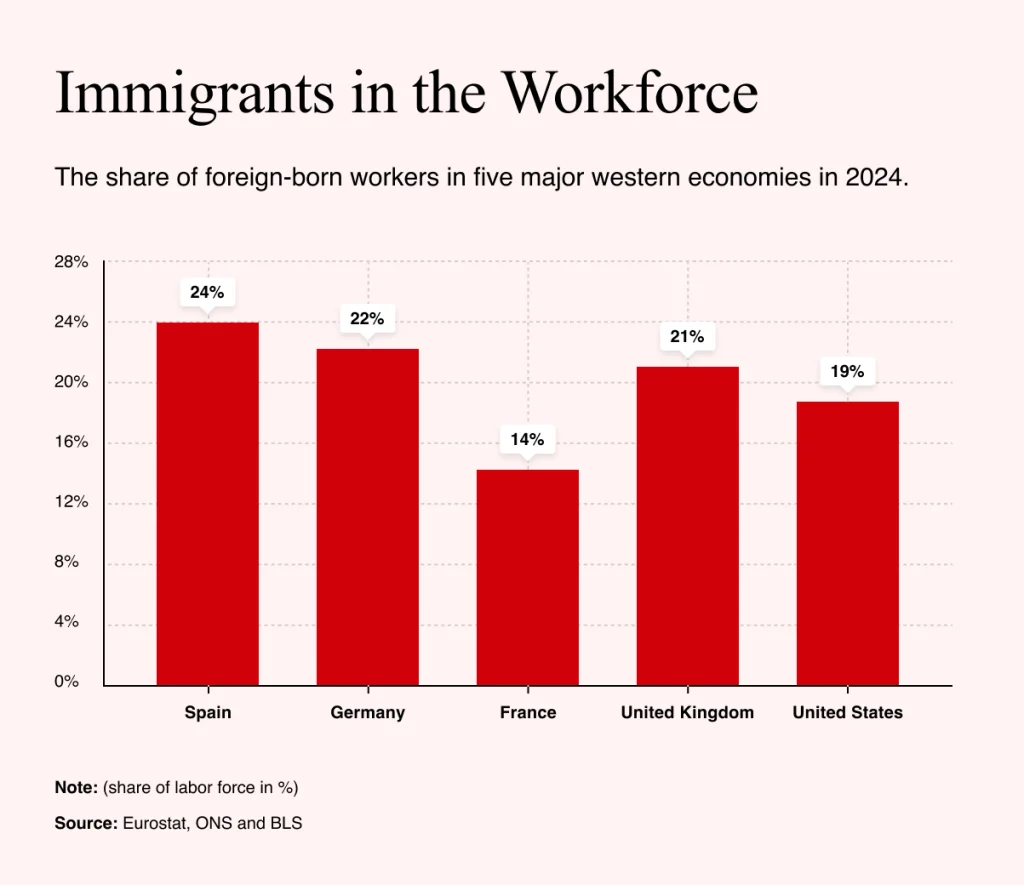
This growth is largely driven by the service industry, in which migrants make up a significant portion of the labor force. While the 5.76 million foreign-born workers in Spain made up almost 24% of the country’s workforce in 2024, immigrant workers account for 72% of employment in domestic service, 45% in hospitality, 32% in construction and 31% in agriculture.
Remarkably, in 2024, immigrants accounted for 90% of all new jobs created in the Mediterranean country.
Given these figures, it is no surprise that Josep Sánchez Llibre, the head of a leading Catalonian business group, said in December 2025 that "companies need immigration like the air we breathe and the water we drink. Spanish companies absolutely need immigration to be competitive".
Re-elected for a third term as president of lobby group Foment del Treball in May, Llibre recently doubled down on his comments, describing immigration as a "capital" element for business competitiveness.
It will come as no surprise to learn that it was a think tank associated with Foment that projected the 1.4 million shortfall in workers without sufficient immigration.
Reliance on Migrant Labor
Llibre’s thinking exemplifies a common liberal defense of mass immigration, arguing that it is good for the economy and necessary for businesses.
While this argument is running into increasing trouble, as outlined above, it cannot be ignored that some key business sectors are reliant on migrant labor or that shrinking populations reduce the pool of both workers and consumers.
US President Donald Trump’s immigration policies have run into issues presented by this reality, meeting significant pushback from business leaders.
For instance, he cut back on raids on businesses associated with tourism and agriculture after lobbying from business groups, while proposals to remove protections for Haitian migrants met with opposition from healthcare and nursing-home employers because of the workers’ importance in caregiving and related roles.
In the US, immigrant workers make up 19% of the labor force, including illegal and undocumented immigrants.
Source: Eurostat, ONS, BLS
The pattern is largely consistent across major Western economies. In Germany, some 22% of the workforce is foreign-born and in France, 14%, based on figures from Eurostat, while and in the United Kingdom the share is approximately 21%, according to the Office of National Statistics.
These survey-based figures may include undocumented and illegal migrants, although most of the datasets do not identify immigration status separately – meaning the figures could be underrepresenting the extent of foreign-born labor in these countries.
As with Spain, immigrant workers are disproportionately represented in sectors including health and care services, hospitality, manufacturing, construction, transport and agriculture.
A Shrinking World
While these sectors may not contribute to economic growth for these economies to the same degree as Spain’s, they are all key cogs in a functioning society.
The sectors are also not typically attractive to national workers, as they are often labor-intensive and low-paying, meaning that getting rid of the immigrant laborers or discouraging further migration may contribute to gaps in these often hard-pressed sectors.
Even if the local population were to start taking on these jobs more, this is still not a long-term solution, as the native workforce is declining quickly due to low birth rates.
When weighed against questions of cultural integrity, pressure on welfare systems and housing, as well as other factors, this is not an argument against tackling the crisis of the West’s migration system, but it is something that right-wing parties will have to consider.
Based on Trump’s experience in attempting to crack down on illegal immigration, the right can expect significant pushback from some business leaders, who may otherwise support their economic programs.
In the case of Spain, Llibre calls for an end to wealth and inheritance taxes, both positions that find broad sympathy across the right in Europe. However, he also favors high levels of immigration over concerns regarding the declining number of working-age Spaniards.
It leaves a conundrum for right-wing parties that is not easy to solve. There are many strong reasons to oppose mass immigration and mounting evidence that it is not the quick fix for the economy that liberals claim.
But with the working-age populations in the likes of Spain, France, Germany and the United Kingdom all expected to decline substantially by 2050, it is not only a question of tackling the exploitation of cheap migrant labor or ending illegal immigration.
When navigating the economics of a shrinking world, the right will need to acknowledge the concerns from businesses that want to know where they will be able to draw a stable supply of labor from.
Welcome to the comments section of the Štandard daily. Please take note of our guidelines, comments are moderated by us. You can contact the moderators at support@statement.com.
Participate in the discussion
Comments are available to subscribers only. If you'd like to join the discussion, choose a subscription starting at €6.72 per month.
All comments 0
Register
Comments are available to registered users only. If you'd like to join the discussion, register here.