AfD on Course for Historic Victory as CDU Faces Rout
The AfD in Saxony-Anhalt is within reach of an outright majority, a result that would send political shockwaves far beyond the state. The governing CDU is heading for a debacle, with its vote share likely to halve.
AfD leaders Ulrich Siegmund, Alice Weidel and Tino Chrupalla celebrate their party’s strong showing in the Saxony-Anhalt state election. Photo: Michael Kappeler/picture alliance via Getty Images
|
Alternative for Germany (AfD) has emerged as the clear winner of the Saxony-Anhalt state election. Led by its lead candidate, Ulrich Siegmund, the party has delivered a remarkable result.
According to the latest available projections, the party stands at 44.4%, far ahead of the Christian Democratic Union (CDU) on 18.3%. The Left is on 9.2%, Alliance 90/The Greens on 8.7% and the Social Democratic Party (SPD) on 8.6%. The Sahra Wagenknecht Alliance (BSW), at 4.8%, is just below the 5% threshold.
If the BSW fails to enter parliament, current seat projections would give the AfD 41 of the 83 seats in the Landtag, Saxony-Anhalt’s state parliament, followed by the CDU with 17, The Left with nine and the SPD and Greens with eight each.
That would leave the AfD exactly one seat short of an outright majority. The latest trend is slightly in the party’s favor, so it could still secure one.
By 4 p.m., 65.3% of eligible voters had already cast ballots at polling stations, compared with 41.0% at the same point in 2021, according to the state returning officer. Estimates put turnout at a record 75%–80%.
AfD Claims Mandate to Govern
The AfD views its record result as a clear mandate to govern. Lead candidate Ulrich Siegmund spoke of the “beginning of a new era” and said he was confident the party could ultimately secure a parliamentary majority.
He signaled a willingness in principle to hold talks with other parties and individual lawmakers, but ruled out substantive “contortions”. AfD co-leader Alice Weidel called it a “very clear mandate to govern”, while fellow party leader Tino Chrupalla had already expressed openness to talks with other parties.
In the new Landtag, the AfD will wield considerably greater parliamentary power. It will be able to establish committees of inquiry on its own, since only a quarter of lawmakers are required, and block measures requiring a two-thirds majority, including constitutional amendments.
Nationwide, the party can also project far greater confidence, pointing to the scale of its electoral support.
The likely difficulty of forming a majority without the AfD, and especially any potential cooperation between the CDU and The Left, would also give the party lasting political ammunition.
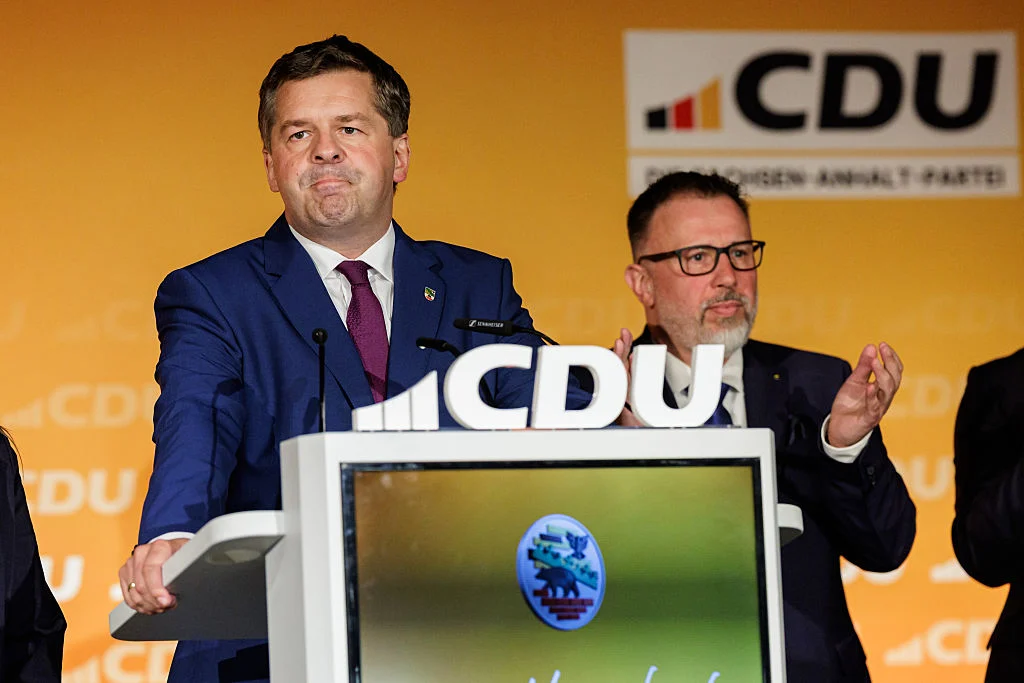
Saxony-Anhalt Minister-President Sven Schulze of the CDU reacts to the first projections after polls closed in the state election. Photo: Jens Schlueter/Getty Images
The CDU, by contrast, has acknowledged its heavy defeat but continues to rule out cooperation with the AfD. Saxony-Anhalt Minister-President Sven Schulze congratulated the AfD on its election victory and said simply: “That is democracy.”
Calls for the resignation of incumbent CDU Minister-President Sven Schulze have already emerged from within the party.
The Junge Union (JU), the CDU’s youth wing in Saxony-Anhalt, is openly demanding action in response to the election debacle. In a resolution adopted by its state executive, it called for changes in policy and personnel, specifically Schulze’s resignation as minister-president as well as fresh elections for the state party chairmanship and the entire CDU state executive. After a defeat on this scale, it said, business as usual was not an option.
So far, there has been no indication from the CDU’s federal leadership that it intends to soften the so-called firewall, the political cordon sanitaire surrounding the AfD. Nor is there expected to be any debate over Chancellor Friedrich Merz.
The SPD is treating the result as both a defeat and a warning to the federal government. Party leader Lars Klingbeil called it a “signal to Berlin” and held out the prospect of changes to the government’s course.
The SPD in Saxony-Anhalt also noted that its return to the Landtag had at times been far from certain.
Despite its own result, The Left sees its primary role as preventing an AfD government. Lead candidate Eva von Angern had already said during the campaign that there would be no government she regarded as right-wing extremist.
That defines the central fault line of the evening: the AfD is staking a claim to govern on the strength of its commanding result, while the other parties search for a parliamentary majority without it.
The violence feared in Magdeburg ahead of the vote had not materialized by early election night. Greenpeace and the youth wing of the German Trade Union Confederation (DGB) demonstrated on Domplatz under the slogan “We remain colorful”. Police initially reported no incidents.
Further rallies were announced at the main railway station and in Halle and Dessau-Rosslau.
More substantial protests took place outside Saxony-Anhalt. Hundreds took to the streets in Hamburg against the AfD’s election victory. In Berlin, demonstrators gathered outside Saxony-Anhalt’s representation in the capital, while further rallies were reported in Frankfurt.
Opponents of the AfD also turned out in Lehrte near Hanover to protest an election-night celebration by the party.
Welcome to the comments section of the Štandard daily. Please take note of our guidelines, comments are moderated by us. You can contact the moderators at support@statement.com.
Participate in the discussion
Comments are available to subscribers only. If you'd like to join the discussion, choose a subscription starting at €6.72 per month.
All comments 0
Register
Comments are available to registered users only. If you'd like to join the discussion, register here.