Der Spiegel called him Germany’s most dangerous man, but Ulrich Siegmund campaigns as a polished moderate. Now he could make AfD history.
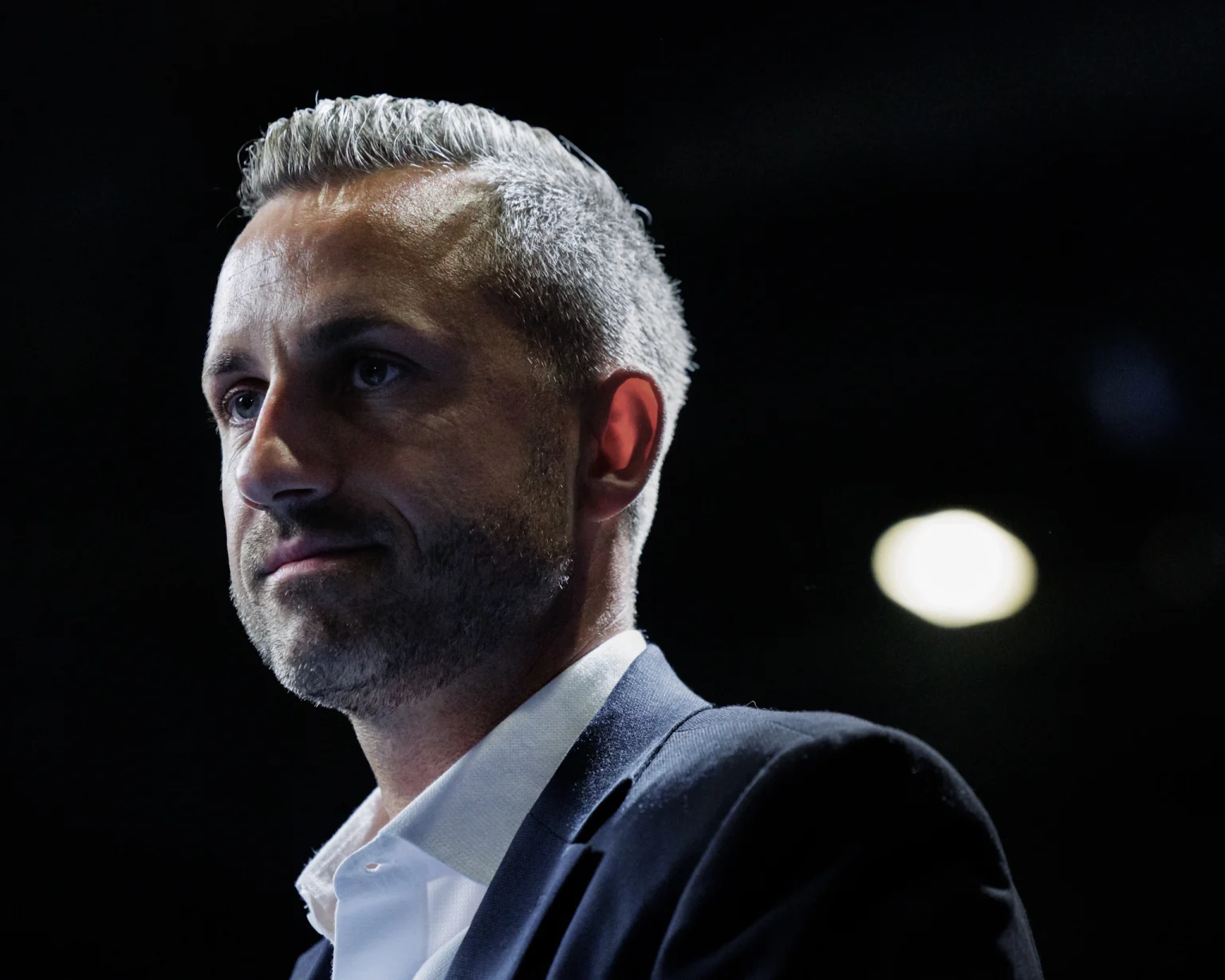
Ulrich Siegmund wants to govern Saxony-Anhalt. Photo: Jens Schlueter/Getty Images
|
Ulrich Siegmund could make German political history as early as September. The 35-year-old businessman from Tangermünde is leading the Alternative for Germany (AfD) into Saxony-Anhalt’s state election with a commanding lead over the Christian Democratic Union (CDU). If that translates into a governing majority, he could become Germany’s first AfD state premier.
Behind his rise lies an unspectacular, almost conventionally middle-class biography. After leaving school, he completed a commercial apprenticeship, worked in sales, studied for a degree alongside his job, started his own business, founded a family and spent 10 years as a member of the state parliament.
Siegmund wins people over with charm. He smiles frequently. His appearance is serious: dark suit, white shirt and a carefully trimmed beard. He speaks slowly, constructs his sentences deliberately and, like a good teacher, repeats the messages he wants people to remember. On social media, he appears riding his motorcycle, talking to citizens or campaigning. He has more than 700,000 followers on TikTok.
A Series of Elections
Saxony-Anhalt will be the first of three German states to hold elections. A new state parliament will be elected on 6 September. In the latest polls, the AfD stands at between 41% and 43%. The CDU is on 22%-24%, followed by The Left at around 13%. The Social Democratic Party (SPD), Greens, Sahra Wagenknecht Alliance (BSW) and Free Democratic Party (FDP) are all, to varying degrees, fighting to enter the state parliament. Parties need at least 5% of the vote to qualify.
Depending on which of these parties fail to clear the 5% threshold, the AfD could come close to, or even secure, an absolute majority of seats with a vote share in the low 40s.
Siegmund makes no secret of his ambitions. He has set a target of "45% plus X". Ideally, he wants to govern without a coalition partner. A coalition is in any case considered unrealistic because of the Brandmauer, or firewall, maintained by other parties against cooperation with the AfD.
Even without an absolute majority, however, his path to the state chancellery is not necessarily blocked. Under the state constitution, a candidate needs an absolute majority of state parliament members in the first two rounds of voting. If no candidate secures one and parliament subsequently decides against holding a new election, a majority of votes cast is sufficient in the third round.
An Idyllic World in the East
The man presented with this opportunity was born in Havelberg on 25 October 1990. He grew up just a few kilometers away in Tangermünde. When Siegmund talks about his home, he likes to evoke the image of a "heile Welt", an idyllic world. People know one another, help each other and children can play outside. That is how he describes his childhood. Just a few days after his birth, he says, he was essentially already a Tangermünde local.
His family was not originally politically active. His father, Andreas Siegmund, born in 1960, worked as an engineer and sales manager. He now works for an AfD member of the Bundestag. Siegmund’s older brother is also involved in local politics in Tangermünde. His mother died in an accident in 2019. Siegmund says his parents taught him "that nothing falls from the sky".
From the Warehouse to Sales
Siegmund left the secondary school in Tangermünde after the 11th grade with a Fachhochschulreife, a qualification for admission to a university of applied sciences. He wanted to work and, as he puts it today, "create value". In 2008, he began training as a wholesale and foreign trade clerk at a regional electrical wholesaler.
He initially worked as a commercial employee before taking on sales responsibilities in the wholesale sector, serving customers across Saxony-Anhalt. He then moved to Berlin and became a key account manager for an eye clinic.
Siegmund still likes to tell the story of how he got the job. He had undergone laser eye surgery himself and says the head of the clinic effectively recruited him for a sales position "on the operating table".
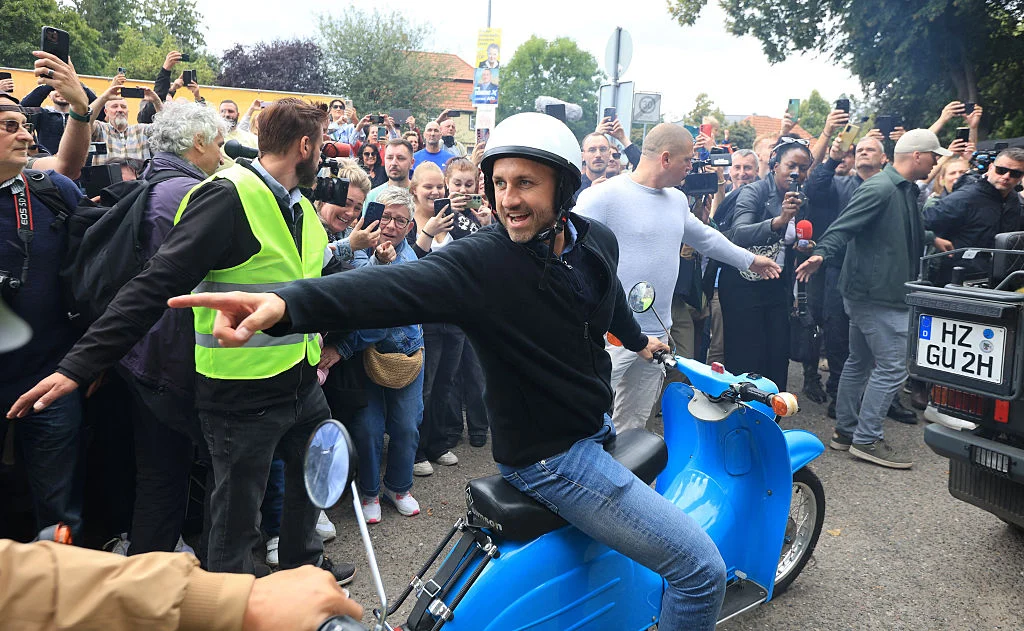
AFD lead candidate Ulrich Siegmund sets off on a Simson motorcycle ride in Quedlinburg with more than 5,000 participants. Photo: Matthias Bein/dpa/picture alliance via Getty Images
While working full-time, he began a distance-learning course at the European Distance Learning University of Hamburg in 2013. He studied business administration and business psychology, graduating with a Bachelor of Arts in 2016. The university explicitly confirmed his degree again in the summer of 2026 after doubts about his credentials had circulated online.
Scent Marketing and Politics
His studies in business psychology led Siegmund into an unusual line of business. In 2014, he founded a scent-marketing company. The idea was to use fragrances to alter the atmosphere of spaces and, for example, reduce aggressive behavior on public transport. In 2015, he completed management training in Beijing and remained an entrepreneur alongside his political career until 2026.
He withdrew from the company following a dispute over whether he had properly declared his business activities to the state parliament. Siegmund rejected the allegation.
His private interests also depart somewhat from the conventional political résumé. He trained as a coffee sommelier in Vienna. A portrait of Otto von Bismarck hangs in his office. Siegmund was raised Catholic but left the Catholic Church in 2017. He told the Mitteldeutscher Rundfunk (MDR) that he still carries Christian values "in his heart", but has broken with the institutional Church in Germany. Politically, he has clashed with both the Diocese of Magdeburg and the regional Protestant Church.
Siegmund is married. He met his wife after he had entered the state parliament. The couple have a daughter together and, according to MDR, the family also includes a stepdaughter. Siegmund says they deliberately talk little about politics at home.
First the CDU, Then the AfD
Siegmund began his political career by joining the CDU in 2008. Then 18, he wanted to become involved in his home region. The break came during the euro crisis, when Siegmund opposed the federal government’s bailout policies. He left the CDU in 2014 and joined the AfD. Two years later, he entered the state parliament.
In the 2016 election, the then 25-year-old won a seat through the AfD’s state list and has served continuously in parliament ever since. In 2021, he was second on the party’s state list. He is also firmly rooted in local politics, sitting on both the Stendal district council and Tangermünde city council. In the 2024 local elections, both Ulrich and his father Andreas Siegmund were elected for the AfD in Tangermünde.
In the state parliament, Siegmund initially focused primarily on social and health policy. In 2016, he became chairman of the Committee for Labor, Social Affairs and Integration. Following the 2021 state election, he chaired the committee under its new name, the Committee for Labor, Social Affairs, Health and Equality.
At the same time, he rose through the AfD parliamentary group. He initially served as deputy parliamentary group leader. Since August 2022, he has jointly led the group with Oliver Kirchner.
Removed as Committee Chairman
The sharpest setback of his parliamentary career came in 2024. Siegmund had attended a meeting in Potsdam in November 2023 that subsequently became the subject of intense controversy. He gave a presentation there on his "Vision 2026".
In February 2024, the state parliament consequently removed him as chairman of the social affairs committee by 71 votes. Those behind the motion cited the Potsdam meeting and the ideas allegedly discussed there. Many of the claims subsequently made in the media proved to be false. Siegmund rejected the allegations and described his removal as "guilt by association".
The Saxony-Anhalt AfD is classified by the state Office for the Protection of the Constitution as a confirmed right-wing extremist organization. The intelligence agency is subject to ministerial direction and reports to the state interior minister.
The Potsdam controversy did not halt Siegmund’s rise. In May 2025, 231 of 237 delegates elected him to the top position on the party list, making him its lead candidate.
The Disciplined Campaigner
On the campaign trail, Siegmund presents himself as friendly and focused. He is disciplined and knowledgeable in interviews. His answers are rarely surprising. The same core messages recur: security, migration, productivity and bringing skilled workers who have left the region back to Saxony-Anhalt. MDR has described him as a "polished communicator".
The same discipline extends to social media. Siegmund has one of the largest online followings of any German state-level politician. His videos rarely require much prior knowledge. They begin with a problem, identify an opponent or failing and end with a simple political demand. TikTok has turned the state legislator from Tangermünde into a nationally known figure.
Siegmund promises a rapid change of direction if the AfD enters government. The party has presented a 100-day program that calls for more places in deportation detention centres, mandatory community service across the state for asylum seekers and deportations "from the outset". Asylum seekers would be housed more frequently in centralized accommodation. At the same time, the party stresses that it does not fundamentally oppose legal immigration through regular work visas.
Schools and Social Policy
The AfD is also planning changes in schools. Some children whose parents have temporary residence status would be taught in separate classes. The party wants security guards deployed at what it calls problem schools. Rainbow flags would no longer be displayed there, while the German flag would be flown on school days.
The program also includes social policy measures. Apprentices would receive subsidies of up to €1,500 [$1,750] toward the cost of obtaining a driving license. The AfD is calling for free school meals and, in the longer term, free childcare. It wants to reduce the number of ministries by one or two and cut funding programs for political foundations and democracy, gender and climate projects. A parliamentary inquiry would investigate Saxony-Anhalt’s policies during the Covid-19 pandemic.
Some of the party’s most far-reaching plans concern public broadcasting. The AfD wants to terminate the interstate broadcasting treaties and fundamentally restructure the existing system. Its parliamentary group has pursued this position in the state parliament for some time.
On security, Siegmund returns to the story of his childhood in Tangermünde. Back then, he says, children could still play outside in the evening. Today, he argues, many citizens no longer feel safe.
No Revolutionary
On economic policy, Siegmund frequently points to his professional background. He prefers to cite his apprenticeship, dealings with customers and experience as an entrepreneur rather than his university degree.
Saxony-Anhalt, he argues, must become cheaper for businesses, less bureaucratic and more attractive to skilled workers. At the same time, he wants to encourage skilled Germans who have left the state to return. The Halle-Dessau Chamber of Commerce and Industry estimates that Saxony-Anhalt could face a shortage of around 100,000 workers over the next 10 years.
Siegmund does not present himself as a revolutionary. He portrays himself as a family man, former traveling salesman and entrepreneur from the Altmark region. At the same time, he is promising a far-reaching political change of direction on migration, schools, the media and government funding if elected.
Whatever the numbers show at 6:01 p.m. on 6 September 2026, no AfD politician has ever been as close to becoming a state premier as Ulrich Siegmund is now.
Placeholder For Topreaded Placeholder For Topreaded
Placeholder
Placeholder
Placeholder For Topreaded Placeholder For Topreaded
Placeholder
Placeholder
Placeholder For Topreaded Placeholder For Topreaded
Placeholder
Placeholder
Placeholder For Topreaded Placeholder For Topreaded
Placeholder
Placeholder
Placeholder For Topreaded Placeholder For Topreaded
Here is placeholder for Article excerpt Here is placeholder for Article excerpt Here is placeholder for Article excerpt Here is placeholder for Article excerpt
Here is placeholder for Article excerpt Here is placeholder for Article excerpt Here is placeholder for Article excerpt Here is placeholder for Article excerpt
Here is placeholder for Article excerpt Here is placeholder for Article excerpt Here is placeholder for Article excerpt Here is placeholder for Article excerpt
Welcome to the comments section of the Štandard daily. Please take note of our guidelines, comments are moderated by us. You can contact the moderators at [email protected].
Participate in the discussion
Comments are available to subscribers only. If you'd like to join the discussion, choose a subscription starting at €6.72 per month.
All comments 0
Register
Comments are available to registered users only. If you'd like to join the discussion, register here.