Europe is shrinking and ageing rapidly. By 2100, the European Union is projected to lose 53 million people, while the workforce contracts and the share of the over-80s rises sharply, with consequences for the economy, social systems and politics.
Europe faces rapid decline and ageing, with a shrinking population and workforce set to reshape its economy and politics. Photo: David Ramos/Getty Images
|
The European Union is heading towards a demographic watershed. According to the latest projections from Eurostat, the population will fall by 53 million by 2100, a decline of 11.7%.
In the short term, the trend still appears stable. From 451.8 million today, the population is expected to rise to 453.3 million by 2029. This modest growth is largely due to migration and a post-pandemic normalization in mortality. Yet the effect is limited. From the end of the decade, the trajectory turns downwards for good. The EU will then lose population year after year, falling to 398.8 million by the end of the century.
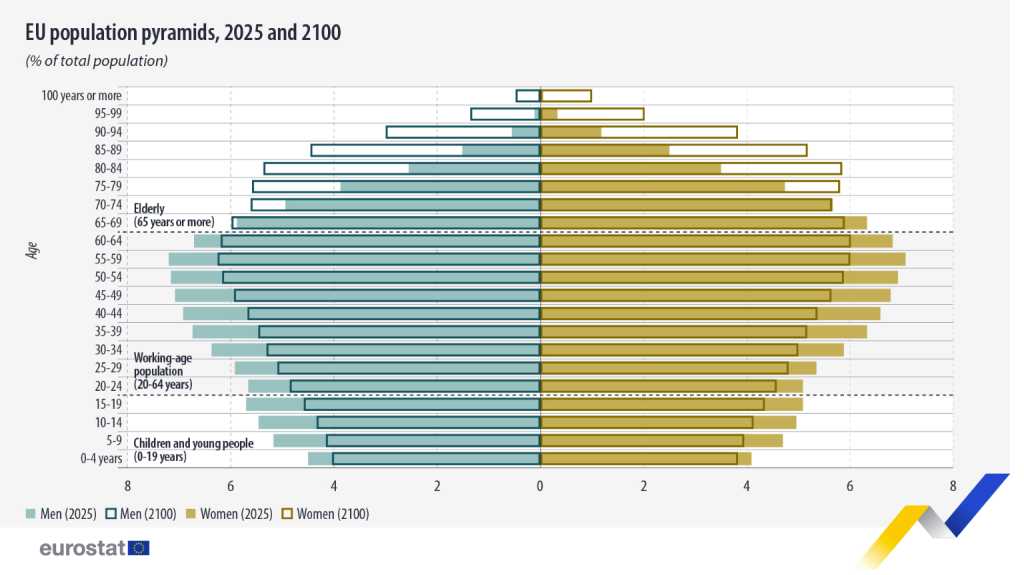
The real break, however, lies not in the absolute numbers but in the structure of society. Europe is ageing at a pace that will have far-reaching economic and political consequences. The share of the working-age population will fall from 58% to 50%. At the same time, the proportion of those aged over 80 will surge from 6% to 16%.
The demographic balance is thus fundamentally shifting. The classic population pyramid is losing its shape. What still has a broad base today will in future be defined by a relatively small younger generation and a dominant older cohort.
Demography as a Structural Shift
This development is the result of several trends that have been solidifying for years. Birth rates in many EU countries are well below replacement level. At the same time, life expectancy continues to rise. Migration can partially offset these effects, but it is neither sufficient in scale nor politically stable enough to reverse the trend. Even under optimistic assumptions, population ageing remains the central constant.
The EU population pyramid shifts from a broad working-age base in 2025 to a top-heavy structure by 2100, reflecting rapid ageing and a shrinking younger population. Source: Eurostat
The economic consequences are foreseeable and far-reaching. A shrinking workforce means fewer workers, weaker productivity potential and structurally lower growth. Companies will increasingly struggle to find qualified staff. At the same time, pressure on social systems will intensify. As fewer workers are required to support ever more pensioners and people in need of care, the existing model will come under significant strain.
Public finances will also have to adjust. Higher spending on pensions, healthcare and long-term care will meet a stagnating or shrinking revenue base. This will sharpen distributional conflicts and force governments into reforms that are politically difficult to implement. Experience shows that ageing societies often delay reforms because a growing share of voters directly benefits from existing systems.
Economic and Political Systems Under Pressure
A structural shift in the economy is also under way. Older societies consume differently. Demand is moving away from growth-oriented investment towards healthcare, care services and age-related products. That may strengthen certain sectors, but overall it points to weaker economic momentum and a more cautious investment culture.
Europe’s political landscape is changing as well. Societies with a higher average age tend to be more risk-averse. Long-term projects that involve short-term costs become harder to justify. At the same time, pressure on policymakers to stabilize existing systems increases, rather than to pursue new initiatives.
Eurostat’s projections are based on long-term assumptions about fertility, mortality and migration that change only slowly. Even when policy measures take effect, they do so with a significant delay. A lasting reversal of the trend is therefore not expected in the near term.
Europe thus faces a structural challenge that cannot be resolved through individual policy decisions. It requires a fundamental adjustment of the economy, social systems and political priorities to a reality of fewer people and significantly older societies.
The figures leave little room for interpretation. The decisive question will be whether Europe can turn this development into a new form of stability or whether demographic change will become a lasting strain on the continent.
Welcome to the comments section of the Štandard daily. Please take note of our guidelines, comments are moderated by us. You can contact the moderators at support@statement.com.
Participate in the discussion
Comments are available to subscribers only. If you'd like to join the discussion, choose a subscription starting at €6.72 per month.
All comments 0
Register
Comments are available to registered users only. If you'd like to join the discussion, register here.