Marriage plays an independent role in helping families stay together and improve their financial prospects, a new UK study shows.
Supporting family stability benefits both society and the economy, the report argues. Photo: Westend61/Getty Images
|
The received wisdom among most policymakers is that family stability is largely determined by socioeconomic factors. A new study disputes that assumption, suggesting marriage plays a significant, independent role in shaping household income and upward economic mobility.
By analyzing data from a long-term study of parents in the United Kingdom, the Centre for Social Justice (CSJ) found that marriage itself accounts for a substantial share of the gap in relationship stability and financial progress between married and non-married couples.
As a result, the British advocacy group argues that strategies to reduce poverty cannot succeed if they overlook family stability. The report therefore calls for the government to introduce policies aimed at strengthening marriages by supporting couples in the early years of parenthood and integrate family stability into its poverty strategy.
The report paints a bleak picture of the state of family stability in the UK. As marriage has ceased to be the default context for raising children and parental separation has become more common, child poverty has remained persistently high and inequality has widened.
Although the link between family structure and economic outcomes is well established, income has generally been seen as the main driver. Influential think tanks such as the Institute for Fiscal Studies, along with successive governments, have generally made little distinction between marriage and cohabitation.
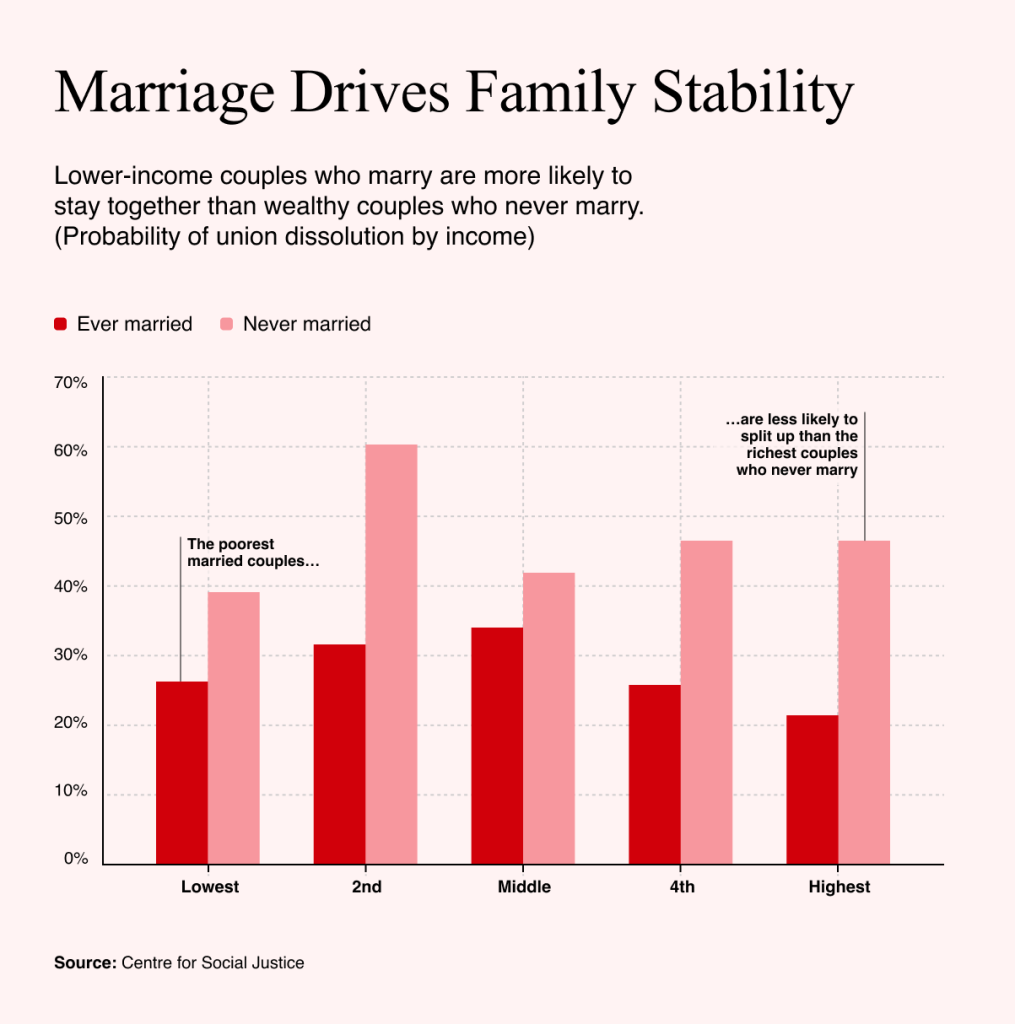
However, two key findings from the CSJ’s report, The Stability Advantage: Marriage, Family Breakdown and Poverty in the UK, challenge this belief. They show that over the first 14 years of parenthood, parents in the poorest fifth of households who married at any point during the study are less likely to separate than parents in the richest fifth who remain unmarried. This pattern persists even after controlling for a range of socioeconomic and demographic factors.
The authors also highlight the close relationship between family stability and financial progress. Parents who remain together are significantly more likely to move into higher income brackets, while those who separate are more likely to fall into lower ones.
According to the evidence, family breakdown is not only associated with poverty, it is also a “key mechanism through which poverty persists and deepens”, the authors write.
The report is based on data drawn from the Millennium Cohort Study, a nationally representative survey of almost 19,000 children born in the UK between September 2000 and January 2002. For its analysis, the CSJ examined 3,286 couples who became parents for the first time, were living together when their child was born and took part in all six rounds of the survey over the following 14 years.
According to the CSJ, the study's improved methodology and longer follow-up period produced more accurate results.
If income was the primary determinant of family stability, you would expect richer cohabiting couples to be more stable than poorer married couples. But the CSJ's findings point in the opposite direction.
Couples in the lowest economic category who married at any point during the study were significantly less likely to separate than those in the highest income category who remained unmarried, as the graph below shows.
Source: Centre for Social Justice
The difference — 26% versus 46% — remained even after the researchers accounted for 26 factors, including religion, education and employment status.
Income did, however, influence whether couples were married before the birth of their first child. Among the lowest earners, 32% were married before becoming parents, compared with 79% of the highest earners.
The findings suggest that marriage acts as a stronger safeguard against family breakdown than income, particularly for disadvantaged families. The CSJ argues this should be reflected more clearly in government policy.
Changing Government Policy
The report makes three policy recommendations for the British government, two of which relate to specific welfare reforms.
The first is to shift more child welfare payments to the early years of parenthood instead of distributing them evenly over a child’s lifetime. The CSJ says this is when families typically face the greatest financial pressure.
It also calls on the government to end what it describes as the “couples penalty”, under which people – especially mothers – can lose thousands of pounds in benefits if they enter into a relationship.
But perhaps the most significant recommendation is to make family stability a core part of the government's poverty strategy. The authors argue that current policy treats marriage as no different from cohabitation, despite long-standing warnings from bodies like the Catholic Church, as well as many conservative voices, that this approach undermines the institution of marriage and contributes to poorer social and economic outcomes.
Although it does not address political divisions, the study makes a strong case for the conservative view that stable marriages are necessary for a thriving society and economy.
The authors argue that even modest improvements in family stability would result in positive, large-scale effects across the UK. They conclude that encouraging stronger families involves no “coercion or moralizing”, just sensible policy, backed up by statistical evidence. It remains to be seen whether policymakers will heed the CSJ’s findings or stick to the status quo.
Given the growing emphasis in much of the liberal media and non-governmental organizations on destigmatizing non-traditional relationship and parenting structures – such as single parenthood and polyamorous unions – it is difficult to see the report's findings being reflected in public policy anytime soon.
Welcome to the comments section of the Štandard daily. Please take note of our guidelines, comments are moderated by us. You can contact the moderators at support@statement.com.
Participate in the discussion
Comments are available to subscribers only. If you'd like to join the discussion, choose a subscription starting at €6.72 per month.
All comments 0
Register
Comments are available to registered users only. If you'd like to join the discussion, register here.