Democrats Push Supreme Court Reform as Republicans Decry an Attack on the Judiciary
As the midterm elections loom, the Democrats are resurrecting a 90-year-old court-packing plan to reform the Supreme Court over liberal anger at its recent decisions.
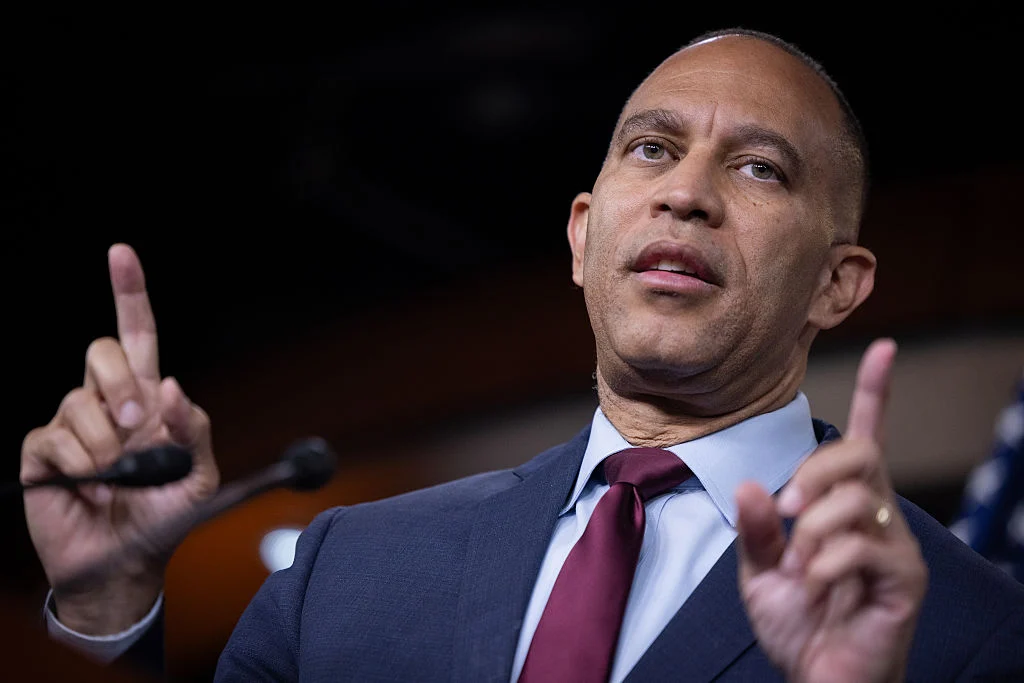
The Democratic House Minority Leader Hakeem Jeffries is leading the charge to make Supreme Court reform a key election issue. Photo: Nathan Posner/Anadolu via Getty Images
|
As the run-up to the American midterm elections heats up, the Democrats are trying to capitalize on what they see as the public’s discontent with the state of the Supreme Court.
It began over the summer with former US Vice President Kamala Harris reviving the Biden administration’s plea to reform the nation’s top court, going even further by proposing expanding it.
Since then, senior Democrats – in particular House Minority Leader Hakeem Jeffries – have thrown their weight behind proposals including packing the court with extra justices and introducing term limits.
The Democrats are targeting the court over anger at decisions favoring Trump policies, most notably its April 2026 ruling Democrats say weakened the Voting Rights Act. Some party figures also argue that polling indicates a majority of American voters are in favor of reform.
Republican candidates have predictably fired back at the proposals, accusing the Democratic Party of trying to undermine the independence of the nation’s top court.
However, even liberal commentators angry at what they perceive as MAGA’s control over the Supreme Court are not convinced by Democratic plans, warning of their effect on public opinion.
Calls for "dramatic reform"
While Kamala Harris got the ball rolling by calling for an increase in the number of justices, Hakeem Jeffries, the Democrats’ House Minority Leader and prospective speaker, is at the forefront of the party’s bid to make the Supreme Court an election issue.
He called for “dramatic reform” in a meeting with journalists earlier this month, expressing frustration with the court’s April 2026 decision in Louisiana v. Callais, which struck down a state law that allowed the use of race as a determining factor in creating election districts.
Jeffries and many other Democrats have been increasingly incensed by the conservative-majority court’s decisions, accusing the three Trump-appointed justices of using the court to implement MAGA policies.
This is despite the fact that the court has not infrequently found itself in the US president’s crosshairs, including for blocking Trump’s bid to end birthright citizenship and rejecting his appeal against a $5m judgment awarded to E. Jean Carroll after a jury found him liable for sexual abuse and defamation.
If the Democrats win the midterms, Jeffries said there were a variety of options on the table, calling the status quo “unacceptable”.
https://twitter.com/RepJeffries/status/2092229274816102903
Jeffries rails against the Supreme Court's 24 August decision on Trump's controversial bid to reform the US mail-in voting system.
Momentum Builds
Since then, a string of op-eds and analysis in liberal-leaning publications – such as the Washington Post and the Los Angeles Times – have weighed in on the prospect of reform, giving vent to Democratic anger.
There is also increasing political support, largely on the progressive wing. For example, Representative Alexandria Ocasio-Cortez has been a long-time supporter of expanding the number of justices.
Meanwhile the Democratic Senate candidate Abdul El-Sayed supports term limits instead of lifetime appointments, according to his campaign website, which also calls the Supreme Court a “major impediment for democracy”, Bloomberg Law reports.
However, the idea is gaining currency with so-called moderates such as California Governor Gavin Newsom, who has warmed to the proposal after initial opposition, along with Senate candidates in Texas and Iowa.
Term Limits and Court Packing
Term limits and expanding the court – called court packing by critics – to as many as 13 justices are the two proposals with the most support so far.
At present, once you are appointed to the Supreme Court, the US Constitution states that you are there for life, depending on “good behavior” in office.
While introducing term limits – either of a specified length or through an age cap – is the most popular option with the public, it would likely require altering the Constitution, a lengthy process with no guarantee of success.
The option with the most immediate impact would be to revive the almost 90-year-old policy of court packing, first attempted with any real gusto by Franklin D. Roosevelt in 1937.
He too was frustrated with decisions by the Supreme Court, but even at the heights of his power, Roosevelt could not win public support for his plan to expand the number of justices.
The court has changed size in the past, but the number of justices was set at nine in 1869 and has remained constant ever since.
However, the Democrats justify their moves today by claiming that 13 justices would be more nationally representative, reflecting the 13 federal circuit courts in the US.
It is also a plan that could be implemented more quickly, without tricky constitutional questions – although it would still likely require the Democrats to control Congress and win the 2028 presidential election.
The figure of 13 justices would, quite conveniently, give the Democrats the chance to select four new justices themselves, shifting the balance of power from a 6-3 conservative majority to a 7-6 liberal one.
Unsurprisingly, Republicans have hit back strongly. Even before Jeffries' latest comments, Senator Chuck Grassley accused him of “orchestrated attacks on the judiciary”, which he said “undermined public trust”. Grassley and Jeffries clashed on the issue during a political debate.
Grassley proposed a constitutional amendment that would fix the number of justices at nine, a proposal previously supported by prominent Republicans like Marco Rubio when he was a senator, as well as Senator Ted Cruz.
However, it is not only Republican voices criticizing the proposal. Center-left news outlet The Hill published an op-ed warning that Democrats may regret their push for reform, saying it distracts from the real issue: a Congress unwilling to defend its prerogatives.
Similarly, after Democrats responded fiercely to the Supreme Court’s April ruling on the Louisiana case, CNN warned that the party’s “Trump-esque” rhetoric risked “further damage” to the court’s credibility in the eyes of voters.
Judicial Independence
A Gallup poll taken in July found the court had its lowest approval rating since the respected pollster started collecting data on the issue in the year 2000.
As the CNN article outlined, the Supreme Court has become the focus of ire from both sides of America’s political divide, with liberals growing increasingly disenchanted following recent court decisions.
However, as has been argued in Statement previously, an independent judiciary causing frustration for both parties’ supporters is likely a sign it is doing its job well.
Reforming the Supreme Court might seem an easy win for the Democrats, but as even liberal voices warn, they would do well to remember that the independence of a nation’s judiciary is one of the key pillars of liberal democracy.