
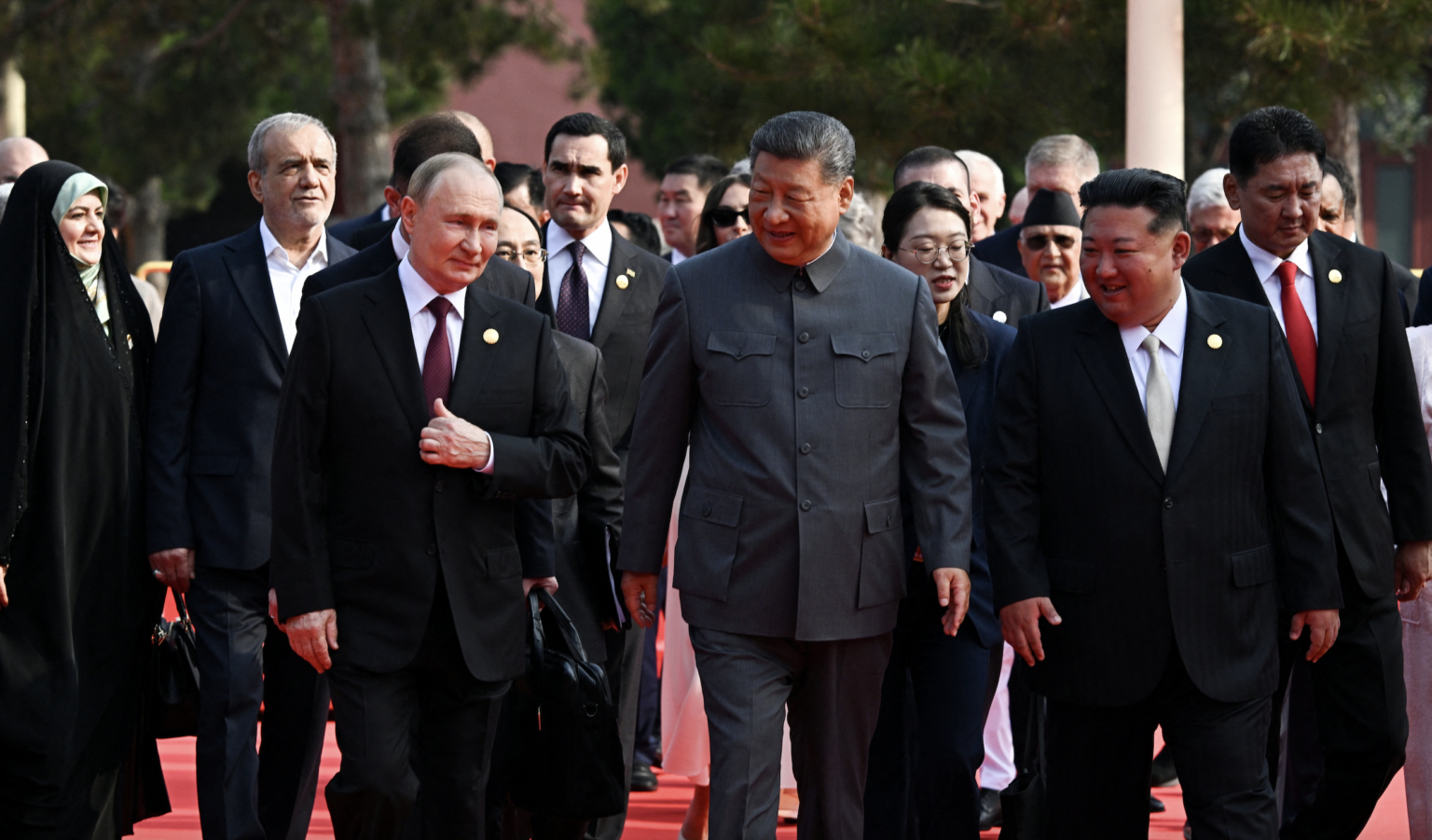
The host, Chinese President Xi Jinping, declared that the world was facing a “choice between peace and war” and presented an image of a self-confident, strong, and independent China.
At his side were Russian President Vladimir Putin and North Korea's supreme leader Kim Jong-un. Also present on the podium were Belarusian President Alexander Lukashenko, Iranian President Masoud Pezeshkian, and Serbian President Aleksandar Vučić.
The only high-ranking representative of an EU and NATO member state was the Prime Minister of the Slovak Republic, Robert Fico.
The Chinese president's message
Xi Jinping's short but concise speech was dominated by contrasts: “peace or war, dialogue or confrontation.” According to Xi, the “revival of the Chinese nation is unstoppable” and Beijing will continue to follow the “path of peaceful development.”
He declared that China was ready to “work hand in hand with the peoples of all countries.” The news portal Politico recalled that Xi described the Chinese people as a nation that “is not afraid of violence, is independent and strong.”
The ceremony began with 80 gun salutes and the national anthem “March of the Volunteers.” In his capacity as chairman of the Central Military Commission, Xi Jinping then drove past the military units lined up on Chang'an Avenue in a black limousine.
The soldiers greeted him with the cry “Serve the people” – a moment that the AP news agency described as a central element of the patriotic ritual.
The trio of Xi, Putin, and Kim
The most powerful visual symbol of the day was the joint appearance of the three heads of state—Xi Jinping, Vladimir Putin, and Kim Jong-un—side by side on the grandstand. Beforehand, they had shaken hands with World War II veterans and waved to the cheering crowd with smiles.
BREAKING: Xi Jinping, Vladimir Putin, and Kim Jong Un have arrived for the start of China's biggest ever military parade
— Sky News (@SkyNews) September 3, 2025
Watch live: https://t.co/95pL7zkMJV
📺 Sky 501, Virgin 602 pic.twitter.com/y4mkyVP4Ii
The British newspaper The Guardian interpreted this image as a demonstration of power by an alternative geopolitical pole to the US and its allies. According to analysts, if this trio were to indicate a closer military partnership, it could fundamentally change the military balance in the Indo-Pacific region.
Putin used his visit to China to sign new energy agreements with Beijing, while Kim sought the opportunity to gain indirect support for North Korea's banned nuclear weapons policy.
It was the first time in 66 years that a North Korean leader had attended a Chinese military parade. Kim traveled with his daughter Ju-ae, who, according to South Korean intelligence, is considered a possible successor – but she was not seen at his side during the parade.
China presents its new weapons to the world
The parade lasted about an hour and a half and featured thousands of soldiers and hundreds of pieces of military equipment. The Chinese army unveiled a new generation of weapon systems, many of which were on public display for the first time.
On display were intercontinental ballistic missiles, hypersonic anti-ship missiles from the YJ series, and laser and anti-aircraft systems designed specifically to defend against drones. The specialist portal Naval News also referred to unmanned underwater drones that can operate autonomously at great depths – a technology that could fundamentally change the nature of submarine warfare.
So-called “Loyal Wingman” drones – escort drones that operate in conjunction with manned fighter jets – also attracted attention. Experts see this as a response to experiences in Ukraine and the Indo-Pacific region, where unmanned systems and the fight against them are becoming increasingly crucial.
According to analysts, President Xi Jinping had several goals in mind with this display: to send a signal to the US and its allies, to neighboring countries, to major powers such as India and Russia, and to potential buyers of Chinese defense technology.
⚡️Chinese soldiers march in military parade celebrating 80th anniversary of victory over Japan in WW2. 🎥
— The World War (@TheWorldWar12) September 3, 2025
China showcases nuclear missiles, anti-drone tech, and unmanned fighter jets at Victory Day parade in Beijing. 🎥📸 pic.twitter.com/oeu4tEqugh
Taiwan warns – and Donald Trump taunts again
Taiwan's President Lai Ching-te recalled that Japan's surrender in 1945 was signed on behalf of China by the then Republic of China. In a post on social media, he criticized “fascist characteristics” such as extreme nationalism, personality cults, and a network of secret police – an indirect jab at the images of the parade in Beijing.
US President Donald Trump also couldn't resist a dig, ironically greeting Xi Jinping, Vladimir Putin, and Kim Jong-un as those who “conspire together against the US.” At the same time, he reminded everyone that it was the United States that provided significant support to China during World War II.
Trump had previously told journalists that he did not see the military parade as a challenge to the US. A spokesperson for the Japanese government declined to comment on the parade, but emphasized that Asia's two largest economies were working on “constructive relations.”
(reuters, est)