
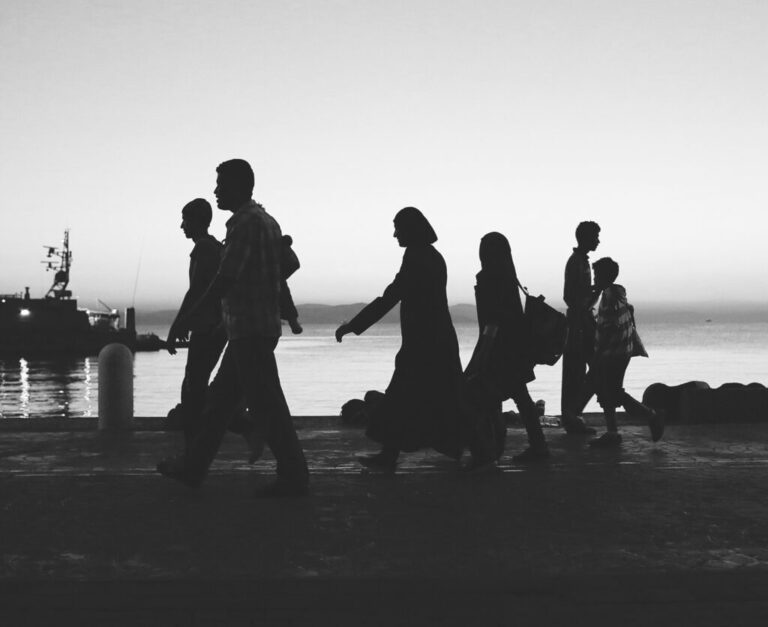
Thus far, this Summer has brought us images one would expect to see in dystopian fiction: vigilantes with night vision goggles on are patrolling the German-Polish border, and angry British families are protesting the housing of illegal migrants in coastal towns like Epping.
Meanwhile, the European establishment is staging ever more conferences while offering ever fewer answers. Distrust of the political class runs deep—and not just in rural areas.
An Overloaded Continent
Ten years after she made the statement, Angela Merkel’s famous ‘We can do it’ now rings hollow. Asylum applications in the EU have declined slightly since the 2023 peak—with around 1.01 million first-time applications in 2024—but any talk of relief is premature. Monthly figures for 2025 show persistently high levels. Added to that are tens of thousands of illegal entries, an estimation as best as many are unrecorded. Italy's former interior minister Matteo Salvini repeatedly stresses that border protection is not only necessary but a fundamental right, and leaves no doubt that states must decide who enters.
The political response? The terminology might have changed, but the way of doing things remains much the same. In Brussels, officials avoid talking openly about migration control, preferring euphemistic labels like the ‘Global Approach to Migration and Mobility’ (GAMM)—a technocratic term for repatriation deals, mobility partnerships, and legal migration channels that sidesteps the real issue. In Berlin, it's ‘migration management’, in London, a ‘humanitarian challenge’.
And it very much is a ‘challenge’. Germany’s 2024 crime statistics report over 217,000 violent offences –a 1.5% increase over the previous year. Particularly notable is the 7.5% rise in non-German suspects in this category. In France, authorities speak of ‘lost zones’ in the banlieues, though hard data on youth violence in migrant-heavy suburbs remains sparse. In the UK, the Metropolitan Police reported a new record in knife attacks in 2024 – many in areas with high levels of immigration. Yet those who ask why violence is on the rise in cities like Marseille, Malmö, or Mönchengladbach are quickly labelled as extremists of some kind.
Security as a Private Matter
Where the state fails to assure its citizens’ safety, the latter take it upon themselves—out of fear, frustration, and indeed, necessity. In Saxony and Brandenburg, domestic intelligence and police are observing grassroots groups forming self-organised border patrols or instituting ‘protection zones’. Authorities insist the state holds the monopoly on violence, yet informal networks claim they have been abandoned. Internally, intelligence services warn: these groups risk radicalising, and could attract far-right ideologies.
National politicians are calling for vigilance. Wherever such groups emerge, German authorities have emphasised that civilian border-control attempts would be illegal—and must be suppressed ‘immediately.’ Chancellor Friedrich Merz has re-emphasised that only federal police may act at borders and must intervene when private vigilante groups appear. What was once a state monopoly—border control and maintaining public order—isnow being contested. Where institutions are absent or too slow, dangerous gaps form—with some stepping in to fill them.
Media Reflexes
The media’s response has been mostly reflexive. Critics of the current migration policy are swiftly branded ‘far-right’, ‘xenophobic’, or ‘reactionary’. The lines between analysis, polemic, and taboo have been blurred.
Take the case of German journalist Matthias Matussek—once a celebrated Spiegel reporter, later a Welt columnist—who hasn’t appeared on public television in years. His offence? Openly, sometimes provocatively, criticising Merkel’s welcoming stance. What once counted as democratic dissent is now labelled ‘toxic’.
The pattern is the same across the Channel. Britain’s Conservative Party struggles to define itself. Nigel Farage, still popular under Reform UK, sounds increasingly mainstream. Many wonder why he no longer hits the immigration issue as hard. Even on the island, once a bastion of combative discourse, public debate has cooled. A culture of moral intimidation seems dominant. Not every opinion is banned—but those who stray too far from acceptable speech are publicly discredited, socially isolated, and algorithmically suppressed.
Who Protects the People—and Who Defines Them?
For years, Europeans laughed at the notion of ‘populist’ movements gaining real power—that is, until Donald Trump. Now many see in him all which Europe lacks. Among them Liz Truss, Britain’s short-lived former Prime Minister, now a guest at Viktor Orbán’s forums in Hungary. In podcasts, she speaks openly of the influence of technocrats and bankers on No. 10, warning that Britain has little time left to turn the ship. Starmer, the current PM, is not, in her view, the right man for the job.
Does Europe then need more, not less populism to save itself? Or put differently: what exactly is wrong with doing politics in the interest of the people? Doesn’t democracy mean that majorities should shape decisions?
Law Without Reach?
But even those who win elections hit a wall: the law. Treaties like the Geneva Convention or EU human rights standards make deporting rejected asylum seekers and setting immigration caps legally difficult. Legal experts warn that the rule of law may fail by its own rigidity, unable to adapt to new social pressures.
A current example is AfD politician Maximilian Krah. Once an advocate of strict ‘remigration’ policies, in 2025 he has taken a softer stance, having distanced himself from ethno-nationalist rhetoric.
Krah acknowledges that such concepts are ‘unrealistic’ and ‘constitutionally problematic’. This repositioning places him at odds with the party’s radical wing—and underscores how even populist movements come against entrenched legal limits. The real question remains: how can law be reformed to preserve its effectiveness without sacrificing its core norms?
British author Douglas Murray warned in The Strange Death of Europe that Europe isn’t collapsing through outside pressure but because of internal weakness—a mixture of legal inflexibility, moral self-flagellation, and political cowardice. He writes: ‘Europe is committing suicide… because it has lost faith in its beliefs, traditions, and legitimacy.’
America as a Beacon of Resolve?
While Europe argues, others act. The United States under Trump pursues strict border controls, deportations, and bilateral deals with origin countries. The Supreme Court reinforces executive powers on migration. Like him or not, Trump has what many Europeans say they lack: political resolve.
What Europe lacks is not only a migration strategy. It lacks a renewed self-conception. It needs no walls—but also for the floodgates not to be open. What it needs is responsibility, the courage to be selective, as well as being honest with its people. Legal reforms to restore the state’s capability to make decisions for itself are equally necessary. For without borders, there is no polity. Without control, no liberty. And without a people, no democracy.
Statement
Ongoing mass migration has worn away Europe’s social cohesion—especially in its cities. Its traditions of democracy and free speech are also under attack. Those who raise concerns are smeared, while those demanding accountability are branded as dangerous. Yet politics that refuses to reflect the will of the people undermines its own legitimacy. This is not about isolationism, but preservation. Not about racism, but realism. Should Europe fail to stop its decline—politically, legally, and culturally—the danger it faces is not that of a far-right revolution, but that of a slow disintegration.