
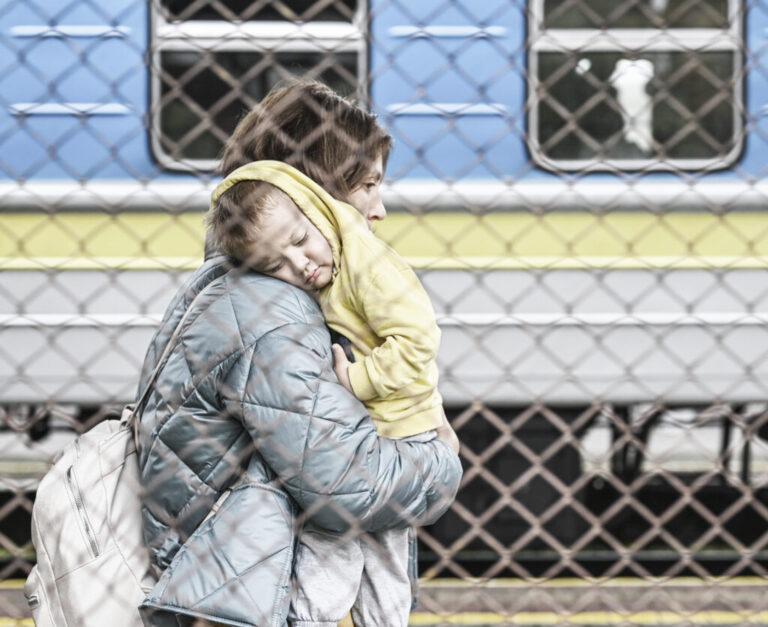
In February 2022, when the first air-raid sirens pierced the dawn air of Kyiv, a rapid exodus took place. Mothers hurriedly packed bags, children clutched stuffed animals, and whole families poured into train stations without knowing where they were going—only that they had to leave.
By the time the smoke had cleared after the first missile strikes, thousands were already crossing the border into Poland, a country that, overnight, had become both a sanctuary and the site of an unfolding humanitarian crisis. The roads from Lviv to Przemyśl, once the neglected periphery of Europe, turned into lifelines.
More than 3.5 million Ukrainian refugees crossed into Poland during the early stages of the war. Around 1.5 million—just over 40%—stayed, while the rest continued on to places like Germany, the Czech Republic, or even Canada. In those first months, Poland’s response was marked by a wave of solidarity. Public support was strong, driven by sympathy for Ukraine and long-standing distrust of Russia. The warm welcome was also seen as a reply to Western European criticism: that Central and Eastern Europe, often accused of rejecting migrants from the Middle East and Africa, could be open and generous—just more selective about who they welcomed in. These were not economic migrants, but women and children fleeing a war happening next door.
Demographic Hopes, Harsh Realities
But there were also practical reasons for Poland’s openness. One of the biggest threats to its economic future is demographic decline. Fertility plunged in the 1990s to 1.3 children per woman, and has since slipped further—to just 1.1, among the lowest rates in the world. Poles embraced capitalism with enthusiasm, but rapid growth came with trade-offs: smaller families, delayed parenthood, and a shrinking pool of young workers. The country’s post-communist boom now risks stalling for a lack of people to sustain it. By 2060, Poland’s population could drop from 38 million to 26.7 million. The elderly are projected to then make up nearly 40% of the population. Against this backdrop, the arrival of over a million Ukrainians—mostly women and children—was seen by many as a demographic lifeline.
While the post-invasion influx drew the most attention, the Ukrainian presence in Poland was already significant before the war. By 2021, as many as 1.5 million Ukrainians had migrated to Poland, drawn by higher wages and labour demand. But Ukrainians are unlikely to solve Poland’s demographic crisis. For one, Ukrainian women also have low fertility rates—barely higher than those of Polish women—offering little hope of reversing long-term population decline. Their presence may ease short-term labour shortages, but it does not provide a structural fix. Meanwhile, the early wave of solidarity has faded. Public attitudes toward refugees have cooled noticeably, as economic and integration pressures have mounted.
Not Enough People, Too Much Politics
After the upheavals of the 20th century—war, shifting borders, and mass population movements—Poland emerged from the communist era as an almost entirely homogenous nation-state. With limited experience of multiculturalism, Polish society has struggled to adapt to large-scale migration. Tensions with Ukraine have resurfaced. The legacy of the Volhynia massacres—when Ukrainian nationalists killed tens of thousands of ethnic Poles—still casts a shadow.
These historical wounds have re-entered political discourse, featuring in debates in recent parliamentary and presidential elections. Economic frictions have added strain. The inflow of cheap Ukrainian grain into the EU—vital for Ukraine’s wartime economy but damaging to Polish farmers—has repeatedly triggered protests and soured bilateral relations. Meanwhile, many Ukrainian refugees have moved on. Of the 1.5 million who registered for residency in 2022, fewer than a million are thought to remain—and some estimates place the figure as low as 600,000. Germany, in particular, has attracted many with its stronger welfare system.
In the broader context, Poland faces demographic dilemmas common to many developed countries. Rapid growth has pushed Poland into the high-income bracket, but this success has come at a cost. Persistently low fertility rates now threaten both long-term economic growth and national security. Ambitions to field one of Europe’s largest armies, for instance, will eventually be thwarted by a shrinking pool of recruits. Immigration provides only limited relief. Migrants from culturally similar countries such as Ukraine or Belarus are merely a band-aid, as their fertility rates closely mirror Poland’s own.
Immigration from further afield—particularly from Muslim-majority countries—could lift birth rates in the short term, but it threatens to undermine Poland’s social cohesion. Many Poles regard Western Europe’s experience with mass immigration as a cautionary tale and are determined to avoid similar outcomes. Even the current centrist government has maintained a hard line on migrants trying to cross Poland’s border with Belarus. Ultimately, raising fertility among native citizens will require a profound cultural shift—something no government has managed to engineer. In the meantime, Poland’s best strategy may be to adapt to having an ageing population and mitigate the economic and strategic risks that flow from that reality.
Statement
When Russia invaded Ukraine in 2022, Poland became the primary destination for fleeing civilians, as over 3.5 million crossed its border. Poland's decision to give a helping hand was both emotion-based and pragmatic: while sympathetic to the Ukrainians’ plight, Poland faces a severe demographic crisis, its fertility being among the lowest in the world. Yet hopes that Ukrainians might reverse this trend are fading, as many have left and their fertility rates mirror Poland’s. Integration strains, historical grievances, and economic disputes have soured public sentiment. Long-term, Poland must confront its ageing and declining population without relying on immigration alone.