
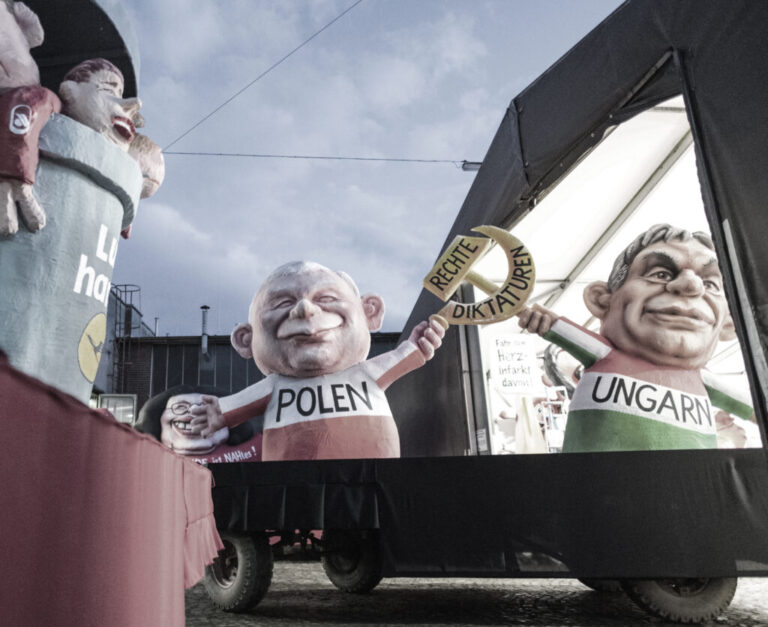
In Warsaw, Budapest – and increasingly in Brussels – an ideological shadow war is raging. No longer between left and right, but between an overly open Union and an ideological parallel universe that claims to be Christian-conservative, yet is in fact trapped in outdated modes of thought. Jarosław Kaczyński and Viktor Orbán stand at the centre of a network that presents itself as the vanguard of a moral renewal – but has long since become a dysfunctional relic of past political battles.
What began as an identity-driven project with slogans like Nation, Family, God has become above all an inefficient, self-perpetuating system of buzzwords, foundations and pseudo-solutions. Poland’s PiS and Orbán’s Fidesz uphold a model that governs with authoritarian leanings, speaks in religious tones, but offers no connection to contemporary social realities. Their vision looks backward, their methods are repetitive. This is a network locked in an endless struggle against liberalism – yet offering no alternatives. A political perpetuum mobile stuck in reverse.
Orbánism as a Model of Decline
With his media empire and the “Mathias Corvinus Collegium” foundation, Orbán has built a bubble that celebrates itself but has little intellectual resonance beyond its own borders. Instead of debate – repetition. Instead of ideas – cadre development. The foundation, endowed with assets worth billions, does produce a new generation – but one educated in a worldview increasingly detached from European and geopolitical realities. In Poland, attempts to copy this model are under way – albeit with less money and greater dependence on international allies.
A particularly telling example of this self-referential structure is the so-called “free media” scene. What appears to be a diversity of voices turns out to be an echo chamber of bloggers, YouTubers and “documentary makers” who quote, praise and invite each other to conferences. In Warsaw, or at the Institute of National Remembrance, there are no critical discourses – only the same narratives repeated ad nauseam: the EU is evil, the West is decadent, gender ideology a conspiracy. It might all be true – but if that’s the case, why isn’t anything being changed? Beyond their own social media channels and pseudo-journalistic videos, the impact is negligible. What remains is a fatigued posture of resistance with no strategic horizon.
The Internationalisation of Provincialism
Much has been written about the international networking of these circles – about conferences in Bratislava and elsewhere. But anyone attending these gatherings will quickly realise: this is more of a class reunion of a self-appointed counter-elite, reassuring each other of their continued relevance. Bewitched apprentices. On stage: the usual types – former diplomats, ex-intelligence operatives, spokesmen of a milieu that still believes it can score points by railing against “Brussels”. Yet many of these figures appear more like agents of a bygone age – professionally equipped, but strategically aimless.
Donald Tusk, Poland’s Prime Minister, serves as a target for this milieu – not because he poses a real threat, but because his mere existence as a liberal, pro-European politician undermines their narrative. The vehemence with which he is attacked betrays one thing above all: deep insecurity. Those who must demonise Tusk in such terms no longer have a political agenda or ideas – only moral indignation and indoctrinated linguistic templates.
President-elect Karol Nawrocki is a symbolic embodiment of the intellectual dead end of Poland’s new right. Rather than looking forward, he retreats into a mystified past. Instead of historical engagement: sacralisation of national trauma. His closeness to PiS secures him power, but not legitimacy. His speeches sound as if they were written in another era – even if some younger voters supported him, he is not an independent personality, nor a man of vision. Just as his opponent Rafał Trzaskowski was not – who now plays once again the part of Warsaw’s contented mayor.
Statement
What Kaczyński, Orbán & Co. are engaged in is not a defence of Christian civilisation – it is a political act of self-deception, masked in religious symbolism. Their networks resemble poorly aged performances of a culture war that now only plays out within their own ranks. Their rhetoric is morally charged, but intellectually hollow. Their structures appear powerful, but are internally void. Something new will have to come.