
In the shadow of global economic turbulence, Central Europe’s Visegrad Four—Poland, Hungary, Czechia, and Slovakia—have charted distinct paths, with only Slovakia embracing the euro. The decision to stay outside the eurozone for Poland, Hungary, and Czechia has sparked debate: has it shielded them from the bloc’s woes or denied them its stability?
Recent crises—the 2008 financial crash, the Covid-19 pandemic, and Russia’s war in Ukraine—have tested these economies, while rising tariffs and trade tensions threaten global growth. The World Bank now forecasts weaker global GDP expansion, with inflation lingering like an unwelcome guest. Yet, the Visegrad countries, for the most part, have shown remarkable grit.
Visegrad’s Economic Scorecard
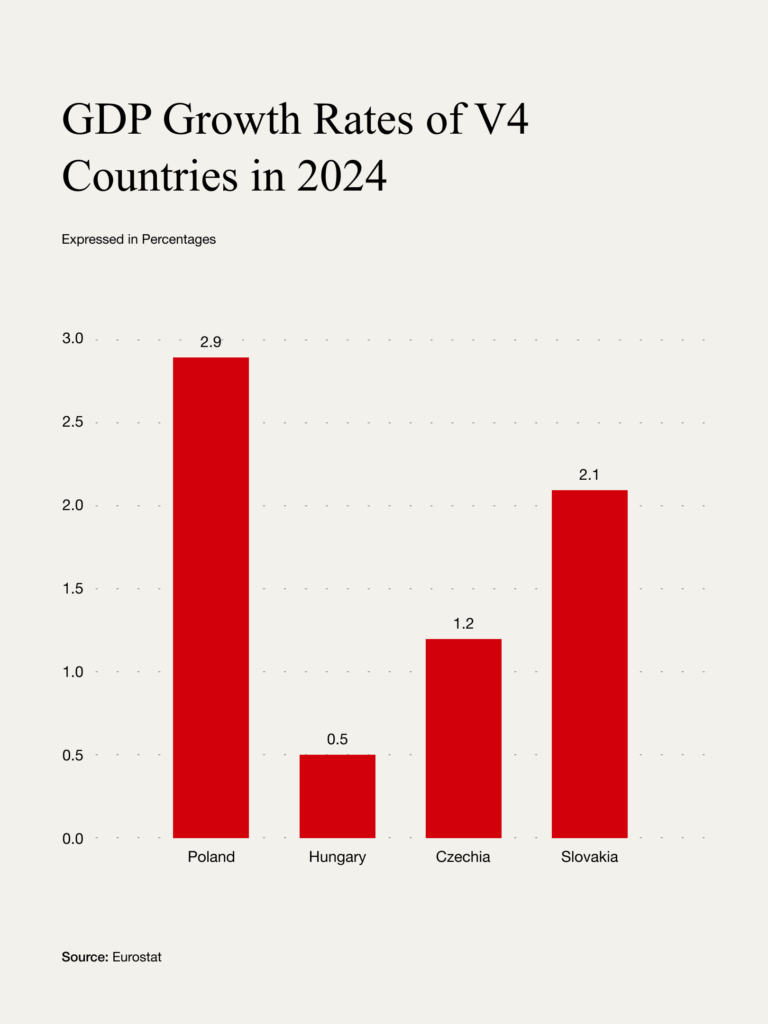
Poland’s economic ascent is the region’s standout story. In 2024, its GDP growth of 2.9% outpaced many eurozone peers, driven by infrastructure spending and EU recovery funds unlocked after rule-of-law reforms. Inflation, tamed to below 4%, allowed the central bank to ease rates, boosting confidence. This resilience stems from Poland’s flexible zloty, which cushions external shocks by adjusting export competitiveness. The 2008 crisis, where Poland avoided recession, cemented this advantage, as did its ability to navigate Covid-induced supply chain snarls.
Hungary, by contrast, is a cautionary tale. Its 0.5% growth in 2024 reflects an economy battered by inflation, which soared to 25% in 2023 due to energy price spikes and wage pressures. EU funds, worth €19 billion, remain frozen over governance disputes, starving investment. The forint’s volatility has compounded woes, unlike the zloty’s stabilising role. Hungary’s trade exposure, particularly in automotive sectors, makes it vulnerable to global tariff hikes, with US trade policies adding uncertainty. The European Commission projects Hungary’s GDP to grow by 0.8% in 2025, but inflation, forecast at 4.1%, remains a drag.
Czechia strikes a middle ground. Its 2024 growth of 1.2% reflects cautious optimism, with inflation cooling to 2.5%. The koruna’s flexibility has helped exporters weather global demand dips, though high energy costs from the Ukraine war hit manufacturing. Czechia’s fiscal discipline, with a deficit of 2.8% of GDP, contrasts with Hungary’s 4.9%. Yet, investment lags, hampered by policy uncertainty and tariff threats. The World Bank’s downgraded global growth forecast—2.3% for 2025—signals headwinds, but Czechia’s balanced approach keeps stagflation at bay.
Slovakia, the eurozone outlier, offers a mixed picture. The euro stabilised trade and attracted foreign investment, contributing to 2.1% growth in 2024. But eurozone membership exposed it to shared risks, like ECB rate hikes squeezing borrowers. Inflation, at 3.1%, mirrors eurozone trends, offering little respite for households. Slovakia’s energy import reliance, exacerbated by the Ukraine conflict, mirrors vulnerabilities in eurozone giants like Germany. While the euro eased some shocks, it didn’t insulate Slovakia from global trade disruptions or stagflation risks.
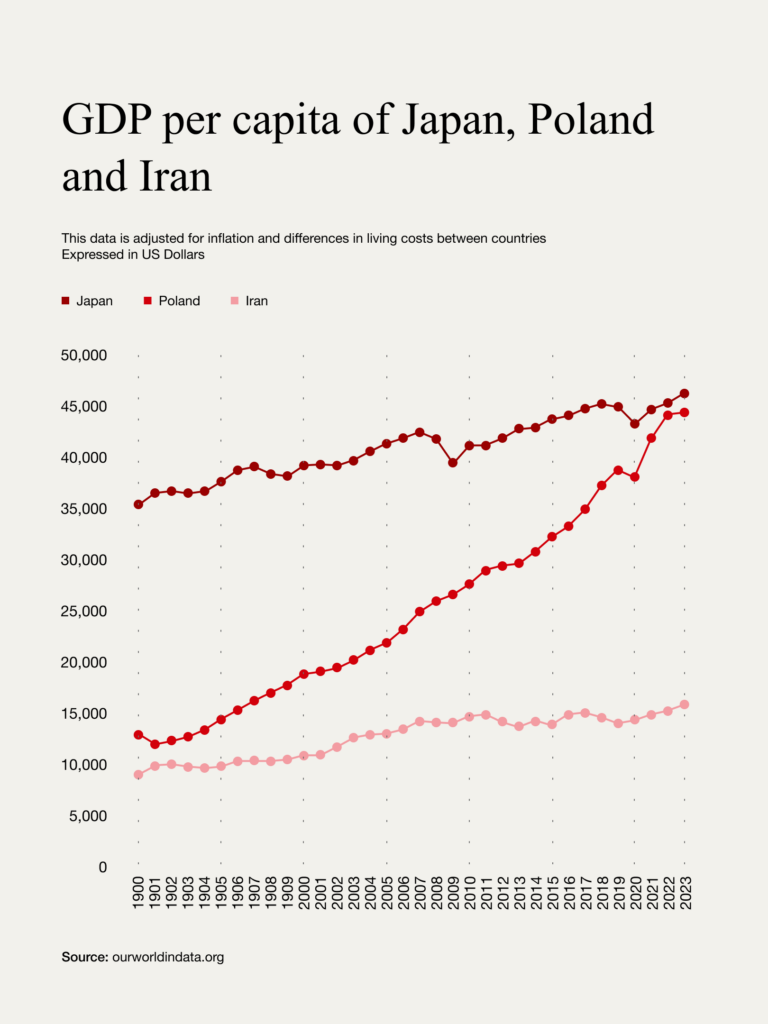
To put things into broader context, Poland’s GDP per capita has surged from $10,000 in 1990 to over $40,000 by 2023, reflecting its robust economic rise. In contrast, Iran’s GDP per capita remains relatively stable, hovering around $15,000, underscoring Poland’s superior growth trajectory.
Global Trade and Stagflation Risks
The global economy is at a crossroads. Tariffs, notably from the US, have upended trade, with the European Commission estimating a 0.2% GDP hit to the EU in 2025. The World Bank’s grim outlook—global growth at 2.3% in 2025, the weakest in 17 years—reflects this fracturing. The fragmentation of the supply chain, coupled with energy price volatility from the Ukraine war, fuels inflation, which the IMF projects at 2.4% for the EU in 2025. Stagflation, last seen in the 1970s, threatens if growth stagnates further.
For the Visegrad Four, trade exposure varies. Poland and Czechia, with diversified exports, are better positioned than Hungary’s car-centric trade or Slovakia’s eurozone ties. Yet, all face risks from US-China trade tensions diverting flows. The IMF warns that persistent inflation could force tighter monetary policies, choking growth. Visegrad’s non-euro members retain monetary autonomy, allowing tailored responses—Poland’s rate cuts contrast with the ECB’s rigidity. Public opinion, wary of eurozone constraints, reinforces this stance: polls show 60% of Poles and Czechs oppose euro adoption. In Hungary, despite the opposite trend, quick change is unlikely as the Forint was enshrined in the Constitution as Hungary’s currency in 2011.
Slovakia’s experience underscores the euro’s double-edged sword. It gained stability but lost flexibility, facing the same ECB-driven rate hikes as troubled eurozone economies. The Visegrad’s broader lesson is clear: currency sovereignty, while not a panacea, has helped Poland, Czechia, and even struggling Hungary navigate crises with agility. As global trade splinters and stagflation looms, Central Europe’s euro-scepticism looks less like obstinacy and more like prescience, a choice to dance to its own economic tune in a discordant world.
Statement
The Visegrad Four—Poland, Hungary, Czechia, and Slovakia—have weathered global economic storms, from the 2008 crisis to Covid and the Ukraine war, with mixed but largely positive outcomes. Poland’s 2.9% growth in 2024 highlights the benefits of currency flexibility, while Hungary’s inflation woes underscore governance challenges. Czechia’s steady path and Slovakia’s eurozone experience show trade-offs: stability versus autonomy. Despite tariff-driven global growth downgrades and stagflation risks, non-euro Visegrad countries have thrived by retaining monetary control. Public resistance to euro adoption, rooted in a desire for independence, suggests Poland, Czechia, and Hungary will stay outside the eurozone, a choice that has, on the balance, served them well