Faux iPhone unboxing for $14 reflects a shift from labour to attention. Value now lies in optics, not effort, in a $32.5bn influencer economy.
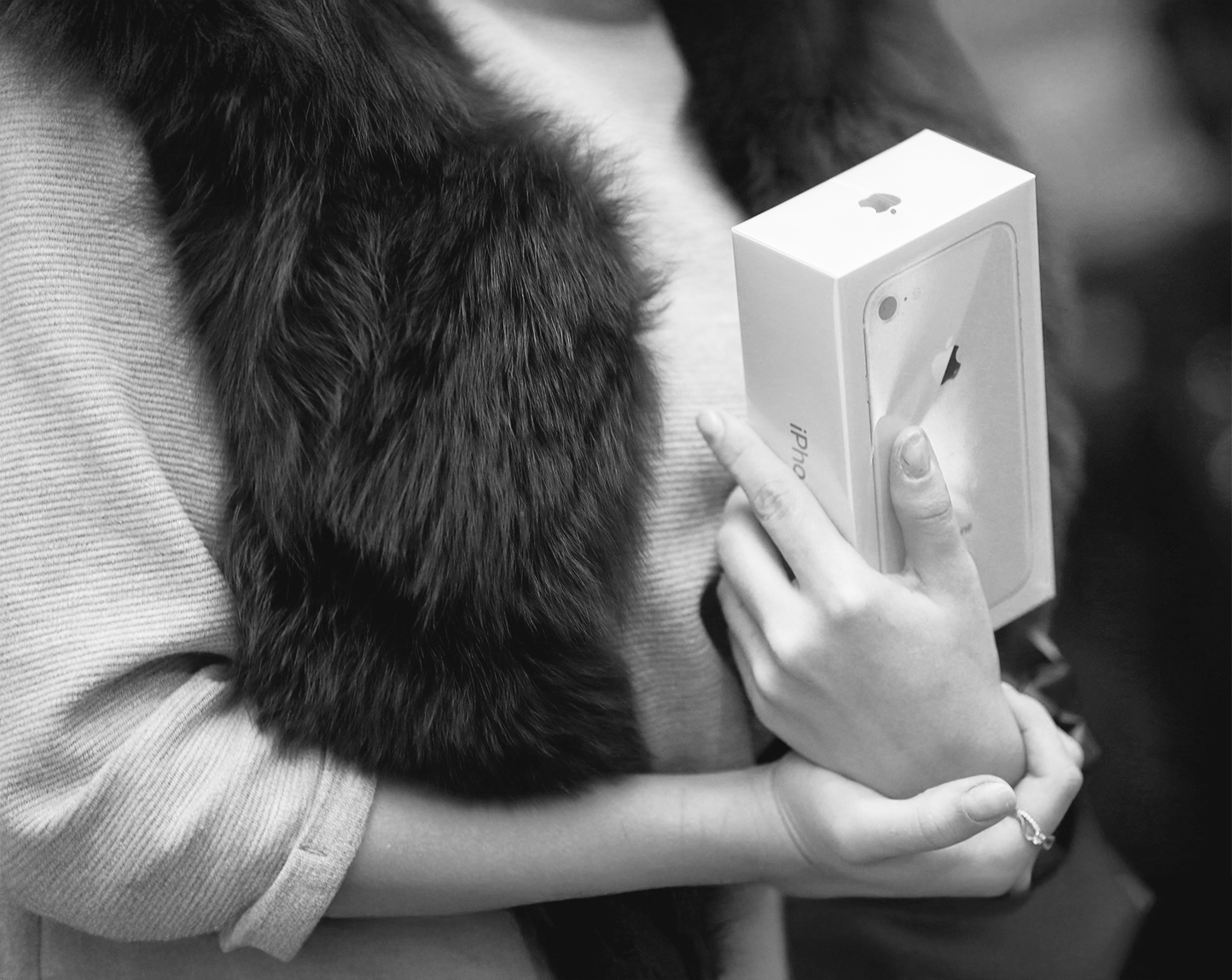
For just $14, one can buy a pristine iPhone 16 box—dummy phone included. Absurd? Perhaps. A hollow shell with no utility, bought solely for effect. At first glance, this seems absurd: why buy a sleek cardboard shell that serves no functional purpose? And yet, the answer is deceptively simple: for a short-form video in which someone performs the ritualistic unboxing of a phone that retails for no less than $799. In the age of performative consumption, authenticity is no longer a prerequisite for influence. Apple is often accused of selling marketing rather than innovation—but even its packaging is now commodified. What we are witnessing is not simply marketing, but hypermarketing.
From Object to Ontology
The Apple box is merely a symbol of a larger shift. Classical economists such as Adam Smith or David Ricardo understood value as a function of labour—how much effort was needed to make something. On that basis, a phone box is worth a few cents. Later theories, like marginal utility, saw value as tied to subjective satisfaction. These help explain why desire can outweigh material input. But even these models fall short in capturing the logic of faux unboxing. Maslow’s hierarchy of needs places self-actualisation at its peak, yet it is difficult to argue that mimicking the purchase of a phone embodies the apex of human fulfilment.
In the industrial era, wealth creation was practically linked to physical labour, as the production of goods depended on manual work in factories and mines. Marx went further, describing work under capitalism as the annihilation of being, often literally—through bodily harm and shortened life expectancy. But today’s post-industrial malaise manifests in what anthropologist David Graeber dubbed ‘bullshit jobs’—roles devoid of meaning, where the only commodity expended is time, humanity’s most finite resource. Instead of building, healing, or learning, people trade time for algorithmic crumbs. This diagnosis may feel dated—more like 1990s ennui than 2020s hustle—but it resonates with youngsters.
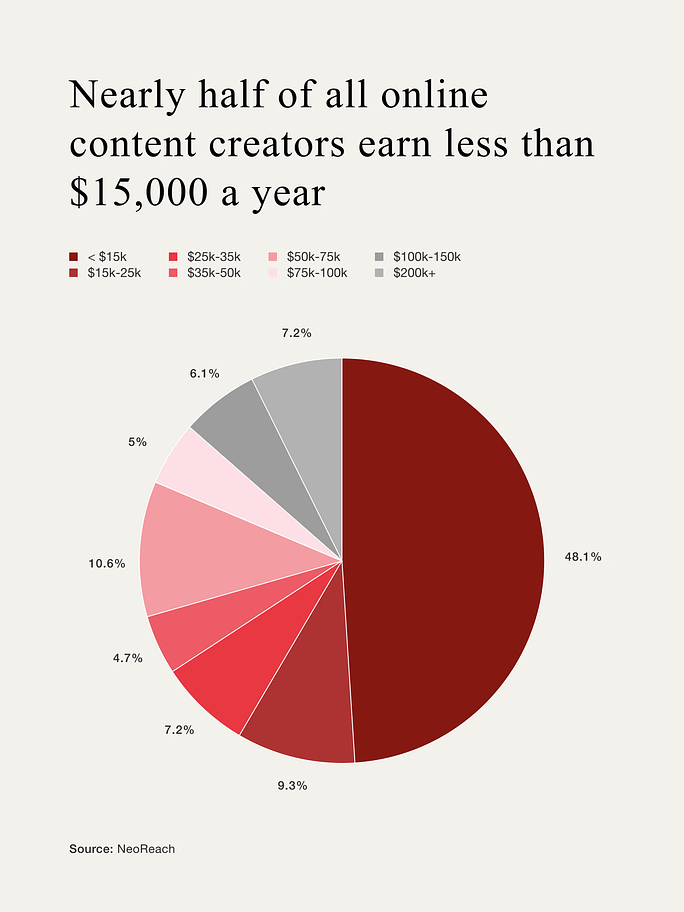
According to a 2023 Morning Consult survey, 57% of Gen Z would become influencers if given the chance. Yet less than 4% earn over $100,000 annually, and most make under $100 per post. Yet fewer than 4% of influencers earn over $100,000 annually, and most make less than $100 per post. Is unboxing a fake phone before a faceless audience the epitome of a ‘bullshit job’, as David Graeber might argue? Or is it a calculated game, where creators exploit the attention economy’s rules to outsmart the system and secure visibility and income with minimal effort—i.e. labour?
Yearly income levels for online content creators.
The difference, of course, is that influencers choose this path. But is that choice free? As Spinoza noted in his Ethics, ‘Human bondage consists in being subject to passions,’ which he understood passively in the classical sense—as reactive states prompted by external forces, such as the allure of social media likes driving faux unboxers’ actions.To understand this bondage, we must trace the forces that render the trivial meaningful.
Bullshit Jobs, Spiritless Effort
In Christian theology, the burdens of labour are understood as divine punishment for original sin—a consequence of humanity’s expulsion from Eden. Yet, as highlighted in the encyclical Laborem Exercens, they also carry a divinely inspired meaning that transcends toil and imbues it with dignity and value. Roman civilisation, by contrast, viewed freedom from labour as a privilege of citizenship; slaves bore the weight of physical toil. The Industrial Revolution did away with both perspectives, shifting the burden from body to mind: manual effort was replaced by cognitive and bureaucratic routines.
This transformation incurred a hidden cost. We have not only distanced ourselves from hardship—we have lost the capacity to endure it. Stating this is no sentimental yearning for the past. Psychology describes a widespread phenomenon known as experiential avoidance: the tendency to evade unpleasant sensations, emotions, or thoughts. It signals a broader retreat from discomfort.
That retreat now shapes the labour market. Factory jobs go unfilled, but even highly skilled technical professions suffer from chronic shortages. In the US, 91% of construction firms struggle to find qualified workers. These fields demand perseverance and long-term effort—qualities less common in a culture of immediate gratification.
Paradoxically, as technology promises liberation from labour, we risk losing the very ability to engage in meaningful work—that is, deploying our creative skills in reality. Not because we are spared pain, but because we no longer know how to withstand it. Not in the pathological sense, but in the constructive one: as sustained effort in the pursuit of something real. If that capacity fades, the freedom from toil may begin to feel like a form of dispossession.
Attention as Asset
History marches on. We are living through a tectonic shift from labour-based value to attention-based value. Humanity, as always, adapts.. While a life without labour can be imagined and even deemed a good life in Aristotelian terms, filled with the pursuit of meaning and virtue, a life without consciousness—and thus without attention—is inconceivable. Attention is always directed towards something; at a deeper level, as Simone Weil emphasised, it carries a moral dimension of openness to others. Yet, in the economy of faux unboxing, this aspiration for profound attention is drowned out, its value reduced to mere likes and interactions on social media.In this schema, success is measured in likes, shares, and engagement metrics. Emotions become the lever of monetisation—rage, awe, and fear of missing out fuel virality.
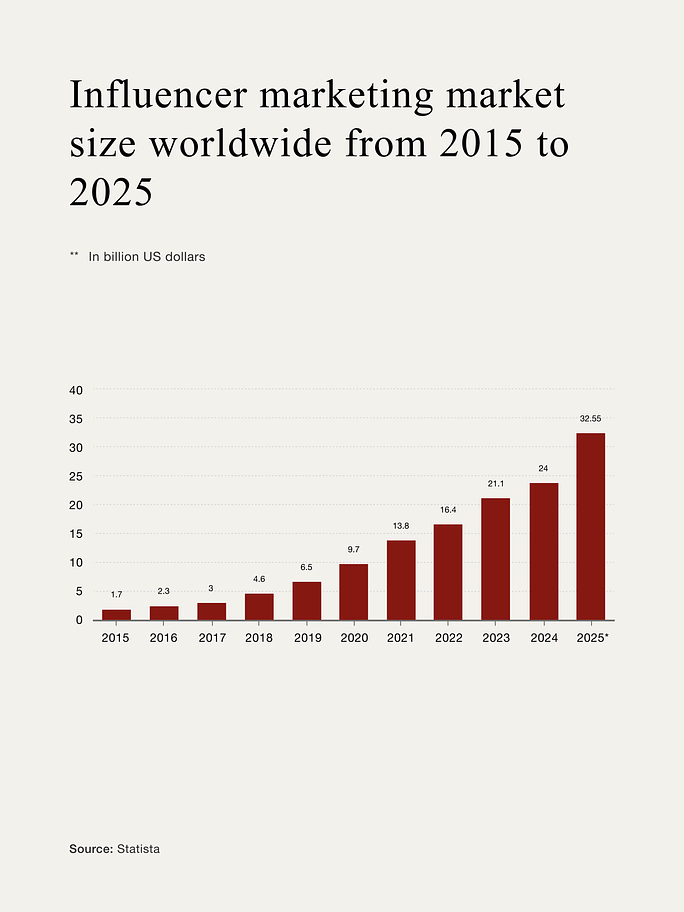
Behind each ephemeral post lies an industry that is strikingly real in its impact and scale. The influencer economy, having tripled in size over five years, is projected to reach $24.1 billion globally by the end of 2024, with estimates suggesting growth to $27–32 billion by 2025, driven by tangible outcomes like brand partnerships and affiliate sales. Wealth from this virtual world can buy real things—a genuine iPhone 16 Pro Max, for instance—turning fleeting likes into concrete rewards.
Market size of internet marketing between 2015-2025.
Much has been made of the democratising potential of social media, where, in theory, anyone can go viral. In practice, however, success is elusive, with algorithms favouring established creators and only a tiny fraction—less than 1% of TikTok accounts, for instance—garnering the vast majority of views, much like the unpredictable odds of a roulette.
To succeed consistently, one must dissect behavioural patterns, reverse-engineer virality, and commit time—again, that most precious commodity. In short, one must work. Thus the circle completes itself: the economy of attention reveals that time is the ultimate scarcest good. In its current economy, attention is often reduced to mere seconds, and everyone’s supply is finite. Yet, as Simone Weil suggests, attention can also be an intensive act of profound engagement, a quality often lost in the fleeting spectacle of faux unboxing, where likes and views eclipse deeper connection.
Wealth is no longer about what you own but how others spend their time on you in the attention economy. The ultimate winner within this system is not merely the one who captures the most fleeting glances, but the one who transmutes this finite time into lasting meaning—whether through authentic engagement or by challenging the shallow metrics of likes and shares.
Statement
In an age where meaning is measured in metrics, even an empty iPhone box becomes a tool of influence. Faux unboxings—$14 performances of $799 illusions—signal a deeper shift: from labour to spectacle, from ownership to optics. Classical notions of value falter before this choreography of attention. The post-production economy prizes not effort, but effect. For a generation chasing virality over vocation, influence is work and work is theatre. Yet behind the algorithmic hustle lies a spiritual deficit, echoing Baudrillard’s critique of consumerism, where society evades real effort to commodify its simulacra—empty performances like faux unboxing that mimic value in a hyperreal digital economy. So we don’t just unbox phones—we unbox the void, hoping others will watch.
Here is placeholder for Article excerpt Here is placeholder for Article excerpt Here is placeholder for Article excerpt Here is placeholder for Article excerpt
Here is placeholder for Article excerpt Here is placeholder for Article excerpt Here is placeholder for Article excerpt Here is placeholder for Article excerpt
Here is placeholder for Article excerpt Here is placeholder for Article excerpt Here is placeholder for Article excerpt Here is placeholder for Article excerpt
Welcome to the comments section of the Štandard daily. Please take note of our guidelines, comments are moderated by us. You can contact the moderators at [email protected].
Participate in the discussion
Comments are available to subscribers only. If you'd like to join the discussion, choose a subscription starting at €6.72 per month.
All comments 0
Register
Comments are available to registered users only. If you'd like to join the discussion, register here.