A deluge of unread papers, broken peer review, and irreproducible findings: academia is drowning in its own literature.
We live in a golden age of science: AI, quantum computing, experts on prime time, more experts on Ted Talks, and so on. On YouTube, scientific videos are among the most watched. One channel, Veritasium, boasts over 18 million subscribers and averages 10 million views per clip. And yet, few truly know what science has become. While still claiming badges of objectivity and novelty, today’s science is also broken and bureaucratised. It is plagued by a peer-review system in ruins, an inflation of redundant papers, and a replication crisis. In short, the grounds for turning admiration into blind trust are shaky—at best.
The Peer-Review Boom
While anyone on TikTok can now pose as a theoretical physicist and explain loop quantum gravity in five minutes, the average lab-coated scientist still earns his title through an academic process: the peer review. In theory, that is a bulletproof process against nonsense. In practice, the system is sagging under ideological bias, bureaucracy, and a tidal wave of publish-or-perish paper inflation.
And indeed, the gates are ideologically locked, particularly in human science. In sociology, gender studies, and education, peer review increasingly functions as a loyalty oath. A 2017–2018 hoax saw 20 fake papers submitted to ‘grievance studies’ journals. Topics included ‘rape culture among dogs’ and a feminised rewrite of Mein Kampf. Seven were accepted. Align with the dogma, and you get published. But if you are a dissent, you’ll enjoy your academic disgrace.
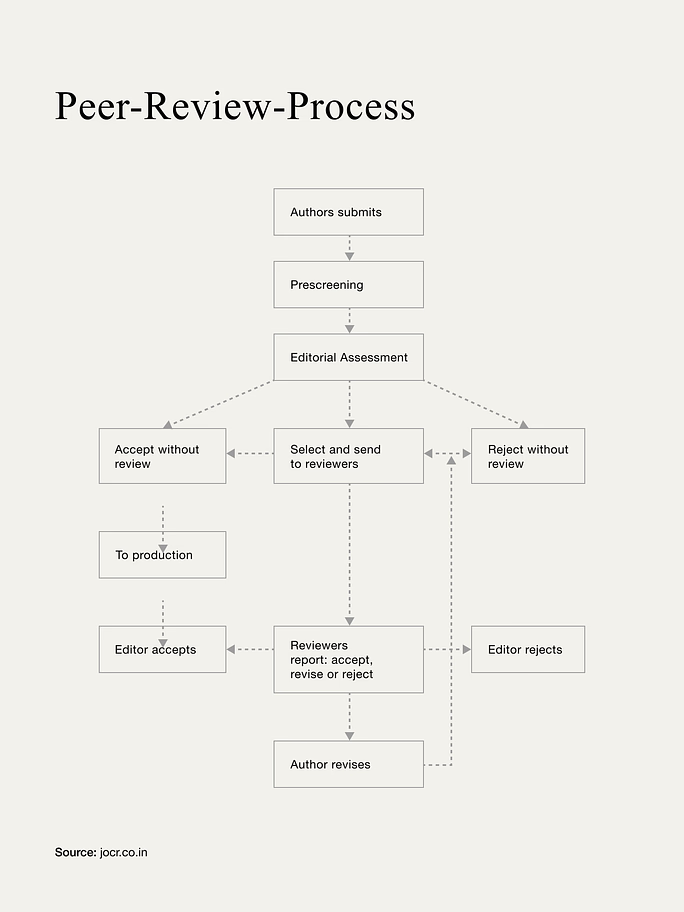
Illustration of a standard peer-review process.
This is mostly due to high publication rates and open scientific journals, with low peer-review standards, that often create a false impression of rigour. PLOS ONE, one of these open mega-journals publishing both in the humanities and the hard sciences, released 23,000 papers in 2021—roughly 1.4% of the entire world’s scientific output that year. All those articles, peer-reviewed.
On the other hand, people often believe that hard science is more serious than other branches of knowledge. Yet, one perfect example of publications that aren’t actually checked is Andrew Wakefield’s infamous 1998 paper, published in the prestigious journal The Lancet, linking the MMR vaccine to autism. The study was retracted in 2010 after being exposed as fraudulent. Yet it refused to die. Despite having been withdrawn, it keeps being cited in literature. A 2019 analysis revealed that of the citations made between 2011 and 2018, approximately 28.3% failed to acknowledge the retraction. This oversight contributed to the persistence of vaccine hesitancy, leading to measles outbreaks and a decline in immunisation rates in the UK and Ireland. In short: the peer-review process isn’t able to keep up.
Commenting on Comments
Science suffers from a second issue: there are simply too many papers being published. As a result, few of them are actually useful or even checked. The scientific publishing machine has turned into an industrial-like sector and inflated beyond reason: in 2016, 1.92 million papers were indexed in major databases; by 2022, that figure reached 2.82 million. Researchers are publishing at a frantic pace and, of course, the rise of AI won’t help bring order to the chaos. More will be published. But as we've already seen, science obeys its own law of inflation: too much leads to poor quality.
Papers just sit there, waiting for another one to be stacked on top of the pile. About 32% of social science papers and 82% in the humanities are never cited by anyone. Another example: some authors have even gone so far as to fake identities and review their own papers under false names, sneaking them through peer review to boost their CVs and publication records. Journals from Elsevier and SAGE have had to retract hundreds of such ghost-reviewed papers. And since hardly anyone reads these articles anymore, the fraud is surprisingly easy to pull off.
And this leads to a major issue: the more that gets published, the less impact each article has. A 2008 study from the University of California raised the alarm within the scientific community. The inflation of scientific publications has created a paradox: as the volume of papers grows, their individual relevance shrinks. With tens of thousands of articles pouring into journals each month, meaningful contributions are buried beneath a flood of derivative studies and redundant analyses.
Repetition Without Replication
And in the inflation problem lies the last issue: the replication crisis within the trial-and-error system. The replication crisis refers to the widespread inability of researchers to reproduce the results of many scientific studies, calling into question their reliability and validity.
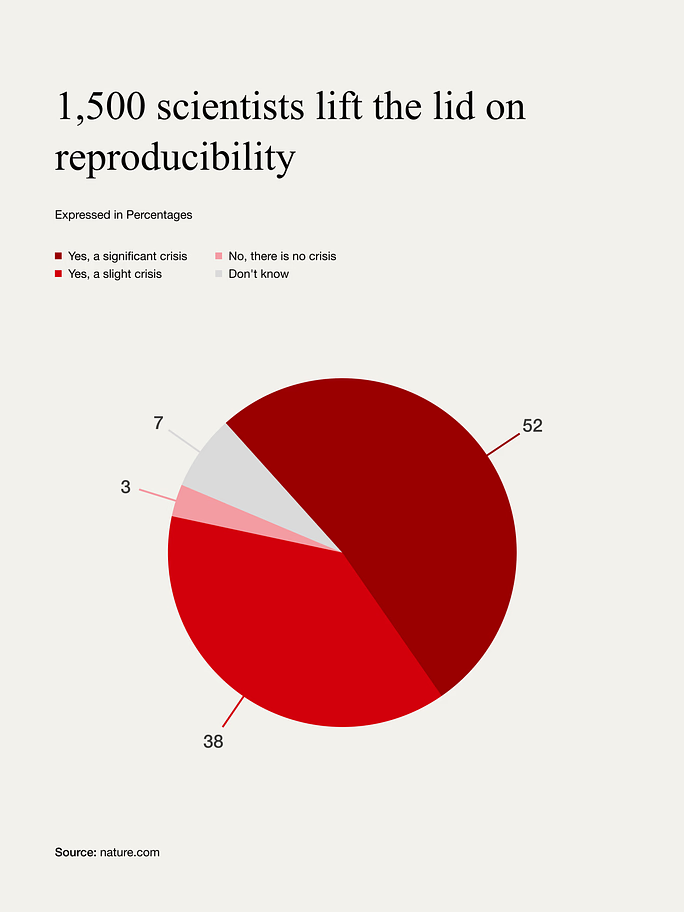
Opinions of professional researchers on the reproducibility crisis (2016).
In psychology, only 36% of landmark studies could be replicated in the Reproducibility Project. Even in the ‘hard’ sciences, Amgen replicated just 6 of 53 landmark cancer studies. And what is science without the ability to reproduce an experiment? Whether in psychology, chemistry, biology, most scientific fields rely on replication. Yet today, papers are routinely published and cited without ever being replicated.
An experiment that a scientist can’t replicate shouldn’t simply be trusted. As the Institute for Policy Research concluded in their study on the replication crisis: science is now grappling with an existential crisis of credibility from its own bloated, unreliable machinery.
Statement
Science today wears a lab coat but acts like a marketing firm. Peer review was meant to be its firewall; instead, it’s more like a hotel concierge. Quantity trumps quality, citation counts matter more than truth, and reproducibility has gone out the window with the reviewers’ free time. Until academia values substance over self-replication—and replaces peer blessing with actual verification—the temple of knowledge will continue to flood—not with insight, but with paperwork.
Here is placeholder for Article excerpt Here is placeholder for Article excerpt Here is placeholder for Article excerpt Here is placeholder for Article excerpt
Here is placeholder for Article excerpt Here is placeholder for Article excerpt Here is placeholder for Article excerpt Here is placeholder for Article excerpt
Here is placeholder for Article excerpt Here is placeholder for Article excerpt Here is placeholder for Article excerpt Here is placeholder for Article excerpt
Welcome to the comments section of the Štandard daily. Please take note of our guidelines, comments are moderated by us. You can contact the moderators at [email protected].
Participate in the discussion
Comments are available to subscribers only. If you'd like to join the discussion, choose a subscription starting at €6.72 per month.
All comments 0
Register
Comments are available to registered users only. If you'd like to join the discussion, register here.