
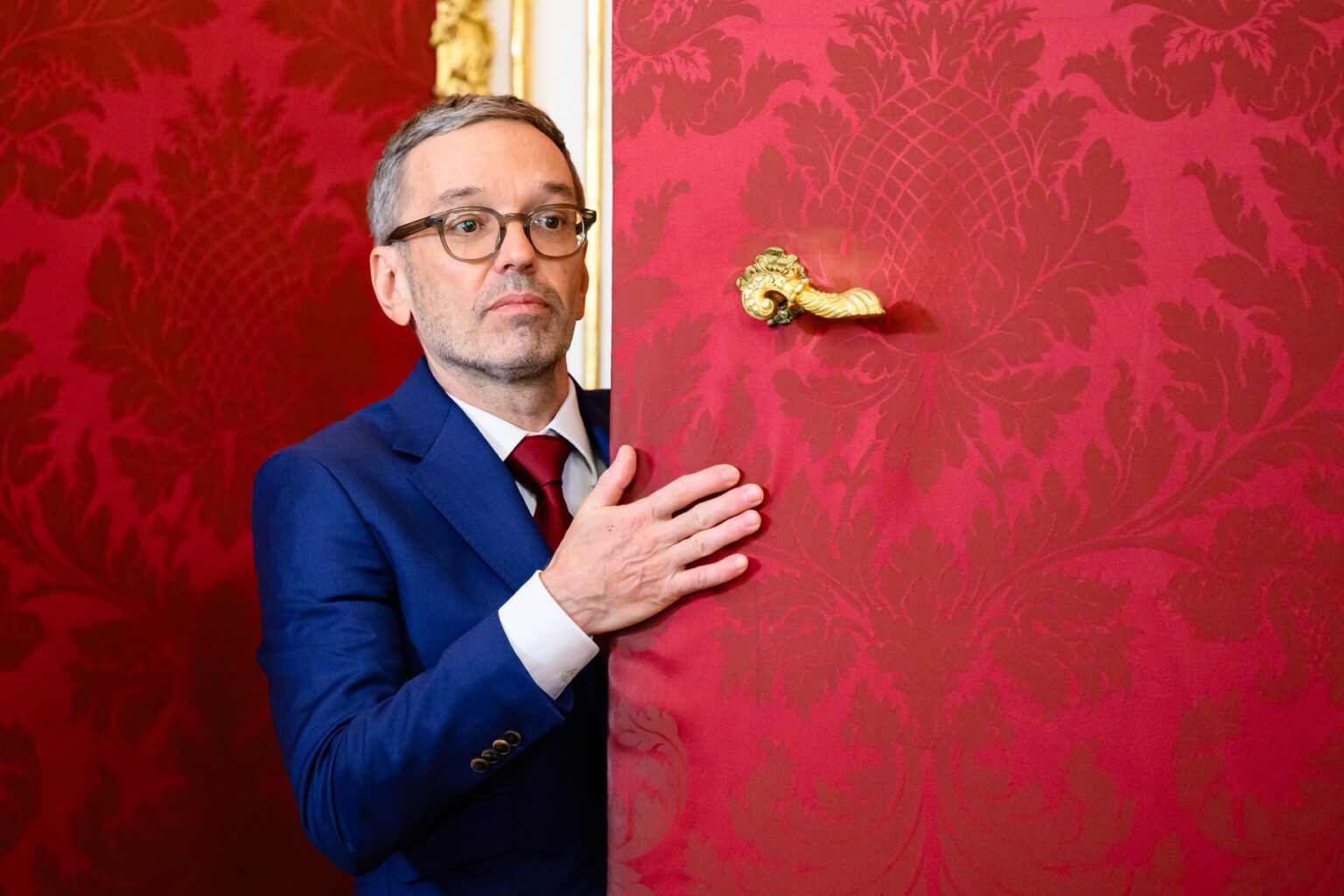
With its third return to government, the FPÖ has not only secured the chancellorship for the first time but also found itself led by Herbert Kickl, a figure markedly different from his charismatic predecessors, Jörg Haider and Heinz-Christian Strache. With his austere and uncompromising demeanour, Kickl resembles a disciplined statesman of the old Austro-Hungarian bureaucracy more than a modern populist politician. This historical association is not merely cosmetic—it may well shape Austria’s future diplomatic ambitions.
Austria has long excelled in playing the role of a mediator. Whether during the Habsburg Monarchy, when deft diplomacy delayed the empire’s fragmentation, or in the Cold War, when neutral Austria became a crucial buffer between NATO and the Warsaw Pact, Vienna’s geopolitical role was rarely passive. Unlike Switzerland, whose neutrality is rooted in isolationism, Austria’s has always been an active one—building bridges between East and West. Under Kickl’s leadership, the country may well return to this role, particularly as fractures within the Visegrád Group open new diplomatic avenues for Austria to revive its historical influence.
The Return of Mitteleuropa
Kickl, alongside Hungarian Prime Minister Viktor Orbán and former Czech Prime Minister Andrej Babiš, has played a key role in launching the Patriots for Europe faction within the European Parliament. This initiative is more than a political project—it signals an attempt to forge a new conservative power bloc in Central Europe. With the Visegrád Group (V4) faltering due to Poland’s pivot back to Brussels under Donald Tusk and internal divisions within the Czech and Slovak governments, the opportunity for a renewed Mitteleuropa—in the Habsburgian tradition of a Central-European power bloc, rather than the plan by German politician Friedrich Naumann to achieve cultural and economic hegemony over the region—has emerged.
It is therefore unsurprising that Austria remains a key player in the Central European Defence Cooperation (CEDC), a security framework established in 2010 that brings together Austria, Hungary, Slovakia, Slovenia, and the Czech Republic. While Austria maintains its constitutional neutrality, it actively engages in joint military exercises, border security, and counterterrorism measures. The CEDC, in many ways, reflects the historical Mitteleuropa vision—one of economic and military cooperation aimed at balancing great power influence in the region. As the V4 weakens, Austria’s leadership within the CEDC could mark the emergence of a new bloc, one that serves as a counterweight to both Brussels’ federalist ambitions and NATO’s dominance over European security policy.
Austria’s Economic and Strategic Leverage
Austria’s economic weight in Central Europe is often overlooked. In 2023 alone, trade between Austria and the Visegrád states amounted to over €49 billion, accounting for 15.54% of Austria’s total foreign trade. This makes the V4 a more significant economic partner for Austria than the United States, China, or even Italy. However, Austria’s most crucial economic partner remains Germany, which commands nearly a third of Austria’s entire foreign trade volume.
This economic interdependence poses both an opportunity and a challenge. While Austria has the economic clout to lead a new Mitteleuropa bloc, it must do so without alienating Berlin. Historically, Germany has viewed Central Europe as its strategic backyard. With Poland aligning more closely with Brussels and Berlin under Tusk, any attempt to form an alternative conservative alliance will be closely scrutinised—and potentially obstructed—by German policymakers. Should the AfD remain excluded from power in Germany, Berlin will likely continue to view Kickl’s collaboration with Orbán and Babiš with suspicion, possibly leveraging economic pressure to counterbalance any shift in influence away from Brussels.
Austria’s history offers a cautionary tale in this regard. When the FPÖ first entered government in 2000, EU member states imposed diplomatic sanctions, isolating Austria from European decision-making. The FPÖ’s most recent stint in government, in coalition with the ÖVP, ended in scandal following the Ibiza Affair, providing then-Chancellor Sebastian Kurz with a pretext to dissolve the coalition and pivot towards the Greens. Kickl, who served as interior minister during that period, is acutely aware of the external pressures that could be brought to bear against an FPÖ-led government.
Ye Olde Diplomatic Courtship
Yet, the landscape has changed since Austria’s last political isolation. In contrast to 2000, numerous European nations are now governed by conservative or right-wing coalitions. International ostracisation, of the kind Austria experienced then, seems far less likely today. Unlike previous FPÖ-led governments, Kickl will not merely be a junior partner in a coalition—he will be leading it. The conditions for a formalised Mitteleuropa bloc, an economic and political expansion of the already robust trade ties in the region, are more favourable than ever.
Austria under Kickl could elevate the Visegrád states above the somewhat raucous image of protest for protest’s sake and provide them with something they have so far lacked: a bridge to the West and South of Europe, where potential allies like Giorgia Meloni’s Italy are similarly interested in reinforcing European sovereignty in the global contest between the U.S., Russia, and China. The challenge, of course, lies in whether Austria can maintain this balancing act without triggering economic or diplomatic retaliation from Berlin and Brussels.
The Path Forward: A Mitteleuropean Revival?
Before Austria can assume this role, the new government must first be successfully formed. Should Kickl overcome this initial hurdle, he will find himself at the helm of an Austria that is no longer merely a spectator in European politics. A redefined Mitteleuropa, positioned as a stronger and more cohesive successor to the faltering Visegrád Group, is not an unrealistic ambition.
Austria’s neutrality has never been synonymous with isolationism. Instead, it has historically been wielded as a diplomatic asset. The Habsburg legacy offers a guiding principle, succinctly encapsulated in the old motto: Bella gerant alii, tu felix Austria nube—"Let others wage war; you, happy Austria, marry." The question is: can Kickl play the role of the groom leading the Visegrád states to the altar of Mitteleuropa? Pragmatism suggests the union makes sense; only time will tell whether sentiment follows suit. In today’s Europe, unlike in centuries past, such considerations still matter—tiresome though they may be.