
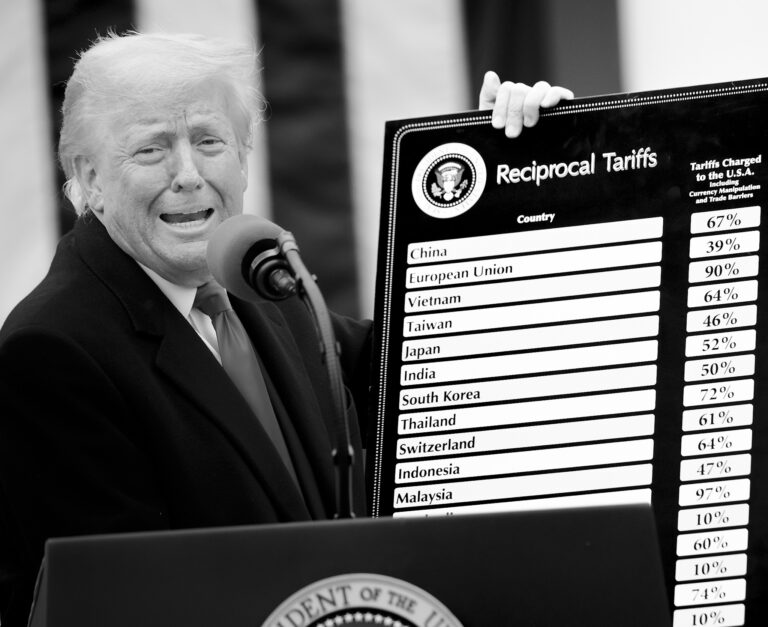
“I think it's going to work out very well, but no, it's not at 145%—it will not be anywhere near that number.” So spoke President Donald Trump at a White House press conference concerning the tariffs on China going forward. This followed a turbulent market phase and blunt warnings from top US business leaders.
US Retreats From a Tariff War
“Liberation Day” tariffs saw an immediate retreat on the part of the US. Not only did the reduction of all initial tariffs fall back to a blanket 10% for all countries but China, but a specific concession to China was also made shortly afterwards: key electronic products would be exempt. China, for its part, reciprocated the tariffs on US goods and reduced rare earth exports, on which the American economy relies.
Monday 14th April brought a further sobering dose of feedback, this time domestic, to the White House. As stocks slid and bond yields dropped, CEOs from three retail giants—Walmart, Target, and Home Depot—met privately with the President, sounding alarms about the consequences of his escalating trade war with China.
Trump’s shift away from 145% tariffs came in this context, but had already been announced by Treasury Secretary Bessent. At a private JP Morgan investor summit in Washington, DC, he reportedly called the trade impasse “unsustainable” and signalled a likely near-term easing. Bloomberg’s report on his remarks sparked a 1,000-point jump in the Dow Jones index on 23rd April, ending a four-day losing streak.
The timing of Bessent’s comments raised eyebrows on Wall Street and beyond. Investors with access to the summit gained hours of advance notice before Trump’s own public remarks. In what could have been an effort to manage the fallout, however, a source close to Bessent, speaking through Fox Business correspondent Charles Gasparino, downplayed the comments. The source claimed that the Treasury Secretary had merely acknowledged “room for talks” and emphasised that progress depended on China’s willingness to engage. However, President Trump’s subsequent statements closely mirrored Bessent’s, suggesting that the Treasury Secretary’s comments were not misinterpreted—but rather indicative of a coordinated shift in strategy.
Trump Misunderstood the Bond Market
Trump’s economic strategy appears to be bending under the weight of hard data and political calculus. While his rhetoric remains combative, the recent pivot reflects a growing awareness within the administration that investor confidence, global credibility, and electoral survival are now inextricably linked.
If the administration expected a rush to US bonds and the dollar after the "Liberation Day" tariffs announcement, as is typical during times of uncertainty, it actually faced the opposite, as global investors turned away from US assets. Treasury yields experienced a dramatic sell-off of US government bonds, with yields on 10-year Treasury notes jumping up.
The sell-off was not only unexpected, but also unusual insofar as investors typically flock to US debt during uncertainty. That prompted the question of who was selling. It has been speculated that China, holding about $760 billion in US Treasury securities as of January 2025, sold Treasuries in response to the tariffs, weaponising its holdings. However, no concrete data has yet confirmed this. What Treasury data does show is that, before the tariffs, foreign holdings of US Treasuries were steady at $8.526 trillion in January 2025, up 7.2% from a year earlier.
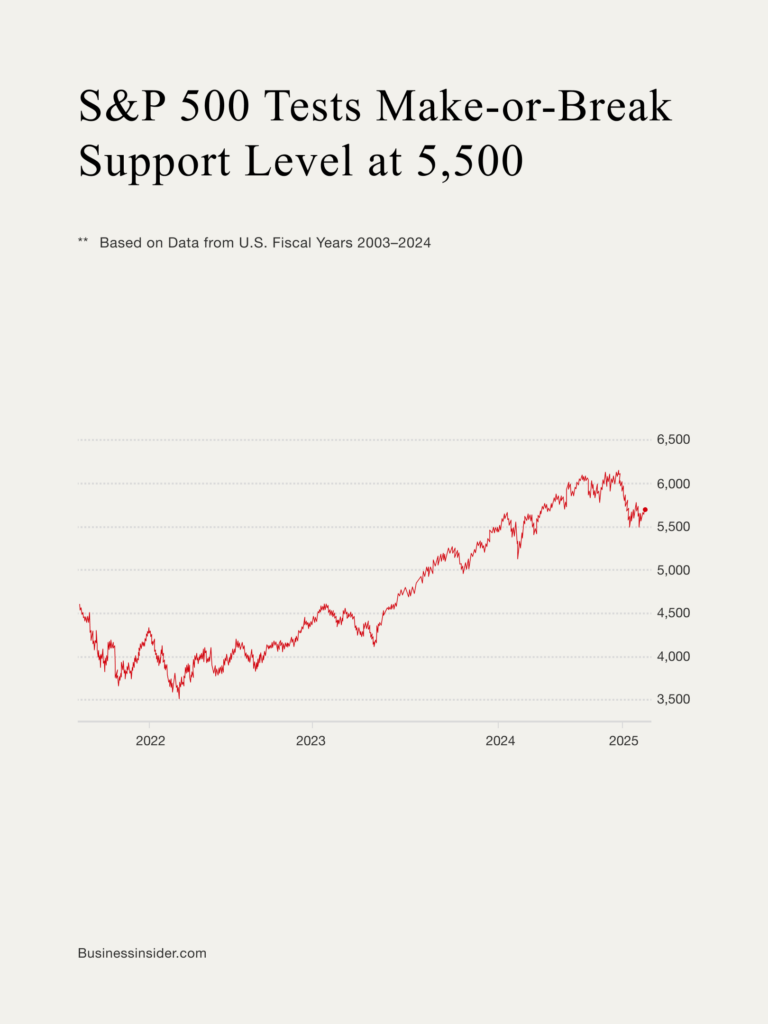
Now, the S&P 500 has fallen by 14% overall—the steepest decline for any president at this point in office since 1957. Recession risk has crept into investor sentiment, with various economic models placing its probability between 45% and 60%. Indeed, recent polling shows that 52% of Americans would hold Trump responsible for an economic downturn.
Still no Plan to Trust
Sweeping tariffs instead of properly targeted tariffs meant on-shoring key supply chains, and signalling lack of strategic focus rather than strength. The brinkmanship Trump intended might have worked if the US had all the leverage he believed, with there being no geopolitical alternative for vassal countries to turn to. As it happens, however, there is one: China.
Although “Liberation Day” tariffs were intended as theatre to get countries to renegotiate, the White House failed to develop a comprehensive industrial policy to make sure on-shoring was viable, or legislation to stop companies from squandering tariff-windfalls on their shareholders by simply issuing stock buybacks.
Despite a few headline-grabbing deportations under Trump, the actual number of undocumented immigrants removed from within the US was lower than under Biden. That meant employers could keep relying on low-wage labor, avoiding the pay hikes that might come with a shrinking workforce—and the rise in consumer buying power that would follow.
There was no serious plan in place, and there still isn’t: Trump’s announcement that the tariffs on China will come down significantly will only serve to freeze sectors of the economy, as businesses relying on Chinese goods will hold their breath and wait until the promised tariff reduction comes in fact. Trump, however, has been consistently lacking in consistency, and China stands to gain.
Statement
President Trump’s aggressive tariff campaign against China has unraveled amid investor alarm, business pressure, and market sell-offs. Despite combative rhetoric, global capital fled US bonds—an unusual move during crises—and the S&P 500 plunged 14%, stoking recession fears. Treasury Secretary Scott Bessent signalled a coordinated de-escalation before the President himself announced tariffs would be nowhere near 145%. With no real industrial policy to support reshoring and only broad tariff cuts promised, the administration’s approach reveals a lack of strategic focus and planning.