
When in 1936 George Orwell trudged off to Spain to join the anti-Franco side of the civil war which had just kicked off there, he carried with him a notebook and the conviction that through his truthful accounts the fog of war could be lifted. The end result was his elegiac Homage to Catalonia.
Reporting on the same conflict, Ernest Hemingway, with his flair for romance, would immortalise the various parties involved in For Whom the Bell Tolls. Both accounts of the Spanish Civil War (1936-1939) read like dispatches from a world both distant and familiar: distant because European life today feels—at least materially— far more comfortable; familiar because the conditions that sparked that conflagration—polarisation and the erosion of trust—are very much present.
But if civil war were to plague Europe again, it would not look anything like 1936. To be sure, conventional means of attacking and defending would still be there, but they would be overshadowed by far-reaching and state-controlled surveillance technologies—something Orwell, who in his 1984 imagined telescreens, might recognise and shudder.
Surveillance in an Age of Algorithms
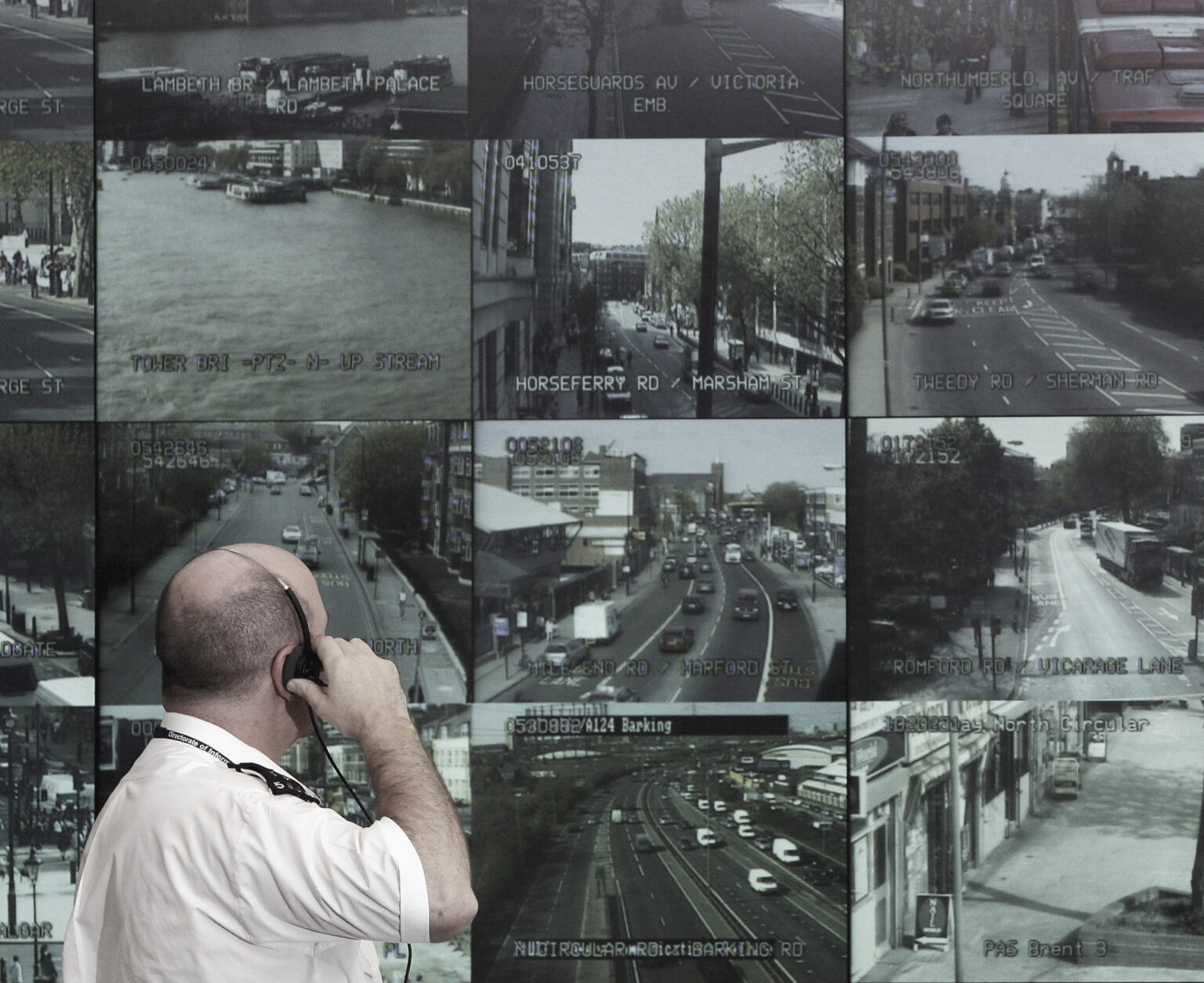
Already, the European continent is covered with vast networks of CCTV cameras, a plethora of drones, biometric scanners, the data they gather fed to AI-driven predictive policing tools.
In fact, London may serve as a showcase for Europe’s drive towards ever more surveillance: recent estimates place over 942,000 CCTV cameras across the city—around one camera for every ten residents. More broadly, the UK is home to between 4 million and 5 million surveillance cameras, translating to roughly one camera per 11–14 people.
Meanwhile, facial-recognition software that once misidentified tourists at airports is now frighteningly adept at picking protest leaders out of crowds.
The tools of surveillance have become so cheap and so integrated into daily life that they risk appearing banal. Yet, in a crisis, their utility would be anything but. Governments, fearing unrest, could track not only movements but intentions—assembling metadata so that organising even a clandestine meeting might prove impossible. WhatsApp groups and Signal chats, presumably encrypted, could be—if they are not already—subject to state-backed hacking.
It is a delicious irony. European societies that once took pride in their liberal openness now are deeply embedded in some of the most intrusive digital infrastructures in history. The argument in favour of such a design is, of course, always ‘security.’ But as any student of Orwell knows, that particular slope is most slippery.
The Militarisation of Police
If surveillance is the watchful eye, militarisation is the clenched fist. In his book Rise of the Warrior Cop, Radley Balko showed how American police had evolved into heavily armed domestic armies, primed to treat citizens less as neighbours than as enemy combatants. Europe, a continent chastened by memories of dictatorship, long imagined itself different. Yet the trajectory now feels eerily familiar.
France’s 2023 riots offer a vivid example. In response to the police killing of a teenager in Nanterre, the government deployed over 45,000 officers, many clad in military-grade armour. Drones circled overhead; armoured vehicles rolled through Paris suburbs. To some, the show of force was necessary. To others, it was a disturbing echo of Balko’s warning: give police the tools of war, and they will eventually find a war—even if it is on their own streets.
If civil conflict returned to Europe, it would very much look like Balko’s nightmare: a permanent, low-level siege in which the state, outfitted like an occupying army, confronts not foreign enemies but its own citizens.
Balko’s insight about mindset becomes crucial here. Militarised forces, once trained for combat, inevitably begin to see dissent not as politics but as insurgency. Combine this with the surveillance grid, and protest itself risks being pre-emptively criminalised.
Street clashes would be instantly live-streamed and manipulated by AI-powered propaganda bots—programmed by citizens and the state alike. Every protester would risk being tagged by facial recognition; every chant, scraped and analysed by predictive algorithms.
Civil war, in such a world, would also be fought out online. Victory would hinge less on the capturing of territory than on having narrative control: whose video goes viral, whose hashtag trends, whose deepfake lingers in the public imagination.
In that sense, a modern European civil war scenario would be a hybrid of Orwell’s dystopia and Balko’s warrior cop.
Lessons to be Learned
Orwell, who exited the war after being wounded in the throat by a Fascist sniper’s bullet, warned how propaganda could warp reality beyond recognition. Balko, decades later, described how a free society could turn its guardians into warriors who no longer saw the difference between citizens and combatants.
Together, they remind us that the greatest danger lies not only in the clash of opposing sides but in the steady erosion of the civic trust that makes politics possible in the first place.
It is tempting to dismiss the spectre of civil war in Europe as alarmist. The European Union, for all its squabbles, has held the continent together through seven decades of peace. But reality has a certain knack for asserting itself eventually.
The stark fact staring us in the face is that polarisation is continuing unabated. Populist movements, who more often than not give voice to citizens’ real concerns, gnaw at the legitimacy of governments. Social media amplifies outrage while nullifying nuance.
Meanwhile, the very technologies that promise safety also furnish the scaffolding for authoritarian control. A continent that prides itself on tolerance and democracy could, in the wrong hands, become the setting for Orwell’s prophecy—and Balko’s warning.
Europe may not be on the brink of another Spain, but the tools are in place. Cameras, drones, predictive algorithms, and militarised police forces would ensure that any future conflict would be watched, catalogued, and suppressed with a precision Orwell could hardly have imagined—and which Hemingway would have found too bleak to even attempt to romanticise.
Statement
Europe’s next civil war, if it comes, will be unlike anything seen in the famous Spanish Civil War. It will unfold under the unblinking eye of surveillance cameras, drones, and predictive algorithms, with militarised police treating the smallest protest as insurgency. The continent is now awash with the tools Orwell foresaw: his telescreens are our current CCTV grids. Meanwhile, police are being kitted out as if they were occupying armies. The real danger is civic trust’s erosion, making politics impossible and unrest inevitable. Europe will not face another 1936—it already is equipped for something else entirely.