
In 2016, as the Syrian civil war dragged into its sixth year, Ali Akbar Velayati—senior adviser to Iran’s Supreme Leader—hailed Syria as a “golden ring in the chain of resistance.” The metaphor was apt, if not hubristic. The Islamic State controlled vast swathes of eastern Syria, including Raqqa. Bashar al-Assad’s regime survived thanks to Russian air support and Iranian boots on the ground. Tehran’s patronage of Hezbollah in Lebanon relied heavily on its Syrian corridor. From Damascus, the Islamic Republic extended its influence to the Mediterranean, weaving a web of alliances from the Levant to the Gulf.
That web may now be fraying.
Iran’s alleged arms shipments to Libya—some of which reportedly ended up with Khalifa Haftar, the Russian-backed commander of the Libyan National Army (LNA)—suggested that Tehran's ambitions were once expansive. Iranian-made drones and munitions surfaced in the eastern Libyan theatre. Yet Iran’s exact role in the Libyan conflict remains opaque. A decade on, the terrain has tilted against Tehran.
From Post-Saddam Gains to Strategic Contraction
The collapse of Saddam Hussein’s regime in 2003 marked a turning point. With the removal of Iraq’s Sunni-led junta, a Shia-majority democracy emerged in Baghdad. Iraq’s government is by no means a proxy of Tehran—but neither does it stand in overt opposition, as its predecessors once did. The regional repercussions were profound: Iraq’s diminished influence elevated the strategic weight of its neighbours—Iran, Turkey, and Saudi Arabia chief among them.
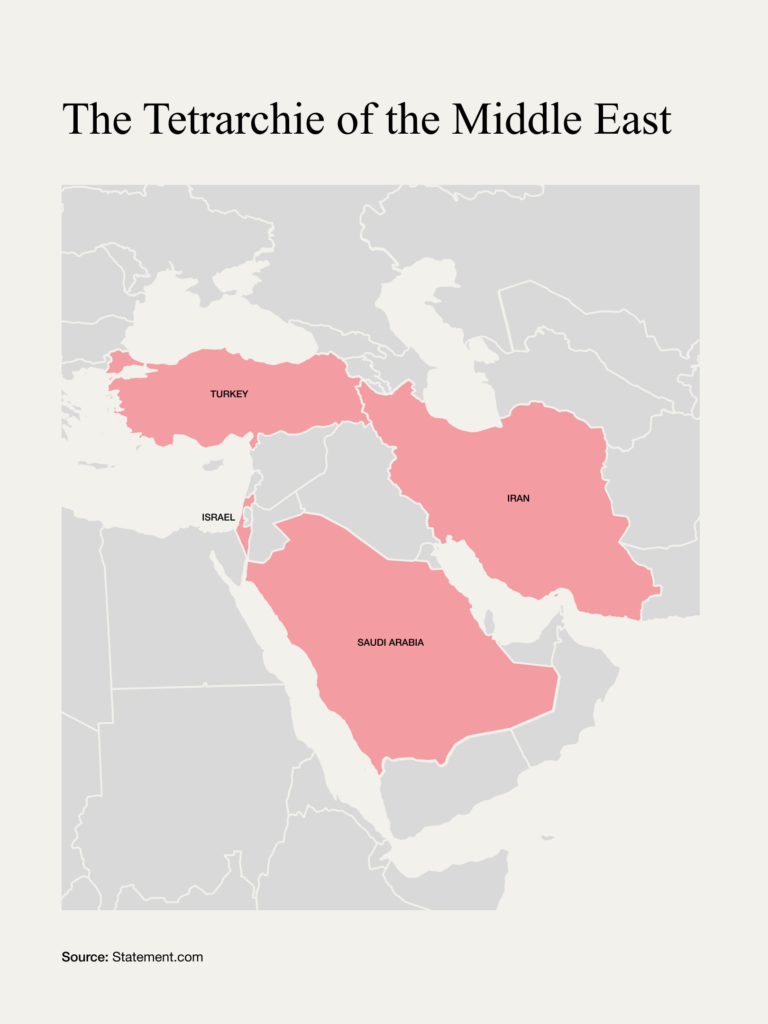
Iran appeared ascendant as the Shia world’s regional champion. Syria, Lebanon, Iraq, and Yemen formed what many in Riyadh perceived as a crescent of Iranian influence. In Bahrain, a Sunni monarchy ruled over a Shia majority; in Saudi Arabia itself, the oil-rich eastern provinces house a restive Shia population. These fault lines, latent for decades, took on a sharper urgency as Iran flexed its muscles.
Iran’s adversaries responded in kind. Saudi Arabia, as the last Sunni Arab heavyweight, perceived an existential threat. When Houthi rebels—Tehran’s allies in Yemen—launched a missile strike on the Abqaiq and Khurais oil facilities in 2019, halving the Kingdom’s oil output overnight, the vulnerability of the Saudi petrostate was laid bare.
The Gulf States Coalesce
Ironically, the threat of Iran’s ascendancy proved catalytic for regional diplomacy. The Abraham Accords of 2020—normalising relations between Israel and the United Arab Emirates and Bahrain—were driven in large part by a shared animus towards Tehran. Talk of a possible Saudi-Israeli rapprochement loomed large in subsequent years. Had it materialised, it would have entrenched a formidable anti-Iranian axis.
But here, too, events conspired to undercut Iranian ambitions. The Hamas-led attacks on 7 October 2023 and Israel’s subsequent military operations had paradoxical consequences for Tehran.
Israeli countermeasures in Syria and against Hezbollah curtailed Iran’s forward positions. Israel’s assertive posture, however, may prove self-defeating. Where once it courted Gulf states with shared fears of Iran, Israel risks regional isolation—mirroring, in a twist of fate, Iran’s own predicament.
Turkish Ambitions, Israeli Dilemmas
Ankara, too, has complicated Israel’s strategic calculus. Once a reliable ally of the Jewish state, Turkey’s drift under Recep Tayyip Erdoğan has upended this dynamic. Turkish incursions into northern Syria and support for Islamist factions—such as Hay’at Tahrir al-Sham (HTS), successor to the al-Nusra Front—are partly driven by its desire to suppress Kurdish autonomy. But they also reflect broader neo-Ottoman ambitions: Ahmed al-Sharaa, the leader of HTS, now serves as Syria’s interim president.
Israel has little interest in seeing Syria transformed into a Turkish sphere of influence. The possibility of a Damascus beholden to Ankara is no more palatable than one subservient to Tehran. Hence, Israel’s military interventions and cautious diplomatic outreach to Syria’s new government reflect a dual strategy: to limit Ankara’s reach while hedging against further estrangement.
Tehran’s Strategic Malaise
Thus, Iran finds itself in an ambiguous position. Its dream of a contiguous arc of Shia-aligned allies stretching from Tehran to the Mediterranean lies in tatters. Syria is no longer the pliant satrapy it once was. Lebanon teeters on the brink of collapse, Iraq oscillates between factions, and Yemen remains a grinding stalemate.
And yet, paradoxically, it is Iran’s nominal rivals—Turkey and Israel—that increasingly find themselves overextended, diplomatically bruised, and regionally distrusted. The spoils of the Syrian vacuum, once seen as ripe for the taking, have turned into liabilities.
Saudi Arabia, meanwhile, emerges as a more measured and agile actor. Its strategic partnerships—particularly with Gulf neighbours—and its role as a self-styled “guardian of stability” position it as the most credible Sunni counterweight to Iran. For Tehran, this may represent both a roadblock and, conceivably, an opportunity.
In 2023, Beijing helped broker a rapprochement between Riyadh and Tehran—an initiative rooted less in goodwill than in shared interests: to prevent a possible new war with a participation of US-Israeli forces.
Statement
America’s 2003 invasion of Iraq shattered the Middle East’s pentarchy—comprising Iraq, Iran, Turkey, Saudi Arabia and Israel—reducing it to a tetrarchy. The remaining four powers have since scrambled to fill the vacuum across the Syrian-Iraqi corridor. Tehran’s advance has not only stalled; it is being rolled back. Yet rising ambitions in Ankara and Jerusalem may paradoxically foster renewed understanding between historic foes: Saudi Arabia and Iran. In a region where the enemy of one’s enemy swiftly becomes a friend, alliances shift—especially when aimed at containing external influence. Realignment, not resolution, is the order of the day.