
In early December 2024, the regime of Bashar al-Assad finally crumbled. After thirteen years of civil war, Damascus fell to a coalition of opposition forces backed discreetly by Ankara and bolstered by defections from within. For Moscow and Tehran, the loss of Assad was a devastating blow—not only strategically, but symbolically.
For Russia, Assad had been the linchpin of its military presence in the Levant, with the naval base in Tartus and the Hmeimim airbase as pillars of Mediterranean projection. For Iran, Syria served as the critical land bridge to Hezbollah in Lebanon and a forward node in its so-called 'Axis of Resistance'. Despite diverging visions for post-war Syria, both Moscow and Tehran had been deeply invested in preserving the regime. Its collapse left them momentarily aligned in discomfort and recalibrating their regional strategies.
Two Powers on the Back Foot
Both countries now find themselves under immense pressure. Iran, once a rising regional hegemon, has watched its influence recede. Syria is lost, Israel advances, Lebanon is ungovernable, and Yemen remains a costly quagmire. Gulf monarchies have grown more assertive. The 2023 Chinese-brokered detente between Riyadh and Tehran must still translate into genuine regional leverage for Iran.
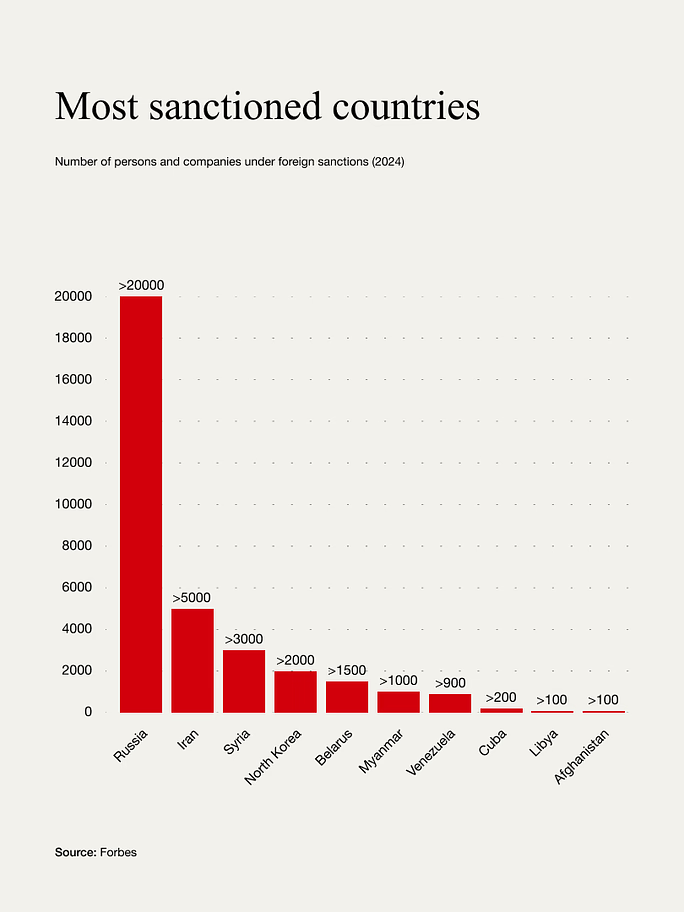
Russia, for its part, is stretched thin. The war in Ukraine has dragged into its fourth year, with Western sanctions biting harder and battlefield dynamics grinding into attrition. Assad's fall denies Moscow a key Middle Eastern foothold at a time when its options for global projection are narrowing.
A Treaty for Troubled Times
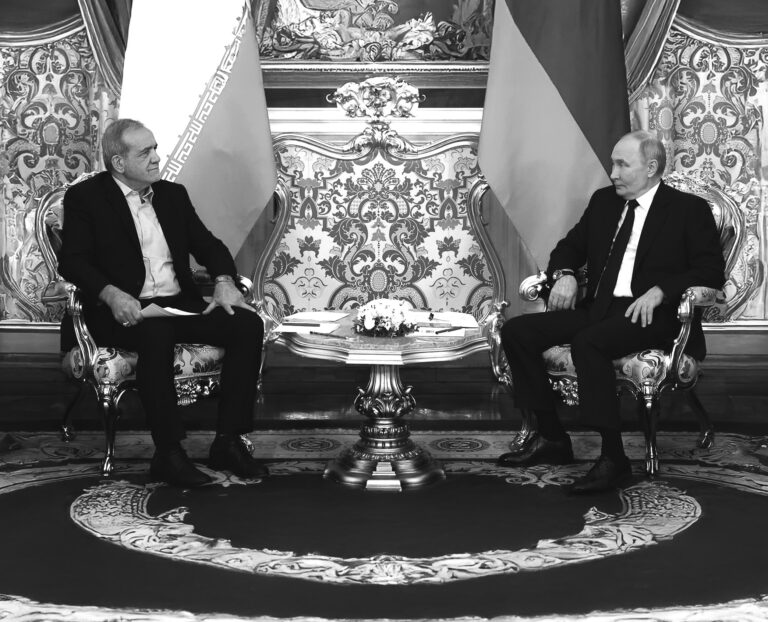
The result is a closer embrace. On 17 January 2025, Iran and Russia signed a comprehensive 20-year strategic partnership in Moscow. The treaty, consisting of 47 articles, is sweeping in scope. One-third of the text is dedicated to military and security cooperation: it binds both parties to mutual non-aggression, shared intelligence efforts, joint military exercises, and technological collaboration. Russian and Iranian security agencies are to establish a permanent coordination mechanism.
The agreement extends into economic affairs. It commits both nations to circumvent Western financial systems through bilateral payments in rials and rubles, and to deepen trade within the Eurasian Economic Union, to which Iran gained free trade access in May 2025. Tariffs on Russian exports to Iran have fallen from 16.7% to 5.2%, potentially saving Russian exporters over $300 million annually. Energy cooperation is also explicitly codified: Gazprom and the National Iranian Oil Company signed memoranda of understanding totalling $40 billion in 2022, and negotiations continue for Russia to supply 55 billion cubic metres of gas annually to Iran.
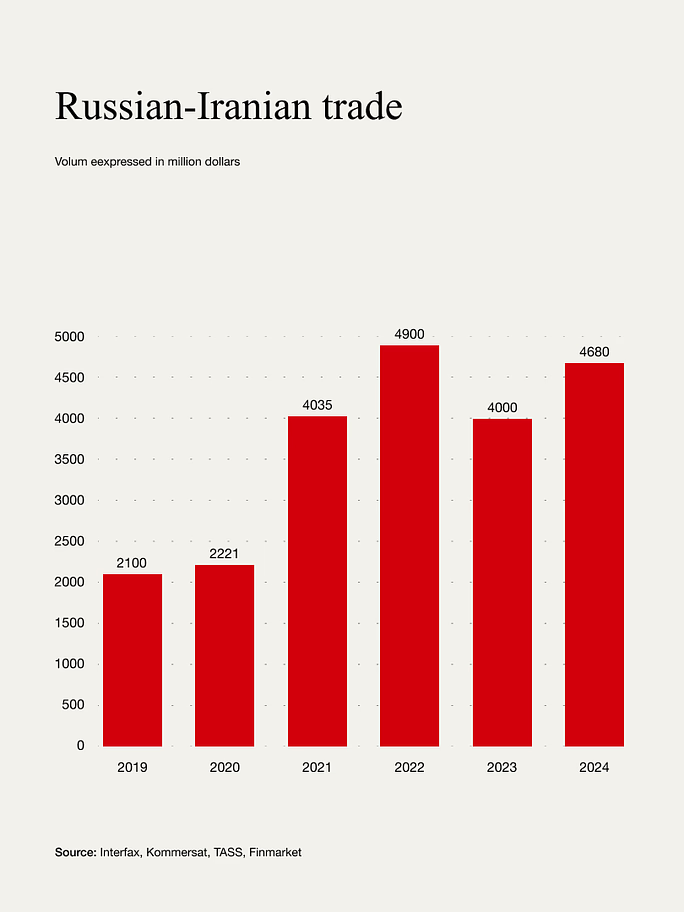
The depth of the partnership has yet to materialise in figures: trade stood at just $4bn in 2023 and $ 4.7bn in 2024, though Russia’s chamber of commerce eyed a tenfold rise in the years ahead.
Drones, Missiles, and Shared Theatres
Militarily, the convergence is already visible. Iran has supplied Russia with Shahed-131 and Shahed-136 loitering munitions since mid-2022. These drones, rebranded and produced under license in Russian facilities, have become a staple of Russian strikes against Ukrainian energy infrastructure. In 2024, deliveries reportedly expanded to include Mohajer-6 drones and short-range ballistic missiles such as the Fateh-110 and Zolfaghar. In return, Russia is assisting Iran with surveillance satellite technology and air defence integration.
Cooperation is not limited to Europe. In Libya, Iranian drones and ammunition have surfaced in Eastern theatres aligned with Khalifa Haftar’s Libyan National Army (LNA), a faction also supported by Moscow. While Iran's role remains murky, the appearance of its weapons alongside Russian interests suggests a willingness to engage in strategic scenarios where both seek to disrupt Western-backed forces.
Economically, the two nations might appear natural rivals. Both are fossil-fuel exporters seeking global markets, particularly in Asia. Yet competition has been subdued. Iran’s energy infrastructure is underdeveloped and still heavily sanctioned; as such, it poses little threat to Russian markets. Instead, the two have focused on logistics and trade corridors. The International North–South Transport Corridor (INSTC), linking Russia to the Indian Ocean via Iran, is being actively developed as an alternative to Western-dominated shipping routes.
Atoms and Alliances
The nuclear file adds a layer of complexity. Russia officially supports Iran’s right to peaceful nuclear energy, helping the Asian country to build and expand the Bushehr plant. It has opposed Western-led resolutions at the International Atomic Energy Agency (IAEA) critical of Iran’s enrichment activities, shielding Tehran diplomatically while stopping short of endorsing weaponisation. In private, Russia is wary of a nuclear-armed Iran, but sees more utility in managing the programme than confronting it.
This bilateral closeness also feeds into a broader trilateral alignment. Together with China, Russia and Iran have formed an increasingly visible axis challenging US primacy. The trio has held joint naval drills in the Gulf of Oman, coordinated diplomatic messaging at the United Nations, and discussed alternative financial systems to the SWIFT network. Beijing’s mediation between Riyadh and Tehran in 2023 showcased the soft-power aspirations sustaining this alignment.
Though Russia and Iran have suffered regional setbacks—and their much-touted economic ties remain more aspiration than reality, given the incompatibility of two fossil-fuel exporters—Iran endures as a hub for anti-Western powers. The Moscow–Beijing axis has long demonstrated that shared adversaries, no less than shared interests, can bind unlikely partners.
Statement
For Moscow and Tehran, the collapse of Assad’s regime has become a catalyst. Bound by sanctions, war and diminished leverage, the two regimes are forging a strategic bond that has become stronger than ever. While regional dynamics remain unstable, Russia—backed by China—is steadily undoing Iran’s isolation and furnishing it with strategic options. Economic incompatibilities between the two states remain a constraint, yet do little to impede cooperation in the face of external threats. The twenty-year agreement suggests that while Russia and Iran may be weakened, they are adapting—shifting from tactical calculation to a long-term strategic alignment.