
Donald Trump once famously declared “tariff” to be the most beautiful word in the English language.
Yet his recent “Liberation Day” tariff announcement—followed almost immediately by a 90-day moratorium on duties above 10% for all except China—suggested a lack of clarity about how to use this policy tool.
Which leaves one to wonder: does the White House have a plan?
Why, yes—judging from interviews with Treasury Secretary Scott Bessent, as well as economist Steven Miran’s writings, the tariffs were but the opening salvo in a grand strategy to reorient international economic relations.
Trump’s team sees revitalising domestic manufacturing—while maintaining the dollar’s status as world reserve currency—not merely as an economic imperative, but as a matter of national security.
Crucially, the thinking seems to be that acting as the world reserve currency means foreign central banks keep a lot of US dollars in reserve and by doing so do not let its value reduce naturally, so that the American export sector can increase competitiveness.
Trump wants to arrest this dynamic while retaining US hegemony.
Brief History of the US Empire
America’s current strategic disadvantages can be framed in terms of two US-led eras of global economic integration: first the Bretton Woods order (1944–1973), and the subsequent neoliberal consensus (early 1980s–2016). Both systems, while initially successful, laid the groundwork for America’s current industrial decline.
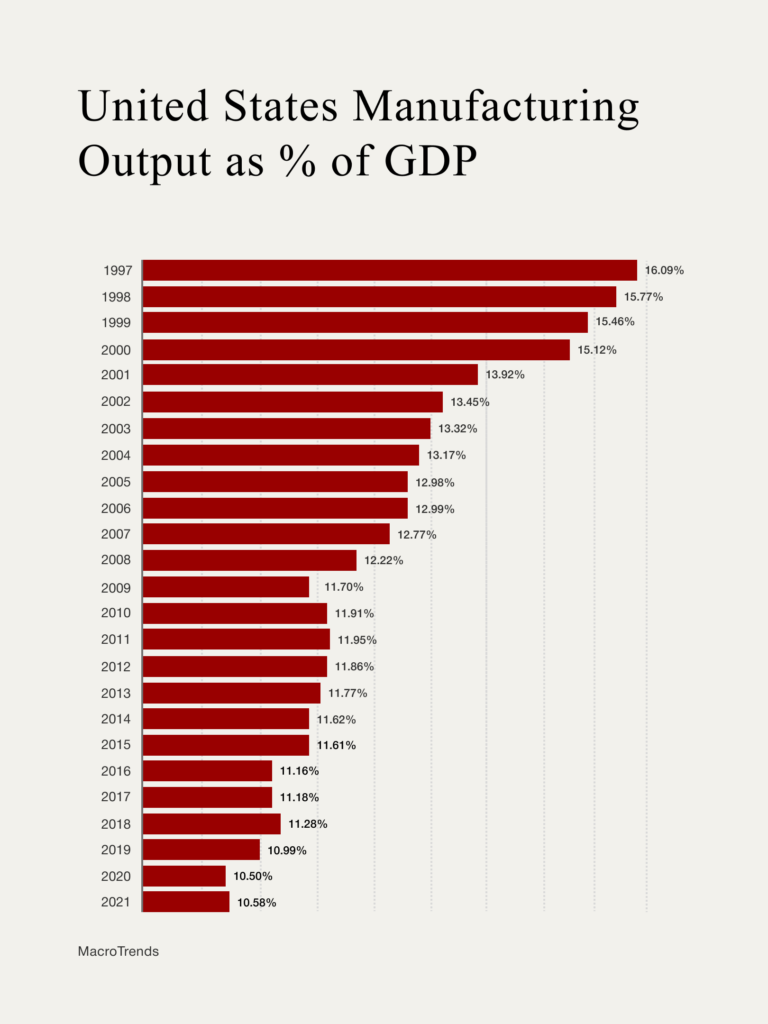
Bretton Woods established a framework in which allied currencies were pegged to the (gold-backed) dollar, bolstered by aid such as the Marshall Plan. In return, the US gained loyal allies, export markets, and the privilege of running deficits without consequence. Trading partners, in turn, enjoyed access to US markets, accelerating US industrial decline.
The system began to unravel in the 1970s under the weight of the Triffin dilemma: global demand for dollars exceeded America’s gold reserves, prompting President Nixon to end the gold-standard in 1971. What followed was the birth of a new order under Reagan and Thatcher—the “neoliberal” age of “free trade,” financial liberalisation and market deregulation.
This maintained the dollar’s dominance but also made outsourcing easy, undermining the country’s industrial competitiveness, particularly after China joined the World Trade Organization in 2001 (with US help).
The “China shock” is to neoliberalism what the “Triffin dilemma” was to Bretton Woods.
China’s entry into the world market decimated swathes of American manufacturing, creating discontent among working class Americans who were hit the hardest, and who ultimately helped propel Trump to the presidency in 2016.
His initial trade war with China, however, failed to reverse these trends. China retaliated and maintained higher tariffs. Biden’s industrial subsidies had a more direct effect but at the cost of ballooning deficits.
Enter 2025 and Trump’s inner circle now seems to have opted for a more radical approach.
What’s the Plan?
Trump’s seemingly chaotic approach serves to extract concessions: the intentional producing of instability is a signal that the US is serious about resetting the terms of global commerce.
After the stick, comes the carrot: rewarding non-retaliation and the willingness to signal vassalship. With the world’s largest consumer market, the US wields unmatched leverage to pressure exporters into accepting its terms.
Finally, a new global monetary architecture would need to solidify—a “Mar-a-Lago Accord”—modeled loosely on Bretton Woods. Under this system, aligned nations would peg their currencies to the US dollar, adjusting upward when the dollar becomes too strong so that US exports do not weaken. In return, they would gain access to US markets, security guarantees, and participation in the dollar-based financial system.
Unlike its predecessors, this system might include explicit payments for protection, with allies becoming de facto tributary states.
Broken Trust
Of course, global diplomatic and financial systems require trust.
The original Bretton Woods agreement and the 1985 Plaza Accord were built on stable American leadership, a stark contrast to Trump’s recent trade threats that may deter foreign governments from joining another US-led system. The tariff rollout, targeting even non-populated territories and countries with low purchasing power yet whose exports are vital to its economy, signaled not serious reformation but severe incompetence.
Using chaos to project commitment appears dubious—true seriousness is demonstrated through steadfast action, especially with China as a formidable rival. Moreover, by declaring a 90-day moratorium and exempting key Chinese electronics, Trump not only conveyed uncertainty and lack of competence but also capitulated, even as China, having made itself more resilient after his earlier trade war, moves to cut exports of certain rare earth minerals to the US
As a result, the US may have hastened its decline by incentivising nations to abandon the dollar’s reserve status. Continuing on this path risks sacrificing global purchasing power and strategic influence, while reverting to reliance on foreign manufacturing equally undermines the MAGA vision of industrial renewal and sovereignty—either outcome signals the end of US hegemony.
Statement
Trump’s tariffs are the start of a plan aiming to reshape global trade by reversing deindustrialisation while preserving the dollar’s reserve currency status. “Liberation Day” was meant to create chaos and force concessions, eventually leading to a “Mar-a-Lago Accord” pegging allies’ currencies to the dollar in return for market access and security. However, the less-than-competent roll-out and lack of consistency have eroded trust and risk prompting nations to draw nearer to China, accelerating America’s final decline.