

The ASEAN summit held on 26-27 May in Kuala Lumpur (Malaysia) illustrated the regional bloc's determination to diversify its partnerships, notably with Gulf countries. In response to the resurgence of protectionism and growing volatility in global trade, ASEAN is working to build a broader network of alliances, in an attempt to—at least partially—insulate itself from the growing China-US rivalry.
The positioning of ASEAN member states vis-à-vis China and Western powers is complex, nuanced, and fundamentally pragmatic.
Founded on 8 August, 1967 at the height of the Cold War, ASEAN initially aimed to contain communism, particularly in its China-backed Maoist form. Its founding members—Indonesia, Malaysia, the Philippines, Singapore, and Thailand—shared a strong opposition to communist ideology, which they fought both internally and diplomatically, notably by aligning with the United States. This orientation has long influenced ASEAN's regional security structure and its external economic relations.
Frictions with China
Things began to shift in 1978, when Deng Xiaoping gradually opened China and transformed it into a global economic power. This metamorphosis led to a deep reshaping of relations between China and ASEAN: on one side, growing integration into China's economic network; on the other, recurring geopolitical tensions with Beijing. Disputes in the South China Sea, particularly between China and the Philippines, reflect this tense dynamic. A month ago, Chinese coast guards even landed on Tiexian Island, territory contested by the Philippines, to ‘assert China's sovereignty.’ For now, dialogue surrounding a code of conduct has helped contain frictions.
Vietnam's integration into ASEAN in 1995 also reflects this balancing policy. While ASEAN's founding members were driven by declared anti-communism, the bloc later had no objection to admitting a communist country after the Cold War and the collapse of the USSR. Vietnam is also highly wary of China, with territorial disputes over several islands in the South China Sea. Its integration thus symbolises both openness and a challenge to Beijing, as ASEAN has from the beginning sought to maintain equal distance from the United States and China.
However, this political independence is increasingly constrained by China's expanding presence through investments.
China's Growing Grip on the Economy
Since the establishment of the China-ASEAN Free Trade Area in 2010, Chinese direct investment flows into ASEAN countries have steadily increased. Singapore, Indonesia, Malaysia, and Vietnam are among the main beneficiaries. These investments focus on infrastructure (ports, railways, industrial zones), renewable energy, the digital sector, and technology. In 2024, China's non-financial direct investment in ASEAN rose by 12.6% compared to the previous year, reaching USD 143.85 billion.
This dynamic is part of the Belt and Road Initiative (BRI), through which China finances and builds major infrastructure in several ASEAN countries. For example, the deep-sea port of Kyaukphyu in Myanmar, developed in partnership with China's CITIC Group, aims to provide China with direct access to the Indian Ocean, bypassing the Strait of Malacca. In Indonesia, China has invested in projects such as the Jakarta-Bandung high-speed railway and the Weda Bay nickel mines, which account for 17% of global nickel production.
The United States: Security Partner
These Chinese investments are generally welcomed with a desire to balance them with the countries’ relationship with the US. Singapore, for example, hosts American warships as part of its security cooperation, while also benefitting from significant Chinese investment in infrastructure and advanced technologies. As for Indonesia, its air fleet includes Russian Sukhois, American F-16s, French Rafales, and Chinese J-10s: the four giants of military aviation.
The United States remains a key security guarantor for several ASEAN countries, including the Philippines, Thailand, and Singapore. Washington maintains a military presence, conducts joint exercises, and provides military and economic aid. Although the AUKUS pact primarily involves Anglo-Saxon countries (Australia, the United States, the United Kingdom), it also seeks alignment with ASEAN countries.
Towards a Balance Shift?
But Donald Trump's approach to diplomacy is increasingly unsettling for his allies. Public opinion in the region tends to prefer the stability offered by China over Washington's political unpredictability; with elections every four years, leadership and policy—as Trump’s stunning win has shown—can change dramatically overnight.
According to the 2024 edition of the ‘State of Southeast Asia’ regional survey, 50.5% of respondents believe ASEAN should align with China, up from 38.9% the previous year. Except for the Philippines, Singapore, and Vietnam, all other member states show a preference for China over the United States. Even Thailand, a formal US ally, appears to be leaning toward China.
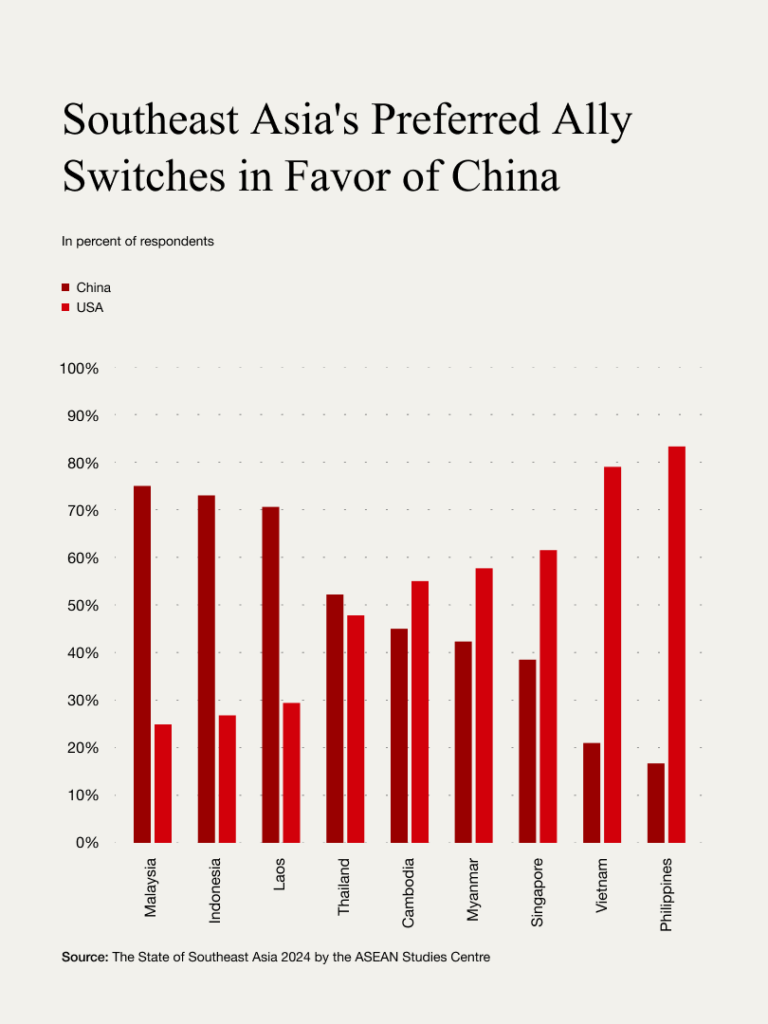
While this figure does not signal a sudden rupture, it does reflect a shift in perception. China's consistency in its economic commitments, contrasted with American hesitation, seems, for now, to be tilting the balance in Beijing’s favour.
Statement
Since its creation in 1967, ASEAN has always sought to balance great powers and blocs. But the United States' erratic diplomacy, contrasted with China’s long-term financial investments, is creating a tilt that leads many countries to consider aligning more closely with Beijing. For Washington, this is not yet a break—but it is a clear warning sign to take steps so it can preserve its influence in this all too crucial region.