
Nothing ever happens. But what if it did?
For anyone watching geopolitics in the 21st century, the world often feels like it’s stuck in molasses. The postwar liberal order began to fray after 9/11 but never quite collapsed. China, still cast as the ‘rising power,’ has in many ways already arrived. Yet the old narrative of a duel with America continues to play on loop.
Elsewhere, little seems to move. The Arab world remains branded by political Islam. Europe slowly dissolves into geopolitical irrelevance. Even global shocks like COVID, which once seemed poised to reshape society, ended up confirming Michel Houellebecq’s grim forecast: everything would stay the same—’just a bit worse.’
But these static frames miss the plot twist. Multipolarity isn’t a future fantasy; it’s the world we live in. And while the great powers still dominate the headlines, it’s smaller blocs and rising regions that are rewriting the footnotes. Enter ASEAN.
An ASEAN Future
At the 46th ASEAN Summit, held on 26–27 May in Malaysia, the media focused largely on the tariff war triggered by Donald Trump’s new economic nationalism—a conflict that has bruised some ASEAN economies. But hopes in Washington that the region might come crawling back were dashed. Malaysian Prime Minister Anwar Ibrahim was explicit: this summit wasn’t about forming an anti-China club or pro-American bloc. It was about crafting ‘a platform for mutual convergence.’
That phrase isn’t just diplomatic fluff. It encapsulates ASEAN’s balancing act: asserting equidistance between Beijing and Washington, while nudging the bloc toward deeper institutional coordination. This was made formal in the ‘ASEAN Vision 2045,’ a policy blueprint aimed at projecting the region more cohesively in global forums such as the East Asia Summit.
Economic priorities dominated: trade flows, digital integration, infrastructure corridors, and green technology. Day two of the summit featured a trilateral meeting between ASEAN, China, and the Gulf Cooperation Council (GCC)—a diplomatic ménage à trois that few would have imagined a decade ago. Not only did it upgrade the ASEAN-China Free Trade Area (ACFTA), it also initiated a new chapter of trade with the Gulf states.
Together, ASEAN, China, and the GCC represent nearly $25 trillion in collective GDPs and over two billion people. But trade among them remains surprisingly modest. That is set to change. A GCC-China Free Trade Agreement, slated for 2026, aims to make South–South commerce more than just a slogan. If successful, it could further reduce ASEAN’s dependence on Western markets—a prospect not lost on Brussels.
Of course, grand designs are easier to announce than to implement. ASEAN still needs to finalise its Digital Economy Framework and integrate it with GCC’s digital governance standards. Given the regulatory patchwork across member states, that’s more marathon than sprint.
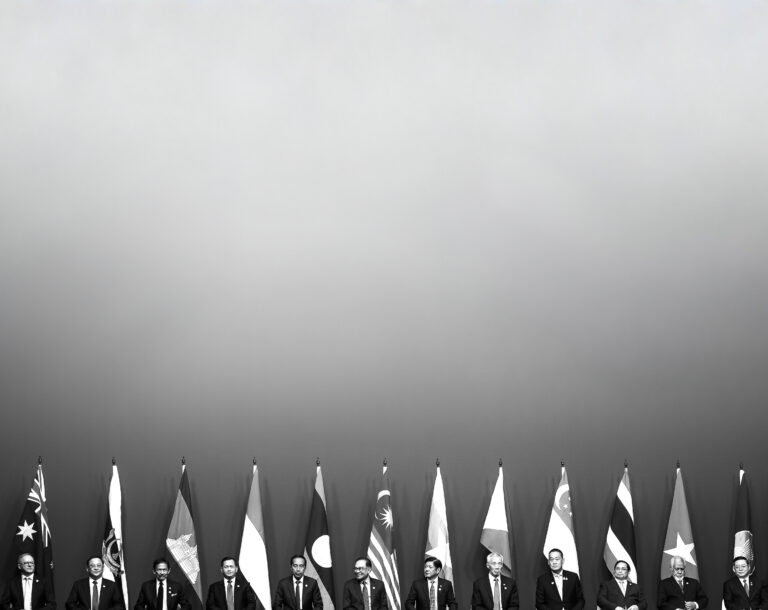
Industrial cooperation also suffers from the usual culprits: weak governance, corruption, political friction. And while ASEAN talks a good game about strategic neutrality, the optics are hard to ignore. The summit’s closing photo—leaders lined up beside Chinese and Gulf dignitaries—suggested a distinctive lean, rather than a balancing act.
To correct this tilt, Malaysia has already announced plans for a separate ASEAN–US Special Summit. Europe, meanwhile, is left staring through the window, unsure if it missed the invitation—or the entire ball season.
From Idol to Actor
ASEAN is not without its cracks. But in a world defined by fragmentation, the bloc is making a visible effort to project cohesion and self-determination. Its message to investors is clear: this is no longer just a growth market—it knows its own value.
Solid economic expansion, a young demographic in parts, and a newfound confidence are turning ASEAN from a geopolitical prize to a potential player. This isn’t just about being the shiny idol that great powers fight over. It’s about becoming the one that writes the script.
For decades, ASEAN was treated as background noise—relevant only insofar as it served someone else’s strategy. Now, it is trying to be the architect of its own destiny. That may not be enough to turn ASEAN into a superpower. But it might be enough to give multipolarity a working example—outside Chinese hegemony, and without Western tutelage.
So maybe the old saying is finally due for revision.
Something happens.
And that is a good thing.
Statement
For years, ASEAN was cast as a stagehand in the theater of great-power politics—courted, coerced, yet rarely commanding the spotlight. But the 46th ASEAN Summit revealed a region no longer content to be the prize in someone else’s game. By affirming strategic equidistance and unveiling a forward-facing ‘ASEAN Vision 2045,’ Southeast Asia signaled it has ambitions beyond alignment. Trade with China and the Gulf hints at a re-ordering—less West-facing, more self-shaped. Execution gaps remain, but the intent is unmistakable: ASEAN is writing itself into the script. It’s not just multipolarity that’s arriving—it’s self-authored agency in unexpected places.