

For decades, Latin America has been trapped in civilisational purgatory. Not quite Western, not quite Other. Its elites speak in the vocabulary of Brussels, govern by the abstractions of Washington DC, and dream not of home, but of Paris and Miami while their people inherit neither the fruits of Western modernity nor the dignity of a pre-rooted tradition.
In his civilisational cartography, Samuel Huntington deemed Latin America a sub-Western cousin—a cultural mimic poised at the periphery of true modernity. That verdict has poisoned generations of policy, education, and elite ambition, yet Huntington was not just wrong: he mistook mimicry for origin and surface for substance.
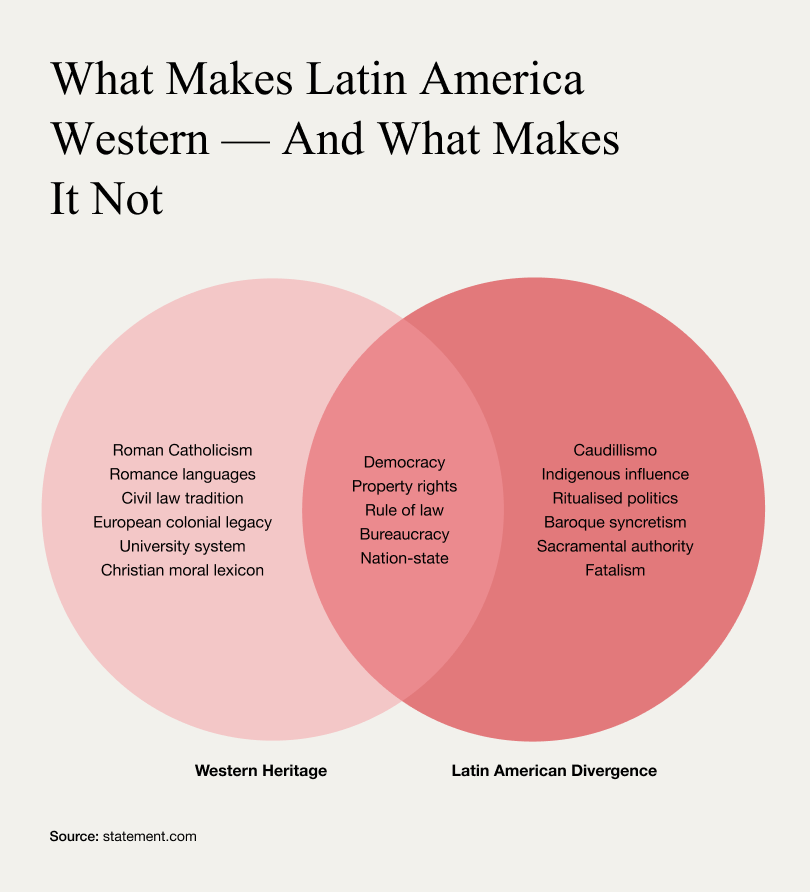
But Latin America is not Western as the West understands itself. What exists from Mexico to Argentina is its own civilisational formation, mixed in blood and structure, excessive and baroque in form, and Catholic in soul. The error lies not in divergence from Europe or the United States, but in the delusion that such divergence signals deficiency. Latin America does not fail because it resists becoming Western. Its failure lies in the pretense.
A Civilisation Forged in Collision
Latin America was born in the collision between Iberian feudalism, steeped in Catholic ritual, crowned by feudal authority, and hardened by the Reconquista against the Muslims, and Amerindian native orders that ruled through cosmic violence and cyclical sacrifice.
The result was neither synthesis nor erasure but a baroque layering of races, castes, rituals, languages, bloodlines, laws, and liturgies folded over each other vertically in elaborate contradiction, and for three hundred years, the Spanish viceroyalties held because the system, however hierarchical and complex, fit the instincts of the land, which up to our day still endure.
Hofstede's cultural dimensions confirm the region's still deep comfort with them: Mexico scores 81 in power distance, Colombia 67, Peru 70. These are not modern egalitarian democracies in waiting but societies where order descends from above, where legitimacy is personal and symbolic, not contractual.
And just as under Spain, the true sources of authority remain the same: the Church and the military. In Ecuador and Colombia, over 60% of citizens trust these institutions above all others.
And whilst presidentialism exists, it functions less as governance than as ritual: each strongman a new president, all becoming secular monarchs, adored or despised, but never simply replaced.
The Institutional Lie
The West misreads Latin America through the lens of its own institutional myths, assuming that where the liberal state fails, governance has failed.
But Latin America does not suffer from institutional incompetence but from institutional incongruity as imported constitutions sit atop societies shaped by different logics: kin over contract, charisma over procedure, honour over legality.
Consider property. In Peru and Bolivia, more than half of all urban land remains informally held. The legal system designed to protect ownership does not recognise the ways property is actually claimed, inherited, or defended. In Brazil, Mexico, and Argentina, Fraser Institute property rights scores remain below 5.5 on a 10-point scale. Meanwhile, Anglo countries soar above 8.5.
This metrical failure is not just bureaucratic but proof of a metaphysical difference: the liberal concept of property, abstract and individualistic, clashes with patrimonial instincts where land is not owned but stewarded, protected through family, patronage, or force.
Democracy fares no better. The Western model presumes atomised individuals choosing among abstract platforms. In Latin America, elections are plebiscites of loyalty where charisma, kinship, regional identity, and sacramental symbolism dominate. This is why clientelism thrives and parties evaporate into electoral vehicles for its leaders. The electorate does not vote for policy: it anoints rulers, for vox populi est vox Dei.
Despite endless reforms, the World Bank’s rule of law indicators place most Latin American nations below the global median. Poland, a post-communist country scarred by its most recent traumas, has surpassed 65%, and the Anglo core sits above 85%, but Latin America hovers around 35% because law there is not the expression of a social contract, but a foreign mask stretched over older forms of power.
Huntington’s Error is the West’s Delusion
Huntington tried to explain the world through a typology of civilisations, but when it came to Latin America, he hesitated. He called it Western by heritage, but less advanced, in what was more than analytical laziness but a refusal to accept that a civilisation could arise from Spain, from mestizaje, from the Americas below the United States, and yet not aspire to Anglo standards. Latin America was deemed a derivative failure rather than an original success.
But elsewhere lies the truth: China never imitated the West and reinterpreted its Confucian and bureaucratic soul through Marx. Russia remains statocratic, Orthodox, and cynical, drawing continuity from Tsar to Soviet to oligarch. And even Central Europe, though Western, reintegrates its Catholic memory into its political form.
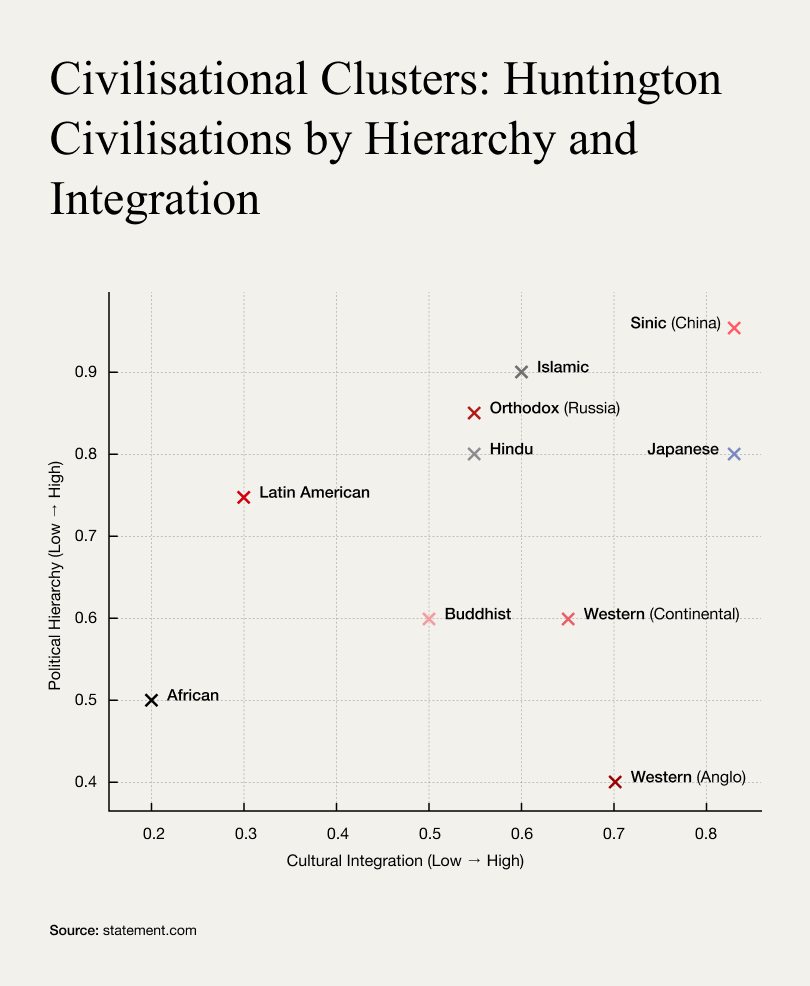
Latin America alone remains suspended. Its elites study in Harvard while its poor pray in centuries old Baroque chapels; its bureaucrats write in legalese translated from French and German, but its people speak in miracles and myths told to them in Spanish, Quechua and Nahuatl.
Even in Spain this shows, as statesman Antonio García Trevijano saw it when he spoke of the false Spanish transition and the mirage of legalism without cultural foundation, or when philosopher Gustavo Bueno called Spain’s imperial project the source of Latin America's civilisational energy, a project later abandoned in favour of minor liberal mimicry.
Latin America inherited the remains of that imperial code, enhanced by Spain's Catholic identity, but without its crown nor its confidence, it now copies models alien to its own synthesis.
A Reckoning Not a Reform
There can be no reform where the frame itself is false. Latin America does not need better elections or smarter public policy: it needs civilisational clarity.
For that to happen, its peoples would need to recognise the reality that the Western paradigms are foreign overlays, and that in Latin America, what works is a paternal form, a structure of sacralised power, of protection and hierarchy that must be reclaimed, not denied.
Likewise, its democracy would need to be understood as ritualised consensus, a periodic blessing of the sovereign, reflecting the local, the spiritual, the communal instead of representative procedure, and the republican system adopted region-wide to be finally seen for what it is: a foreign costume worn by men who never stopped acting like viceroys.
Latin America will not develop by catching up to the West, and will only thrive by ceasing to chase it. In doing so, it may rediscover what the West itself has forgotten: that civilisation is not a destination, but a form of being and that it might be closer to the older medieval Christendom than the modern West will ever be.
Statement
Latin America is not quite Western, and its failure is not one of competence, but of mimicry. Its tragedy lies in denying its own civilisational logic: hierarchical, Catholic, mestizo, and baroque. The liberal institutions it adopted are not anchors, but illusions. To reclaim itself as a distinct civilisation, it must reject the fantasy of Westernisation and embrace the inheritance it buried. What is needed is not reform, but return. Not progress, but recognition. Only through civilisational honesty can Latin America escape the schizophrenia of imitation and become again what it has always been: its own world, with its own soul.