
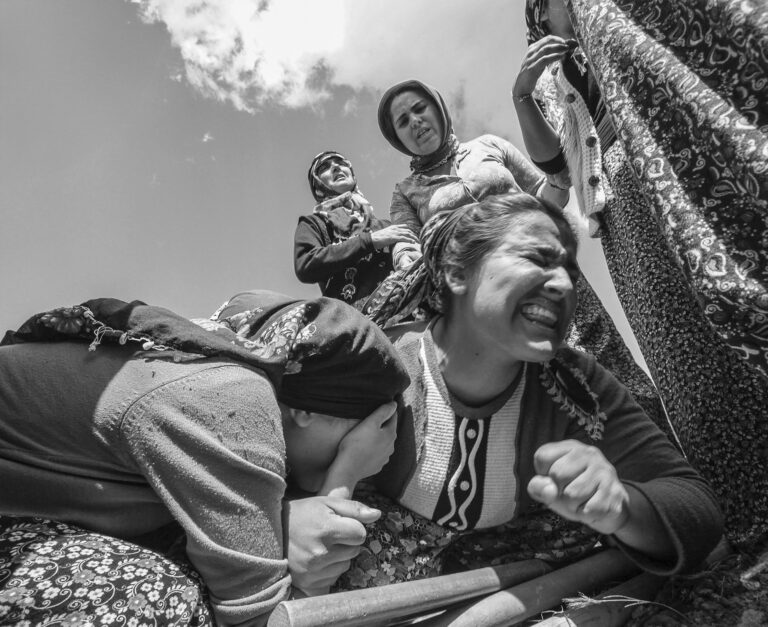
In eastern Ukraine, where traditional family values intertwine deeply with notions of national sacrifice, Russians and Ukrainians remain locked in a bloody conflict. While the West, guided by a doctrine of individual rights, readily provides military and financial aid, it is notably reluctant to risk human lives directly. This asymmetry reveals profound cultural divides extending beyond mere geopolitics. Could our conception of the family ultimately dictate the limits of our willingness to fight?
Samuel P. Huntington's seminal work, ‘The Clash of Civilizations,’ famously argued that the post-Cold War era would witness conflicts defined not by nations but by broader cultural entities, or civilisations. Huntington identified distinct groups: Western, Islamic, Chinese, Hindu, Orthodox, Latin American, Japanese, and African, each with its own unique values, traditions, and societal structures. Religion, he noted, often serves as a critical axis of division. However, Huntington’s framework, though influential, reveals substantial fissures when scrutinised closely.
Religion’s role, for instance, is far less homogeneous than Huntington presupposes. Islam, often portrayed as monolithic, manifests dramatically different expressions in African and Southeast Asian contexts. Likewise, Western civilisation encapsulates diverse traditions, from evangelical America’s fervent religiosity to Europe’s secular rationalism. The recent twelve-day conflict between Iran and Israel starkly highlighted this complexity; eschatological narratives dominated Middle Eastern rhetoric but scarcely resonated in European discourse, where values differ fundamentally between France’s egalitarianism, Britain’s individualism, and Germany’s disciplined collectivism.
Thus, while a multipolar world indeed emerges, its roots lie deeper than broad civilisational constructs suggest—rooted instead within the institution of the family.
Family as the Key to Understanding
The family model possesses a unique advantage: it is universal and inescapable. Each individual’s formative experiences unfold within familial contexts—whether functional, dysfunctional, intact, or fractured. French philosopher Blaise Pascal succinctly captured this reality, remarking, ‘We are all embarked.’ No individual can extricate themselves entirely from the influences of family and ancestry.
The British anthropologist Alan Macfarlane pioneered linking familial structure directly to societal values. In his seminal book ‘The Origins of English Individualism,’ Macfarlane elucidated how Britain’s particular family model fostered individualism. This observation was expanded upon comprehensively by French anthropologist Emmanuel Todd, who argued persuasively that familial structures shape societal values, political orientations, and ultimately, national identities.
Different Types of Families
Three principal family structures predominate globally, each shaping distinct societal and political orientations. The absolute nuclear family, prevalent in France and Britain, typically houses only two generations. In France, inheritance laws are egalitarian, mandating equal division among children. Conversely, Britain allows parents discretion in bequeathing wealth, underpinning the robust British individualism valuing personal freedom and autonomy.
The second model, the stem family, common in Germany and Austria, centres around inherited property that typically passes undivided to a single heir—usually the eldest son. This model, prominent where family agriculture dominates, creates a foundation for societal authoritarianism, as decision-making power is concentrated in a single individual.
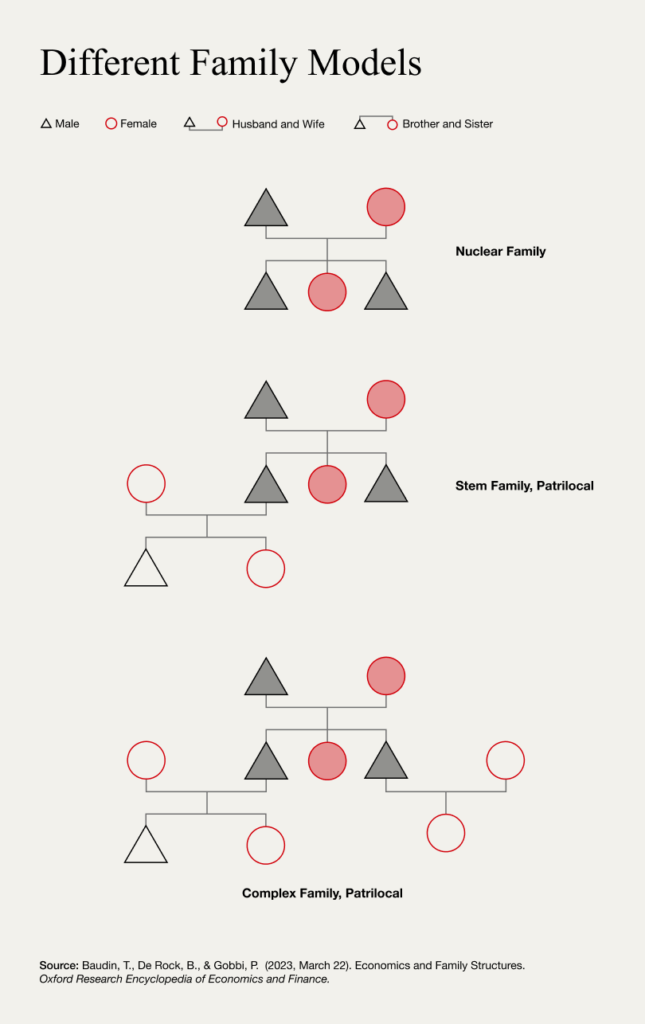
The third and most intricate is the communitarian family, prominent in Russia and China. Here, large, extended families coexist under one roof, emphasising collective over individual interests. Male children usually remain close to their parental homes, while females marry outwards. Collectivism, cooperation, and reduced individualism characterise this model, fostering robust societal cohesion and support networks.
Understanding the 21st Cebtury Through Family Models
No family model intrinsically surpasses another; each offers distinct advantages and vulnerabilities. Historical and political contexts intermittently elevate one model above others, but efforts to enforce uniformity inevitably falter. Indeed, totalitarian ideologies, from communism to Nazism, failed spectacularly in attempting to reconstruct family structures to fit rigid ideological templates.
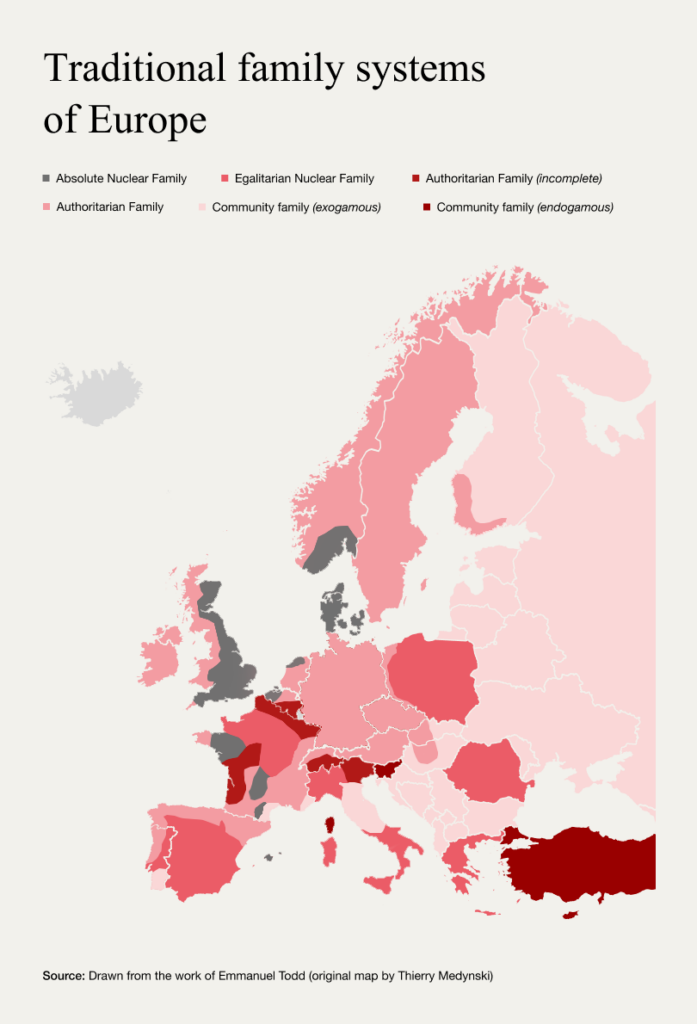
Todd’s insights explain much about post-Cold War global politics, particularly in Russia and China. Neither country adopted Western liberal democracy following the collapse of the Soviet Union precisely because communal family structures deeply rooted in their societal fabric rendered Western models irrelevant and unappealing. Putinism thus emerged naturally from Russia’s communitarian family model, fostering patriotism and nationalism within a tightly bound social framework that resists external ideological impositions.
This communal model grants distinct advantages today, notably robust social cohesion—something increasingly elusive in the individualistic West. While Western individualism fuels innovation and economic dynamism, it also creates fragmentation and isolation, undermining collective purpose and unity. Hence, the Ukrainian conflict illustrates vividly these cultural divergences, as Russians and Ukrainians both draw deeply on familial solidarity and collective sacrifice, contrasting sharply with the West’s reluctance to commit human lives.
Ultimately, Todd’s theory compels a reconsideration of civilisational conflicts through familial lenses, not merely as an academic exercise but as a crucial geopolitical necessity. If families indeed shape national political DNA, understanding their complexities becomes indispensable for navigating the multipolar world of the 21st century.
Statement
The conflict in Ukraine underscores profound global fault lines defined by distinct familial structures. Samuel Huntington’s ‘Clash of Civilizations’ proposed cultural divisions driven by religion, but its inadequacies become evident upon closer inspection. Anthropologists Alan Macfarlane and Emmanuel Todd argue convincingly that family structures—nuclear, stem, and communitarian—shape societal values, political systems, and global conflicts. This familial perspective illuminates why Western liberal democracy struggles to take root in nations like Russia and China, which favour communal cohesion and patriotism.