
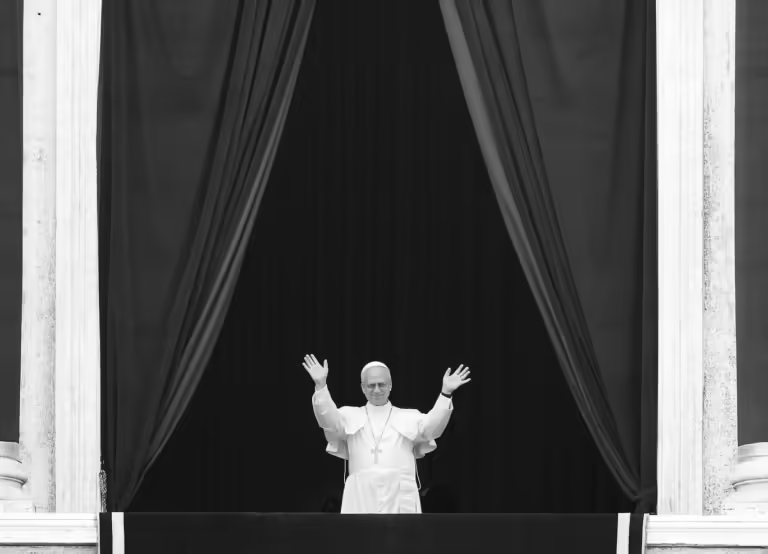
The election of Leo XIV is not a restoration project. It is a recalibration—liturgically explicit and theologically grounded. In a fragmented Church and an uncertain world, Leo does not echo Francis; he repositions the papacy around its essential form: truth expressed with clarity, peace proclaimed without euphemism, and unity sought through conviction—not consensus.
A single image captured it: the papal stole firmly worn, the ring displayed, the blessing delivered without hesitation. Gone were the gestures of interpretative ambiguity. In their place: Urbi et Orbi as mandate, Latin as signal, and form as content. The symbolic grammar of Leo’s first appearance read not as nostalgia but as resolve. His message was unmistakable: the age of curial improvisation is over. The Petrine office, stripped of its affectations, has returned to its usual codes.
This is not a move backwards but a step into clarity. Argentine Archbishop Héctor Agüer—long critical of Francis’ ecclesiological experiments—described it as a 'return of apostolicity.' The form Leo revives, he argues, is not aesthetic, but doctrinal: a restoration of the office’s internal grammar. Georg Gänswein, the former papal aide to Benedict XVI, added his own quiet edge: 'Leo XIV will build bridges—but on doctrinal foundations, not shifting sands.' In that, he gives voice to a theological weariness that runs deep: the hunger not for novelty, but for reliability.
Even Leo’s first words—Pax vobis—functioned as a theological signal. Not a media flourish, but a liturgical anchor. In a world saturated by crisis—wars abroad, institutional fragility within—peace as proclamation regains its ecclesial power. Not as sentiment, but as a mission.
The German Problem
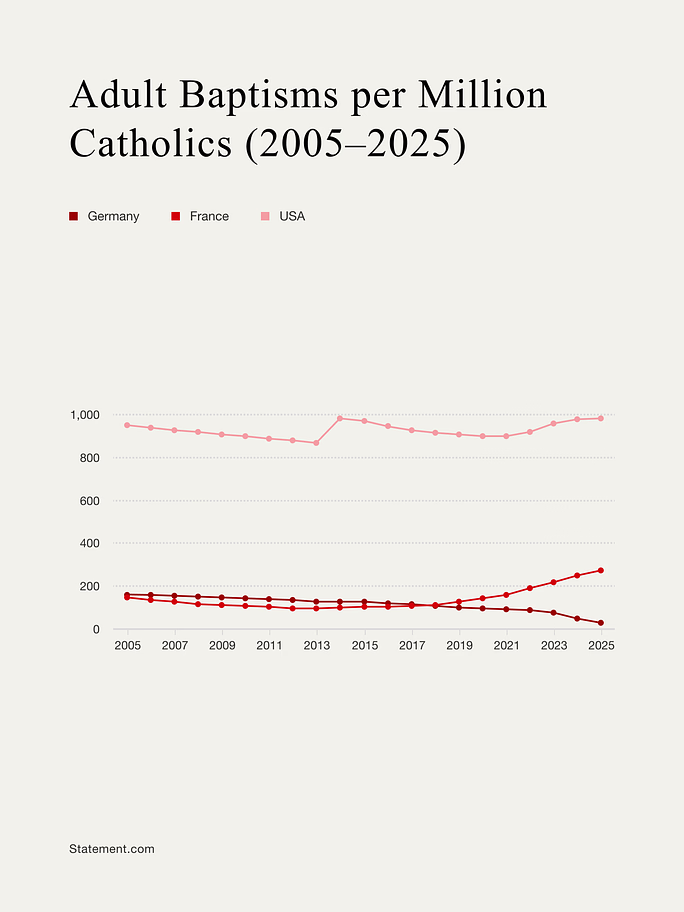
If Leo’s re-centring has a litmus test, it is the German Church. The so-called 'Synodal Path' has become emblematic of institutional drift: methodologically vague, theologically elastic, and structurally self-absorbed. In Leo’s ecclesiology, this mode of Church is unsustainable—not because it offends Rome, but because it fails to evangelise. The data is stark. Adult baptisms in Germany have plummeted—just 430 in 2025. Infant baptisms, over 300,000 back in 2000, have collapsed to 131,000. Contrast this with the United States: over 1,000 adult baptisms per million Catholics. France also tells a different story—less institutional resilience, but a surprising spiritual hunger. Adult baptisms there surged from 3,900 in 2015 to over 10,000 in 2025, with youth catechumenates tripling. Despite its laïcité, France is becoming a laboratory of spiritual rediscovery from below. Here too, Leo’s message may resonate: renewal doesn’t begin in synodal debate, but in conversion.
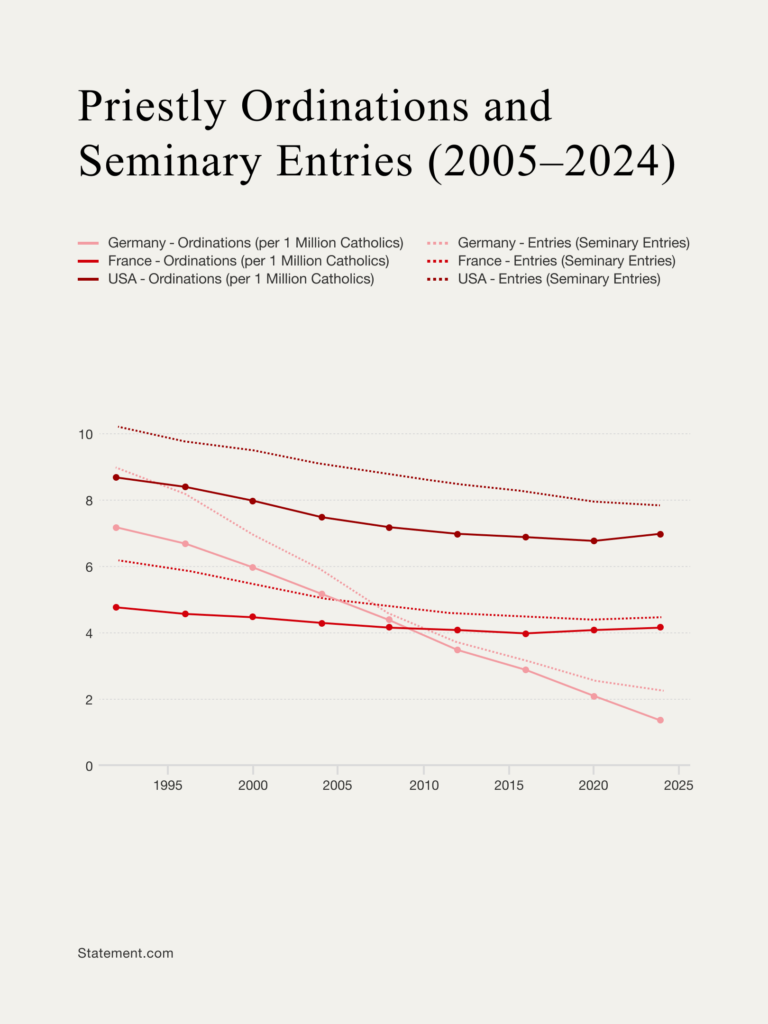
The collapse of the Catholic Church in Germany is starkly evident in the numbers of priestly ordinations and seminary admissions. This is not merely a decline—it is a structural breakdown at the heart of the institution. What was once a steady vocational path has become a statistical anomaly. The issue is not just one of reform fatigue, but of deeper erosion: vocations do not arise where faith is no longer lived out. This is not a pastoral crisis—it is a spiritual one.
Sunday Mass attendance has dipped to 6.2%, and priestly vocations are nearing statistical extinction: 38 ordinations in 2024, fewer than two per million Catholics. In the United States the church has 458 priestly ordinations in 2025, and 24% weekly Mass attendance. Despite its own cultural storms, the Church in the US sustains a liturgically and doctrinally articulate identity. It evangelises not through structural reform, but through visible belief.
Mission Over Management
Leo XIV embodies a papacy shaped not by administrative experience, but pastoral urgency. Formed in the barrios of Peru, in a context of poverty and pluralism, Leo sees proclamation not as theory, but as necessity. His theological instincts are missionary, not managerial. His worldview is formed not by German committees, but by Peruvian streets and American parishes.
This perspective reframes key questions: What is dialogue, if it avoids truth? What is inclusion, if it dilutes proclamation? Leo’s answer is unambiguous: the Church’s primary task is not self-preservation, but visibility. He inherits a bureaucracy—but he speaks like a missionary.
This becomes symbolically visible in his attitude towards liturgical tradition. In many American dioceses and also in France, the traditional rite is celebrated freely—not as protest, but as part of the Church’s organic breadth. Leo’s tolerance here could be strategic, not nostalgic: in a secularising world, tradition can attract especially young people.
Leo XIII's Lineage
The name Leo is no coincidence either. With it comes an explicit gesture to Leo XIII, whose 1891 encyclical Rerum Novarum reasserted Catholicism in the public square. This historical echo is more than rhetorical. Like his namesake, Leo XIV envisions a Church that teaches with authority, rather than opining with vagueness.
Today’s 'new things' are not industrial capitalism, but post-human questions: gender fluidity, digital subjectivity, ecological disintegration. Here, too, Leo seems poised to speak—not with reactionary reflex, but with moral clarity. He knows: the Church cannot compete with secular institutions on services. Its comparative advantage is the truth.
Statement
Leo XIV is not returning the Church to the past. He is returning it to its centre. Mission, not management. Clarity, not compromise. Form, not improvisation. He does not seek to innovate—but to re-anchor. Not to divide—but to bind. Not to appease—but to proclaim. The papacy, in Leo’s vision, is no longer a symbol to be reinterpreted, but an office to be exercised. In this, the long drift of post-conciliar improvisation may have reached its outer limit. A papacy formed in mission, and rooted in clarity, is no regression. It is a reprioritisation. And for a Church for long unsure of itself, that may be the most radical thing of all.