
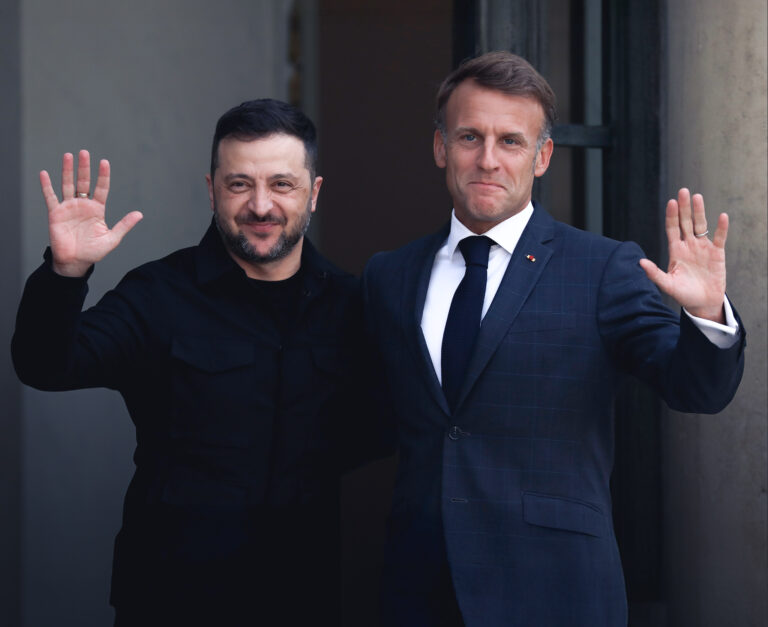
Representatives of the so-called coalition of the willing, which continues to support Ukraine in its war with Russia, met in Paris on Thursday. According to information from the daily newspaper Spiegel, German Chancellor Friedrich Merz came to the meeting well prepared.
In addition to Merz, the coalition consists primarily of British Prime Minister Keir Starmer, French President Emmanuel Macron, and in some cases also European Commission President Ursula von der Leyen. Ukrainian President Volodymyr Zelensky, who had already arrived in Paris on Wednesday, also regularly attends these meetings.
The negotiations began at 10 a.m., with U.S. President Donald Trump expected to join at 2 p.m., according to a statement by German government spokesman Stefan Kornelius.
Zelensky is expected to meet briefly with US envoy Steve Witkoff during the negotiations, an anonymous source from the Élysée Palace told Reuters news agency.
German plan to support Ukraine
As von der Leyen previously told the British Financial Times, member states are working on “fairly concrete plans” to support Ukraine after the war. This was met with outrage from Defense Minister Boris Pistorius, who reminded that the Union has “no competence” in military matters.
Merz also refused to discuss the Bundeswehr's participation in the peacekeeping forces that the coalition plans to send to the demilitarized line after the fighting ends. One of the European diplomats responded to this cautious stance anonymously to Der Spiegel, saying, “If Germany wants to play a leading role in a strengthening Europe, the German government cannot participate in planning for months and then withdraw.”
“If the German government now wanted to send only money to Ukraine instead of soldiers, it would damage its international image,” he added. He thus acknowledged that the federal cabinet was involved in drawing up post-war plans that envisaged the deployment of the army.
According to Spiegel, the German proposal states that Ukrainian donors would increase air defense “by 20 percent per year.” Berlin also wants to invest in low-altitude missiles to be manufactured in Ukraine.
The German government does not rule out a “military contribution” by the Bundeswehr in the form of participation in peacekeeping forces, but this remains conditional on a broad agreement on ending the war. However, according to Merz, Ukraine and Europe are still a long way from a ceasefire or even a peace agreement.
Another important condition for Berlin is the expected participation of American forces in maintaining a possible ceasefire. However, the US is urging its European allies to first agree among themselves on a possible troop deployment, according to sources at Der Spiegel.
Coalition of the willing in the US
Representatives of the coalition of the willing met at the White House on August 18. Trump had originally invited only Zelensky, but Merz, Macron, Starmer, NATO chief Mark Rutte, and von der Leyen also attended the meeting.
The US president reaffirmed his commitment to achieving peace at the time. Just three days earlier, he had also met with Russian President Vladimir Putin in Alaska, although their talks also focused on general US-Russian relations.
Trump also stated openly that Crimea, which “Obama gave away 12 years ago without a shot being fired,” would not return to Ukrainian administration and that Kiev would not join the North Atlantic Alliance.
Not every deployment is the same
Diplomatic sources cited by the German magazine see three possibilities for deploying European soldiers in Ukraine. The first option involves a purely “observation mission” that would only monitor compliance with the ceasefire on the frozen front line.
However, European representatives consider this unlikely, so the second option is to involve these troops in training Ukrainians. According to Spiegel sources, a truly ‘deterrent’ mission would require “tens of thousands” of European soldiers.
However, European countries have limited resources in terms of the number of soldiers they can provide. If the Americans are not prepared to send their own forces, Germany is unlikely to send its soldiers to Ukraine. The French and British also do not have enough infantry to reach the expected threshold of 150,000 soldiers, which is why it remains unclear who will actually monitor this ceasefire.
Over the course of the year, the armies of India and China have offered their services, but so far this has not met with a positive response from the Europeans. Beijing's involvement is also a cause for concern in the White House, as the current US administration takes a strictly anti-Chinese stance.
Russia rejects international troops, and Europe's security is at stake
The Russian Foreign Ministry has strongly rejected the deployment of troops in Ukraine, as it sees this as a threat not only to Russia but also to Europe. “Russia will not discuss the intervention of foreign troops, which is fundamentally unacceptable and jeopardizes Ukraine's security in any form or format,” said ministry spokeswoman Maria Zakharova.
She described Ukraine's demands for Western security guarantees as a “springboard for terror and provocations against Russia” that “do not guarantee Ukraine's security, but are a threat to the European continent.”
Zakharova added that European representatives should also take Russia's position into account. She was indirectly countering Rutte, who had asked at a meeting at the White House in August, “why should we care what Russia thinks about the troops in Ukraine?”