

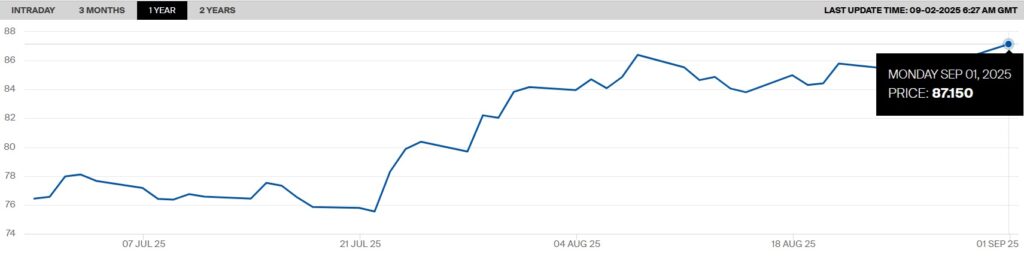
The new tax on fuel and heating, which we will all soon have to pay, rose to a new record high on Tuesday on the ICE exchange in London.
The futures contract for the so-called emissions certificate for households maturing in December 2027 rose to a price of 87.2 euros.
Such a price would mean that from 2027 onwards, we would pay an average of 25 cents more for fuels such as diesel and gasoline. For a 50-liter tank, this would amount to an additional cost of more than 12 euros.
Since the beginning of August, the price of the aforementioned emission certificates on the London Stock Exchange has risen by a further three euros. According to experts, it will become around 100 percent more expensive by 2030.
Mike Azlen, head of Carbon Cap, the world's largest hedge fund specializing in investments in emission allowances, expects the average price of emission allowances to rise from $60 per allowance last year to $120 in 2030. That is effectively a doubling.
This is an average price that also includes some other quota markets besides the EU market, where quotas are by far the most expensive worldwide. According to Azlen, investments in quotas will yield investors 13 percent per year until 2030. And that is simply by buying and holding the corresponding futures contracts now.
The price of quotas must remain high and continue to rise after that. The reason for this is that individual countries have no other choice if they want to meet their commitments under the 2015 Paris Climate Agreement through quotas.
They have committed themselves to decarbonization, and if they want to comply with its parameters, they will have to make fossil fuels so expensive that it really “hurts” people and they have to invest in emission-free or low-emission energy sources [e.g., emission-free pumps or electric cars, editor's note].
This is exactly what large carbon speculators such as Azlen are banking on, finding themselves at one end of the money flow. At the other end is, for example, a single pensioner living in a house in the countryside, whose expenses for heating his home or fuel for his car will increase by hundreds of euros per year due to emission certificates.
The text was originally published on the website lukaskovanda.cz.