
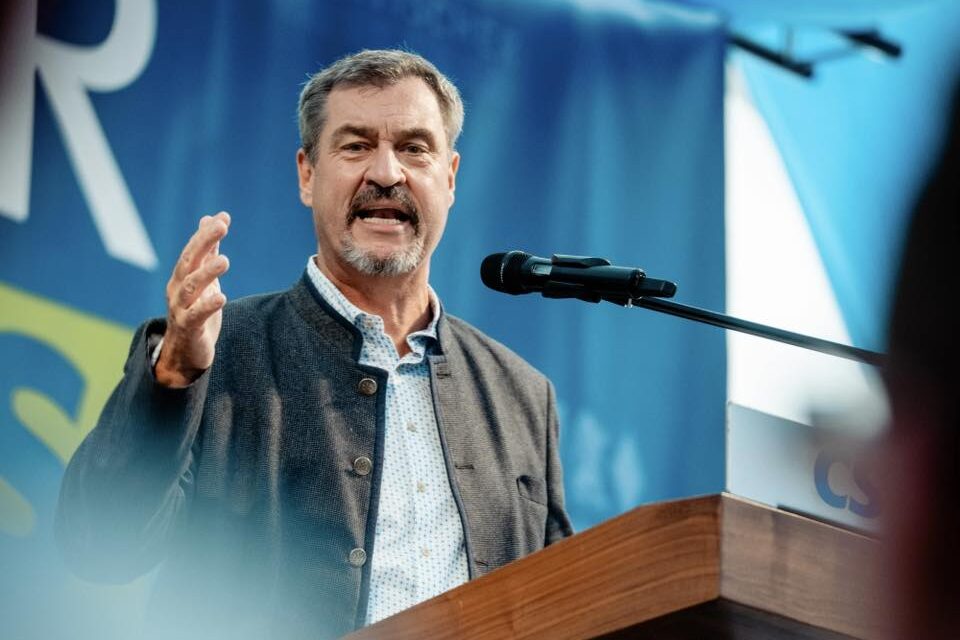
According to the Bavarian Minister-President, the ban on the sale of cars with combustion engines would pose a serious threat to the German automotive industry and could lead to the loss of hundreds of thousands of jobs.
"The combustion engine has a future thanks to e-fuels and modern technologies. A ban from 2035 is a dead end and jeopardizes hundreds of thousands of jobs," Söder told the daily newspaper Bild.
He added that the economic health of car manufacturers remains a key issue for the success of the German economy. He considers the sector to be at the heart of the country's industrial strength. “If it were to disappear, the entire economy would be threatened with collapse,” he explained.
Ten points to support car manufacturers
He summarized his demands in a ten-point plan, which he presented shortly before the opening of the IAA Mobility international motor show in Munich.
In addition to lifting the ban on combustion engines, the document also includes a revision of emission targets, a more intensive expansion of the network of charging stations, a strengthening of supply chains, the promotion of the development of autonomous driving, and a reduction in the cost of driver's licenses.
According to Söder, it is essential to find realistic solutions that maintain Germany's competitiveness while securing jobs.
Merz plans automotive summit
Chancellor Friedrich Merz (CDU) has also joined the discussion about the future of the car. Following the latest coalition talks, he announced that he would invite German car manufacturers and their suppliers to a meeting.
The topic will be the search for ways to cope with declining sales, increasing competition from China, the transition to electric mobility, and at the same time the current trade dispute with the US.
The voices of the automotive giants indicate that while the automotive industry's focus on electric mobility is obvious, the pace and nature of the changes should be adjusted.
Volkswagen CEO Oliver Blume said: “We welcome the government's decision to convene an automotive summit. We want to remain flexible when it comes to drive systems, but the future belongs to electric mobility.”
Mercedes-Benz CEO Ola Källenius expressed a similar view: “We are at a point that will determine the future of the entire industry, jobs, and thus also the competitiveness of Germany and Europe.”
“No deadline, no ban, openness to technologies,” he added.
(sie)