
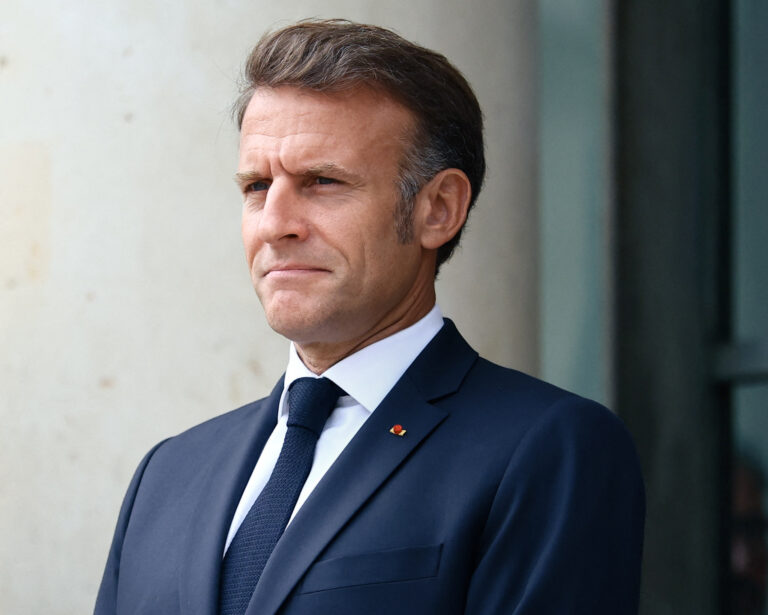
As expected, the French parliament passed a vote of no confidence in Prime Minister François Bayrou's government on Monday. This is the third government to fall under Macron within a year. Let us remember that at the beginning of September last year, the young Gabriel Attal was still at the head of the cabinet, before being replaced by the elderly Michel Barnier. In December, he was replaced by the experienced politician Bayrou, who will soon hand over the reins to who knows whom.
Macron makes no secret of his enthusiasm for war with Russia
President Macron may have lost control of domestic affairs, but he is all the more enthusiastic about pushing Europe into a war with Russia. On Thursday, he chaired another meeting of the coalition of the willing in Paris and declared that the majority of participants were ready for a military mission in Ukraine. Macron's game as a European statesman will end either in ridicule or in a European catastrophe.
The instability of the Bayrou government was obvious from the outset. After Macron unexpectedly called parliamentary elections last year and lost his majority in the National Assembly, he was forced to make agreements with political rivals who, with the end of his term approaching, are giving him nothing.
It was to be expected that the vote on the budget would lead to another government crisis, especially since France is forced to reduce its deficit, the level of which (six percent of GDP) would have long since resulted in strict measures by the European Commission for any other country in the eurozone.
However, the combination of low growth (just over one percent last year, expected to be only half that this year) and rising debt (113 percent of GDP) is now so alarming that France is no longer protected even by Brussels' famous double standards.
The financial markets are not interested in Brussels' considerations, and the International Monetary Fund's “therapy” is just as merciless, an ultimate humiliation that the French are now beginning to talk about. Tax increases and spending cuts are inevitable. This is what awaits anyone who runs for office after Bayrou today and after Macron in two years.
Who in France is really living beyond their means?
Nevertheless, a different approach to savings would be appropriate than the one chosen by the prime minister. He accused the French of living beyond their means and said that public finances were most burdened by the post-war generation of today's pensioners. That is not entirely wrong, but it is somewhat generalizing, because not everyone receives a pension like 74-year-old Bayrou.
It would have been more accurate if he had said: People like myself cost us the most. This is doubly true. Bayrou has belonged to the privileged caste of civil servants and politicians pampered by the state his entire life, and wealthy pensioners are now Emmanuel Macron's most important voter base.
But Bayrou has also been instrumental in political decisions that have ruined France for over thirty years. When he now proposes budget cuts that are to be borne by the non-privileged majority of society, he encounters understandable resistance.
Money for peace at home and war in Europe
The proposed cuts also bypass two costly items of expenditure that are sacrosanct in today's France: social peace at home and war in Europe. The money for internal peace does not go to the growing working poor, from whom the yellow vests were recruited and who can only expect cuts, but to migrants and their often unsuccessful integration.
This money ensures calm in the suburbs, which have become ethnically and culturally disconnected from Europe. It is also paid out via progressive non-governmental organizations, whose support is useful to liberals in mobilizing against the “fascists,” i.e., Marine Le Pen's democratic opposition.
Spending on the war is set to increase even further. When Macron took office in 2017, he pushed through such an austere budget for the army that the chief of staff resigned. Macron was not deterred, as he had a clear goal: to put public finances in order and to pursue a foreign policy that included above-average relations with Vladimir Putin.
France as a military infirmary
Today, the budgets are in much worse shape than at the beginning of his term. Macron wants to double military spending by the end of his term to 2017 levels, arguing that France must prepare for war with Russia.
In the summer, his health minister called on hospitals to be ready to take in up to 50,000 war casualties by March. This number exceeds many times over the number of soldiers France plans to send to Ukraine as part of the European forces, and it is likely preparing for the wartime role of a European provider of medical care.
These further steps show the dangerous path that the coalition of the willing organized by Macron together with British Prime Minister Starmer is taking. It has met several times since the beginning of the year and includes, in addition to the UK, all EU member states except Hungary and Slovakia, then the UK's Anglo-Saxon allies (Canada, often Australia, and sometimes New Zealand), and finally Turkey, Iceland, and several other NATO members.
It last met in Paris on Thursday. Macron boasted a record number of 35 participants, even though most of them were only connected via video link. In his opinion, 26 of them are prepared to engage militarily in Ukraine.
The French and British against Poland and Germany
The purpose of this British-French initiative is to prepare European military units for Ukraine and to convince President Donald Trump to continue supporting Ukraine and to give it the strongest possible American guarantees. Despite Trump's repeated reluctance, they are trying to elicit at least vague commitments from him in this direction.
On Thursday, the direct participants in the Paris meeting spent two hours in a video conference with Trump without being able to convince him of anything. President Putin is clear on this issue. He warns that if European soldiers invade Ukraine, they will become Russian targets.
When Macron declares that European soldiers should not be sent to Ukraine now, but only after a ceasefire has been signed, this does not change Russia's position. Without American guarantees, Germany and Poland rule out military involvement from the outset. They have obviously correctly assessed how the French and British envisage the division of labor.
Macron's farce could trigger a war
Both major powers are now specifying that their joint forces would consist of six to ten thousand soldiers from the navy and air force, so that they could also participate in operations in Ukraine from a distance. The deployment of ground troops to Ukraine to carry out the basic tasks with at least 50,000 soldiers would be the responsibility of others. The Germans and Poles are politely saying no and are not even persuaded by the offer of beds in French military hospitals.
Neither the lack of interest from the US nor the reluctance of Europe is preventing Macron from making strong statements on the European stage. There, he is taken more seriously than at home, where he has already lost everything. His wife Brigitte, who once taught him the art of acting, can rejoice. And the rest of us can laugh at his unintended farce.
However, it cannot be ruled out that Macron's maneuvers, albeit unintentional, will ultimately trigger a war. But then neither Macron nor anyone else in Europe will be able to laugh.